
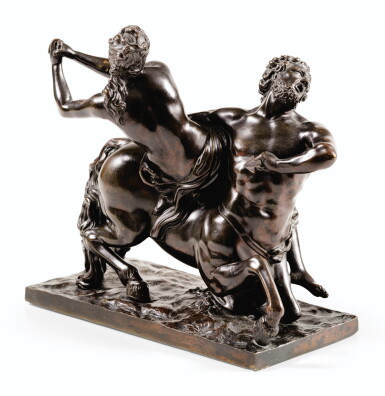
FRENCH, 18TH CENTURY | NESSUS AND DEIANIRA
Auction Closed
December 3, 07:24 PM GMT
Estimate
8,000 - 12,000 EUR
Lot Details
Description
FRENCH, 18TH CENTURY
NESSUS AND DEIANIRA
brown patinated bronze
21.5 x 23 x 12 cm; 8½ by 9 by 4¾ in.
__________________________________________________________________
FRANCE, XVIIIE SIÈCLE
NESSUS ET DEIANIRA
bronze à patine brune
21,5 x 23 x 12 cm ; 8½ by 9 by 4¾ in.
Related literature
R. Wenley, French Bronzes in the Wallace collection, London, 2002, pp. 62-63, n° S 187
__________________________________________________________________
Référence bibliographique
R. Wenley, French Bronzes in the Wallace collection, Londres, 2002, pp. 62-63, n° S 187.
The episode of the Abduction of Deianira by Nessus illustrates the story of the centaur Nessus who seeks to take Deianira away from her husband Hercules. Maintaining his hold firmly around Deianira's hips, Nessus withdraws the arrow unleashed by his rival, which will ultimately be fatal to him. Deianira is about to stab her captor to free herself from his grip.
The author of this bronze, probably of French origin, was certainly inspired by an idea of Giambologna, to create a counterpart to the Abduction of Europe, with which it is often paired.
The first bronzes of this model appeared in France around 1690, they can be found in prestigious collections from the end of the 17th and during the 18th century: the Elector of Saxony acquired a bronze of Nessus & Deianira in 1699 in Paris for his collection in Dresden (Grünes Gewölbe, inv. no. IX.63). Around 1700, two bronzes are mentioned in the inventory of André Le Notre, described as 'l'Europe enlevée par Jupiter' and 'le Santor [sic] et Deianira'. Another pair of bronzes of this subject belonged to the collection of Count Gustav Tessin in Stockholm (Drottingham Castle), acquired before 1740 in Paris. A fine bronze version of Nessus et Deianira, cast around 1690-99, previously acquired by the 4th Marquess of Hertford, is exhibited in the Wallace Collection in London (inv. no. S187).
__________________________________________________________________
L’épisode de l’Enlèvement de Déjanire par le Nessus illustre l’histoire du centaure Nessus qui cherche à enlever Déjanire à son mari Hercule. Maintenant fermement son emprise autour de Déjanire, Nessus retire la flèche décochée par son rival, qui lui sera finalement fatale. Déjanire s’apprête à poignarder son ravisseur pour se libérer de son étreinte.
L’auteur de ce bronze, sans doute d’origine française, s’est certainement inspiré d’une idée de Giambologna, pour créer un pendant à l’Enlèvement d’Europe, avec lequel on le trouve souvent en paire. Les premières versions en bronze de ce modèle apparaissent en France vers 1690, et on trouve des exemplaires de Nessus & Déjanire dans des collections prestigieuses dès la fin du XVIIe et au cours du XVIIIe siècle : L’Electeur de Saxe acquit en 1699 à Paris un bronze de Nessus et Déjanire pour sa collection à Dresde (Grünes Gewölbe, inv. n° IX.63). Vers 1700, on trouve mention de deux bronzes dans l’inventaire d’André Le Notre, décrits comme ‘l’Europe enlevée par Jupiter’ et ‘le Santor [sic] et Déjanire’, et une paire de bronzes de ce sujet appartenaient à collection du comte Gustav Tessin à Stockholm (château de Drottingham) acquis avant 1740 à Paris. Un bel exemplaire de Nessus et Déjanire, réalisé vers 1690-99 en bronze, ayant appartenu au 4e Marquis de Hertford, est visible à la Wallace Collection de Londres (inv. n° S187).