
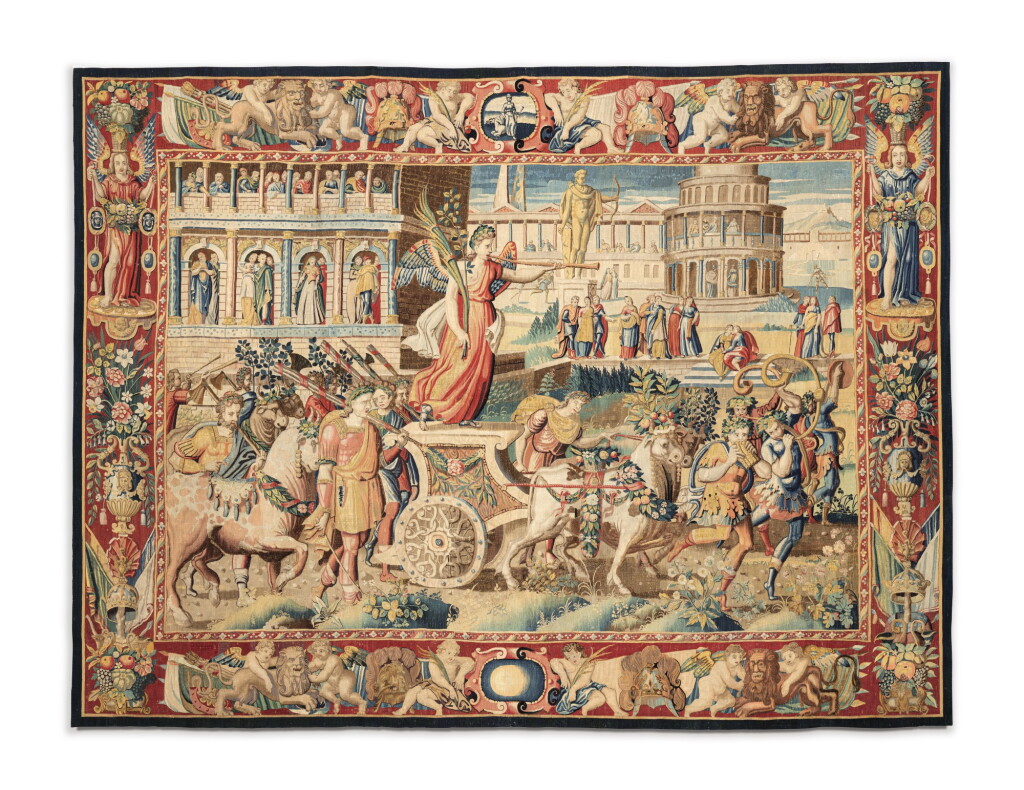
A FLEMISH TAPESTRY FROM THE SERIES 'THE STORY OF JULIUS CAESAR", BRUGES, LATE 16TH CENTURY | TAPISSERIE FLAMANDE DE LA TENTURE "L'HISTOIRE DE CÉSAR", BRUGES, FIN DU XVIE SIÈCLE
Lot Closed
June 4, 01:46 PM GMT
Estimate
40,000 - 60,000 EUR
Lot Details
Description
A FLEMISH TAPESTRY FROM THE SERIES 'THE STORY OF JULIUS CAESAR", BRUGES, LATE 16TH CENTURY
depicting a triumphal procession of the Fame on a chariot through the city of Rome, within a first stylised scrolling foliate border, and a second border richly adorned with cartouches, putti, angels and military trophies
---------------------------------------------------------------------------
TAPISSERIE FLAMANDE DE LA TENTURE "L'HISTOIRE DE CÉSAR", BRUGES, FIN DU XVIE SIÈCLE
représentant la procession triomphale du char de la Renommée au sein de la ville de Rome, dans une première et fine bordure à décor de tors de feuillages, et une seconde bordure richement ornée de cartouches, putti retenant des lions, anges et trophées guerriers
340 x 460 cm approx. ; 11 x 15 ft
Due to the various measures taken to deal with the Covid-19 epidemic, property collection and shipment of this lot will be delayed until the offices where it is located are able to reopen. Please refer to the “auction details” tab. Thank you for your understanding
Please contact FRpostsaleservices@sothebys.com for any shipping inquiries.
[En raison des circonstances actuelles liées au COVID-19, la livraison de ce lot ne pourra intervenir qu’après la réouverture des locaux de Sotheby’s dans lesquels il se trouve. Nous vous remercions de votre compréhension et nous vous invitons à consulter l’onglet « auction details ».
Pour toute demande concernant le transport, veuillez contacter FRpostsaleservices@sothebys.com.]
As Guy Delmarcel recalls in his work La Tapisserie Flamande du XVe au XVIIIe siècle (Paris, 1999, p. 184), "Bruges produced not only mille-fleurs but also figurative series", subjects that were often adapted from Antiquity. The Story of Scipio tapestry, woven for King Francis I between 1532 and 1535 from cartoons by Jules Romain, embodies a prime example.
During the second half of the century, whilst The Story of Julius Caesar was created, this theme was doubtlessly inspired by Andrea Mantegna’s paintings retracing The Triumphs of Caesar (Britain’s Royal Collection Trust). It is unlikely that the Flemish textile artists used a cartoon designer for the compositions of the series. Rather, they themselves compiled details from prints. The number of subjects varied according to the weavings. We know, per the inventory of Louis XIV’s collections in 1673, that the King had a Bruges wall hanging of The Story of Julius Caesar comprising no less than fifteen narratives.
The compositions within the hanging are not all identified, however we can note the following: "The Chariot of Renown" illustrated here, "The Chariot of Minerva" (Christie's auction in London, 6 November 2008, lot 534), and again "The Elephants" (former Mario Bellini collection, then Dario Boccara, ill. in D. Boccara, Les belles heures de la tapisserie, Zoug, 1971, p. 78). All of them have analogously presented ancient Rome and its monuments in the background, notably the stylized Colosseum, as well as a thin border decorated with leafy roundels against a red background.
Certain weavings, such as our tapestry and the example illustrated in G. Delmarcel (op. cit., p. 187), were embellished with a second wider and richer border, including angels topped with baskets of flowers and holding medallions in the upper corners. This border is also found on five tapestries from the former collection of Dr. R.H. Sayre, auctioned in New York, 31 March-2 April 1932, lots 680-684.
---------------------------------------------------------------------------
Comme le rappelle Guy Delmarcel dans son ouvrage La Tapisserie Flamande du XVe au XVIIIe siècle (Paris, 1999, p. 184), "Bruges ne produisait pas seulement des mille-fleurs mais aussi des séries figuratives", dont les sujets étaient souvent tirés de l'Antiquité. La tenture de L'Histoire de Scipion, tissée pour François Ier entre 1532 et 1535 d'après des cartons de Jules Romain, en constitue un premier exemple.
Durant la seconde moitié du siècle fut conçue celle de L'Histoire de César, thème sans doute inspiré des tableaux d'Andrea Mantegna retraçant Les Triomphes de César (collections royales britanniques). Pour les compositions de la série, il est peu probable que les liciers flamands aient fait appel à un cartonnier : ils se contentèrent plutôt de compiler des détails d'estampes. Le nombre de sujets varia selon les tissages : on sait, grâce à l'inventaire des collections de Louis XIV en 1673, que le roi possédait une tenture brugeoise de L'Histoire de César ne comprenant pas moins de quinze sujets.
Les compositions de la tenture ne sont pas toutes identifiées, cependant on peut relever les suivantes : "Le char de la Renommée" illustré ici, "Le char de Minerve" (vente Christie's à Londres, le 6 novembre 2008, lot 534), ou encore "Les éléphants" (ancienne collection Mario Bellini, puis Dario Boccara, ill. in D. Boccara, Les belles heures de la tapisserie, Zoug, 1971, p. 78). Toutes ont en commun de présenter à l'arrière-plan la Rome antique et ses monuments, notamment le Colisée stylisé, ainsi qu'une fine bordure à décor de tors feuillagés sur fond rouge.
Certains tissages, comme notre tapisserie et l'exemplaire illustré dans G.Delmarcel (op. cit., p. 187), furent agrémentés d'une seconde bordure plus large et plus riche, comprenant dans les angles supérieurs des anges couronnés de corbeilles de fleurs et tenant des médaillons ; on retrouve également cette bordure sur les cinq tapisseries de l'ancienne collection du Dr R.H. Sayre, adjugées à New York, 31 mars-2 avril 1932, lots 680-684.