
Property of a New York Lady
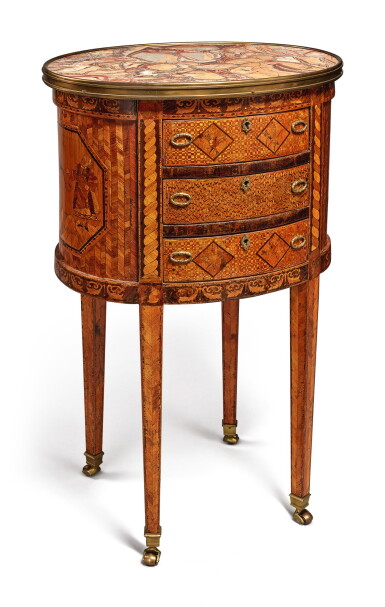
AN ITALIAN NEOCLASSICAL STRAW MARQUETRY TABLE, LATE 18TH CENTURY
Lot Closed
October 21, 03:17 PM GMT
Estimate
6,000 - 9,000 USD
Lot Details
Description
Property of a New York Lady
AN ITALIAN NEOCLASSICAL STRAW MARQUETRY TABLE, LATE 18TH CENTURY
with an inset alabaster top
height 31 in.; width 18 in.; depth 13 ¾ in.
79 cm; 46 cm; 35 cm
Sotheby's New York, 20-22 April 2018, lot 1152
The technique of straw marquetry is most often associated with France, and although it was mainly used for small boxes and objects, several 18th Century tables and writing desks veneered with straw marquetry are recorded in public and private collections. The same technique however is also known to have been practiced in Italy since the 16th century. During his Grand Tour in 1646, the diarist John Evelyn records a visit to a Milan convent where the nuns were crafting liturgical and devotional objects decorated with straw marquetry, and a Florentine lidded casket of c.1600 decorated with hunting and battle scenes in straw marquetry is in the Intarsia Museum in Sorrento (ill. A. Fiorentino, Il Museobottega della Tarsia Lignea, Naples 1999, p.45).
This elegant small table is an exceptionally rare survival, and it is difficult to pinpoint with certainty where in Italy is was created. The Neoclassical inlaid ornament is particularly associated with late 18th century Lombard furniture design, and similar straw marquetry geometric and chevron-pattern decoration appears on a slant-front desk attributed to a Northern Italian hand in the Cleveland Museum of Art. Comparable inlay work does however occur throughout the peninsula, including Tuscany and Southern Italy. The amusing marquetry vignettes on the sides and back - depicting figures in exotic dress smoking, a European and Moorish soldier in combat, and a Chinese pavilion in a park - suggest a center familiar with North African and Levantine subjects such as Venice, Naples or Sicily, and indeed the Chinese pavilion seems to owe its inspiration in part to the King of Naples' Palazzina Cinese in the Favorita park outside Palermo, which dates from the same period as this table.