
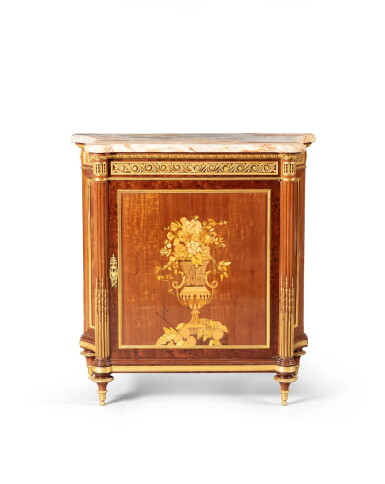
A gilt-bronze mounted mahogany and holly and sycamore maple marquetry meuble à hauteur d'appui, by Guillaume Grohé, circa 1870-1900 | Meuble à hauteur d'appui en placage d'acajou moucheté, marqueterie en houx et érable-sycomore et bronze doré, par Guillaume Grohé, vers 1870-1900
Lot Closed
November 19, 04:52 PM GMT
Estimate
8,000 - 10,000 EUR
Lot Details
Description
A gilt-bronze mounted mahogany and holly and sycamore maple marquetry meuble à hauteur d'appui, by Guillaume Grohé, circa 1870-1900
opening with one door decorated with a flower vase and fruits, based on four spinner feet, brèche marble top.
---------------------------------------------------------------------------
Meuble à hauteur d'appui en placage d'acajou moucheté, marqueterie en houx et érable-sycomore et bronze doré, par Guillaume Grohé, vers 1870-1900
ouvrant par un vantail orné d'un vase fleuri et de fruits, les montants simulant quatre colonnes à cannelures rudentées terminées par des pieds toupies, ornementation en bronze doré d'inspiration antique, plateau de marbre brèche. Estampillé "GROHE/A PARIS".
Haut. 110 cm, larg. 107 cm, prof. 51 cm; height 43⅓ in; width 42¼ in; prof 20 in
Due to the various measures taken to deal with the Covid-19 epidemic, property collection and shipment of this lot will be delayed until the offices where it is located are able to reopen. Please refer to the “auction details” tab. Thank you for your understanding
Please contact FRpostsaleservices@sothebys.com for any shipping inquiries.
[En raison des circonstances actuelles liées au COVID-19, la livraison de ce lot ne pourra intervenir qu’après la réouverture des locaux de Sotheby’s dans lesquels il se trouve. Nous vous remercions de votre compréhension et nous vous invitons à consulter l’onglet « auction details ».
Pour toute demande concernant le transport, veuillez contacter FRpostsaleservices@sothebys.com.]
Denise Ledoux-Lebard, Les ébénistes du XIXe siècle, éd. de Nobele, Paris, 1965, p. 238-244
On January 19, 1884, Maxime Boucheron referred to the cabinetmaker in an article published in Le Figaro: "A famous industrialist who was also one of the great artists of his time ... worthy continuator of Boulle, Gouthière and the Riesener, a true great master of artistic cabinetmaking in the 19th century A career spanning more than fifty years, exclusively devoted to the recovery and reconstruction of a national art among all ... has filled our museums, our national palaces with masterpieces incomparable. His influence on great industrial art was decisive. He ensured the preponderance of French taste in luxury furnishings and the models that his beautiful talent created ensure for a long time to our country this glorious artistic supremacy ... " . He became a member of the Jury in the Universal Exhibitions and was appointed in 1878 vice-president, and member of the admission and installation committees.