
Property from a Private Collection, New York
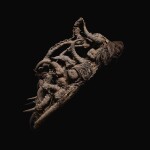
Bamana Kòmò Helmet Mask, Mali
Lot Closed
December 4, 05:39 PM GMT
Estimate
20,000 - 30,000 USD
Lot Details
Description
Property from a Private Collection, New York
Bamana Kòmò Helmet Mask, Mali
Length: 25 1/2 in (64.8 cm)
Alain Dufour, Paris
Private Collection, New York, acquired from the above
Private Collection, New York, acquired from the above
Museum for African Art, New York, Bamana: The Art of Existence in Mali, September 13, 2001 - May 19, 2002
Jean-Pierre Colleyn, ed., Bamana: The Art of Existence in Mali, New York, 2001, p. 181, cat. no. 165
Much like the anthropomorphic power figures of the Congo, the corpus of helmet masks called Kòmòkun was meant to ritually arouse fear and fascination. Born of an accumulation of images invoking the surrounding forces, its aesthetics are out of the realm of our classification. These masks, which were worn during ceremonies of the Kòmò power association, were only meant to be viewed by initiates, and are amongst the "most feared objects in the Bamana culture" (Patrick McNaughton, "The Power Associations Kòmò" in Jean-Pierre Colleyn, ed., Bamana: The Art of Existence in Mali, New York, 2001, p. 176). This example is exceptionally powerful in its reduction of form to abstraction, with animistic qualities suggested by the multiple attachments of horns. For further discussion and illustration of Kòmò warakun helmet masks, including the present lot, see Patrick McNaughton in Jean-Pierre Colleyn, ed., ibid., pp. 174-183.
Known mostly through the writings dedicated to the Bamana initiation society of the Kòmò, this powerful association "holds many secrets, practices and esoteric knowledge about the relationship between Man and the world. [It] acts as a police force to fight crime, but also as a judicial body to resolve cases facing the community. [It] also offers initiates protection against disease, misfortune, the actions of malicious spirits and those of antisocial sorcerers" (ibid., p. 175). As Susan Elizabeth Gagliardi superbly demonstrated in Senufo Unbound: Dynamics of Art and Identity in West Africa, the catalogue accompanying the 2015-2016 exhibition Senufo: Art and Identity in West Africa, this institution transcended the borders created by colonial partition and established itself both in Bamana (Mali) societies and in those traditionally referred to as Poro in Senufo country (Côte d'Ivoire).
The mask presented here is a wonderful illustration of McNaughton’s description of "the exquisitely horrific headdress [...] [which] unites animal motifs and organic materials into a spectacular creature that includes bird, hyena, crocodile, antelope, and more [Their strength] is subsequently nourished with regular programs of sacrifice (sònni), the residues of which grow across the surface of the headdresses, making them progressively more awesome to behold and more potent to engage." (Patrick McNaughton, in Jean-Pierre Colleyn, ed., ibid., p. 175, p. 178)
Known mostly through the writings dedicated to the Bamana initiation society of the Kòmò, this powerful association "holds many secrets, practices and esoteric knowledge about the relationship between Man and the world. [It] acts as a police force to fight crime, but also as a judicial body to resolve cases facing the community. [It] also offers initiates protection against disease, misfortune, the actions of malicious spirits and those of antisocial sorcerers" (ibid., p. 175). As Susan Elizabeth Gagliardi superbly demonstrated in Senufo Unbound: Dynamics of Art and Identity in West Africa, the catalogue accompanying the 2015-2016 exhibition Senufo: Art and Identity in West Africa, this institution transcended the borders created by colonial partition and established itself both in Bamana (Mali) societies and in those traditionally referred to as Poro in Senufo country (Côte d'Ivoire).
The mask presented here is a wonderful illustration of McNaughton’s description of "the exquisitely horrific headdress [...] [which] unites animal motifs and organic materials into a spectacular creature that includes bird, hyena, crocodile, antelope, and more [Their strength] is subsequently nourished with regular programs of sacrifice (sònni), the residues of which grow across the surface of the headdresses, making them progressively more awesome to behold and more potent to engage." (Patrick McNaughton, in Jean-Pierre Colleyn, ed., ibid., p. 175, p. 178)