
Property of a Gentleman, Sold Without Reserve
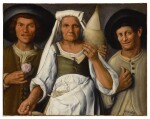
Sold Without Reserve | ATTRIBUTED TO VINCENZO CAMPI | AN OLD PEASANT WOMAN WITH A DISTAFF AND SPINDLE FLANKED BY TWO MALE PEASANTS
Lot Closed
June 11, 02:34 PM GMT
Estimate
20,000 - 30,000 USD
Lot Details
Description
Property of a Gentleman, Sold Without Reserve
ATTRIBUTED TO VINCENZO CAMPI
Cremona 1530/5 - 1591
AN OLD PEASANT WOMAN WITH A DISTAFF AND SPINDLE FLANKED BY TWO MALE PEASANTS
oil on canvas
canvas: 29½ by 37⅝ in.; 75 by 95.5 cm.
framed: 40 by 48 in.; 101.6 by 121.9 cm.
Anonymous sale, London, Sotheby’s, 4 December 2008, lot 177 (as Cremonese School, circa 1570);
There acquired for $90,512.
This enigmatic and amusing painting depicting three humbly dressed and coarsely featured peasants is an example of the types of genre scenes popular in Northern Italy in the late 16th century. Such figures were once relegated to the margins of compositions, but here three of them nearly fill the entire canvas. In the middle stands an elderly woman, wrinkled and weather-beaten, holding a distaff in one hand and a spindle of thread in the other. While her pose directly confronts the spectator, her gaze is slightly off center as she looks into the distance. Standing a step behind her are two young men, the one to the left whose mouth is contorted as if he is about to speak clutches a pink rose to his chest and embraces her shoulder, while the one to the right, with a smirking grimace, gestures towards her with his thumb.
Older women of this type appear in Northern Italian art in the 16th and 17th centuries, sometimes as details within larger paintings, and other times as the central subject of a work, as in Giorgione's La Vecchia (1506), often serving as memento mori, or reminders that time inevitably conquers beauty. In the present work, the older woman, holding the distaff and the spindle, is also reminiscent of one of the three Fates of classical mythology, responsible for the thread of life. Furthermore, the juxtaposition between the older woman and her companion to the left also may allude to the allegory of unequal love.
Although it is unclear as to whether the painting was meant to be allegorical or moralizing, what is clear is that this work was intended to amuse the viewer. It embodies the genre of the pitture ridicole, or comic painting, a tradition that had become well established in Lombardy during the second half of the 16th century, particularly in the regions of Cremona and Milan. In these pictures, which were inspired by Leonardesque figure studies as well as the caricatures of Flemish artists such as Massys, Bosch and Aertsen, artists chose subjects from the lower classes and depicted them half length or three quarter length and (usually) in mildly amusing ways or ribald situations, sometimes with moralizing or allegorical overtones.
In addition to artists such as Niccolò Frangipani and Giovanni Paolo Lomazzo, among the most celebrated early practitioners of this tradition was Vincenzo Campi, a Cremonese artist who played a central role in the development of this genre in Northern Italy in the late 16th century. Although Campi was also known as a painter of religious scenes, he turned his attention to realistic and naturalistic depictions of low-life subjects in amusing situations by the 1570s. His works, characterized by an expressive dynamism and vitality, were instrumental within the tradition of pitture ridicole, and at the same time inspired a close circle of artists and followers.