
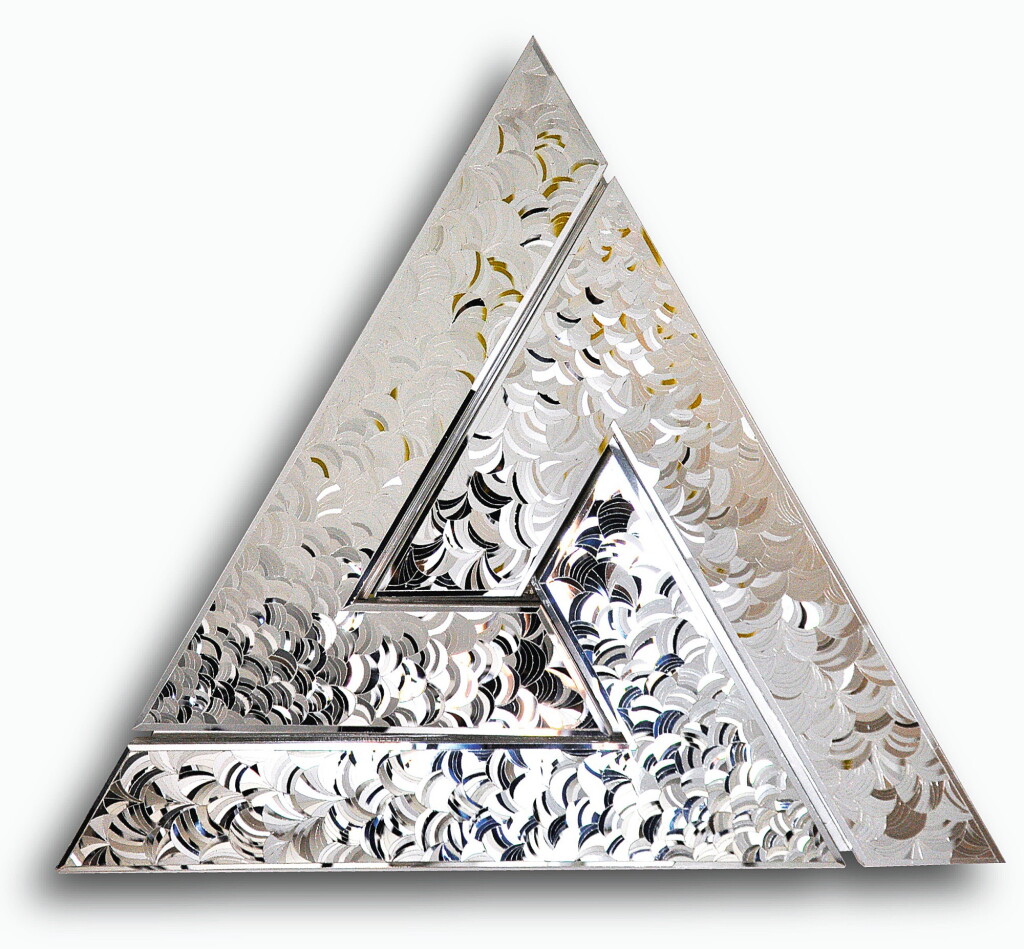
MONIR SHAHROUDY FARMANFARMAIAN | VARIATION #3
Lot Closed
March 31, 01:25 PM GMT
Estimate
120,000 - 180,000 GBP
Lot Details
Description
MONIR SHAHROUDY FARMANFARMAIAN
1922-2019
Iranian
VARIATION #3
signed and dated Monir Shahroudy Farmanfarmaian Tehran - Iran 2010 on the reverse; signed and dated in Farsi on the reverse
mirror and plaster on wood
87 by 75 by 7 cm.; 34¼ by 29½ by 2¾ in.
To view shipping calculator, please click here
The Third Line Gallery, Dubai
Private Collection (acquired from the above in 2010)
Private Collection, USA
Sotheby’s is delighted to offer Variation #3, a rare triangular work by Monir Farmanfarmaian, which explores the artist's affiliation with geometric mirror mosaics whilst simultaneously recalling elements of Islamic art through its composition. In her own words, Farmanfarmaian said: “If you divide a circle at three points, it will be a triangle. In Islamic design the triangle is the intelligent human being” (Monir Farmanfarmaian cited in: The artist in conversation with Hans Ulrich Obrist and Karen Marta, Monir Shahroudy
Farmanfarmaian: Cosmis Geometry, London 2011, p. 20). For this body of work, she used the diameter of a 100cm circle. She utilised objects representing Islamic geometry; in which the points reached would represent the number intended – in this case 3, a triangle. The circle, although indistinguishable, is central to the body of the work.
Farmanfarmaian’s distinct style, which formed in the late 1960s and 1970s, derives through the combination of two crucial bases; the strong and expressive ties she held towards her home country - Iran, and her effective apprenticeship in New York in the 1950s, which encouraged rather than stifled her sense of cultural connection to her homeland. The valuable marriage of these two influences is evident throughout her artistic journey, where Farmanfarmaian employs geometric forms to join the mathematical patterns of Iranian tradition with the minimalist shapes of New York School of Abstraction.
Though the artist’s oeuvre spans over multiple disciplines including pen-and-ink drawings, prints on glass and metal, and mixed-media collage, her career is best defined by her geometric mirror-works, which speak universally. In the words of Rose Issa, “Monir has never fit into any classification, any art movement, any school of thought; her work, free from human tragedy and sentimentality, has a recognisable universal idiom” (Monir Farmanfarmaian cited in: The artist in conversation with Hans Ulrich Obrist and Karen Marta, Monir Shahroudy Farmanfarmaian: Cosmis Geometry, London 2011, p. 99). Farmanfarmaian’s mirror-works are wide-reaching in both readability and recognisability and play a crucial role in her hypnotic oeuvre. When observing her mirror creations, the viewer is literally engulfed into her work, any movement being replicated in the myriad of reflections before them. “Each of these forms has thousands and thousands of ways to see it. Mirrors are a reflection of anything and everything. You become part of that mirror. It is communication—the mirror and yourself, the piece of art and yourself.” (Monir Farmanfarmaian cited in: Robin Wright, 'Two Iranian Artists and the Revolution' in: The New Yorker, 15 September 2015).
Mirror mosaics have decorated the interiors of the Iranian shrines and palaces since the 16th century. During the 1970s, Farmanfarmaian visited the Shah Cheragh mosque in Shiraz, Iran, where she became fascinated with the technique: "Around 1971, I went to a certain shrine [in Iran],…and I became very awed with the way the mirror pieces were reflecting back images of the people there – the beggars, the holy men. It was so beautiful, so magnificent. I was crying like a baby." (Monir Farmanfarmaian in conversation with Laura Barnett in: In Iran, life models wear pants, The Guardian, 2011). It was this event that provided a crucial turning point in Farmanfarmaian’s artistic journey. Monir strove to mix Iranian influences into her works, particularly the tradition of Ayeneh Kari, the art of cutting mirrors into small pieces and placing them in decorative shapes over plaster. She was notably the first contemporary artist to reinvent the Persian craft of Ayeneh Kari. Guided by the Iranian craftsman, Hajji Ostad Mohammad Navid, Monir produced many mosaics by cutting mirrors and glass into a variety of shapes, which were then arranged into compositions that recall elements of Sufism and Islamic art.
In a conversation with Etel Adnan, Farmanfarmaian discussed the presence of mystical geometry and Sufi influences throughout her works, affirming that the representations and meanings of her shapes drive beyond “flat geometry.” When describing the representation of the circle, she states: “The circle is the universe; its number is twelve, and that’s the months of the year, and the zodiac. The numerical symbol goes very deep: from creator [1] all the way up to the solar days [360].” (Monir Farmanfarmaian cited in: The artist in conversation with Hans Ulrich Obrist and Karen Marta, Monir Shahroudy Farmanfarmaian: Cosmis Geometry, London 2011, p. 99).