
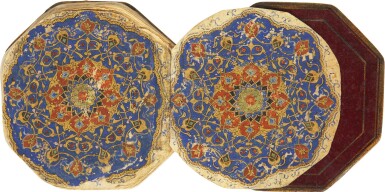
AN ILLUMINATED MINIATURE OCTAGONAL QUR’AN, COPIED BY MUHAMMAD IBN AL-HAJJ MUHAMMAD B. MUHAMMAD AL-TUGHRA’I, PERSIA, SAFAVID, DATED 920 AH/1514-15 AD
Auction Closed
October 23, 11:03 AM GMT
Estimate
20,000 - 30,000 GBP
Lot Details
Description
AN ILLUMINATED MINIATURE OCTAGONAL QUR’AN, COPIED BY MUHAMMAD IBN AL-HAJJ MUHAMMAD B. MUHAMMAD AL-TUGHRA’I, PERSIA, SAFAVID, DATED 920 AH/1514-15 AD
Arabic manuscript on paper, 236 leaves plus 2 fly-leaves, 16 lines to the page, written in naskh in black ink, ruled in gold, black and blue, verses separated by gold dots, surah headings in gold riqa’, .1a with a polychrome and gold illuminated shamsa, f.1b and f.2a with a double-page spread of illumination, f.2b and f.3a with a polychrome and gold incipit frame, in Qajar lacquer binding decorated with flowers and a bird
text panel: 3.6 by 3.6cm.
leaf: 5.2 by 5.2cm.
Christie's London, 16 June 1987, lot 187.
N. Safwat, A Collector’s Eye. Islamic calligraphy in Qur’ans and other manuscripts, London 2010, no.3, pp.34-35.
Octagonal Qur’ans, also called sancak, became popular from the seventeenth century onwards and sixteenth century examples are rare. Often used as amulets to carry on one's person, especially during times of conflict, they were written in a very small script called ghubar (literally 'dust'). Sancak Qur’ans were usually kept in small fitted boxes which could be attached to battle standards. The current example was copied by Muhammad al-Tughra’i. The nisba tughra’i denotes someone who is specialised in copying imperial monograms on documents. The delicate interlacing clouds and scrolls recall those on a Qur’an dated 959 AH/1552 AD and attributed to Shiraz or Qazvin, now in the Nasser D. Khalili Collection of Islamic Art (Inv.no QUR729, published in James 1992, p.173).