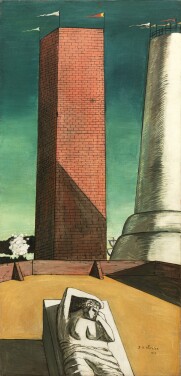
G iorgio de Chirico, born in Greece in 1888, trained in Athens, Florence, and later Munich, where Symbolism and German philosophy shaped his early, eerie imagery of piazzas, statues, and melancholic architectural scenes. Drafted into the Italian army in 1915, he met Carlo Carrà in a military hospital, and together they developed Metaphysical painting, defined by mysterious, incongruous objects and ominous atmospheres.
Giorgio de Chirico Biography
An Italian painter born in Greece in 1888, Giorgio de Chirico was the founder of the Metaphysical painting movement along with alongside the painter Carlo Carrà. In his youth, de Chirico's parents were supportive of his artistic inclinations, and he completed formal training in painting both in Athens, Greece, and Florence, Italy. When his family relocated to Munich in 1906 after his father’s death, he continued his studies at the Academy of Fine Arts. There he was exposed to and influenced by Symbolism, and – in conjunction with his studies of German philosophy – he began to develop a distinctly Surrealist style. Paintings from de Chirico’s early career illustrate his preoccupation with cerebral themes – eerie piazzas, uncanny figuration, and architectural views articulated in a melancholic color scheme – feature prominently through his oeuvre.
In 1915 he was drafted into the Italian army, and was stationed in Ferrara, Italy. He continued to make art during his army years, however the nature of his service influenced his work from the period. He began depicting incongruous objects and settings, and adding a larger number of subjects to his canvases. Diagnosed with a nervous disorder, he was sent to a military hospital where he ultimately met Carlo Carrà, with whom he would develop a new artistic mode they would term Metaphysical painting—a style that produced paintings which were overall ominous in tone, and with seemingly mysterious subjects. The term “metaphysical” references the apparent mystery in these works, as the full scope of the narrative is never quite visible within what is shown.
In the last years of de Chirico’s career, and after he published the article “The Return of Craftsmanship” (which promoted the restoration of traditional artistic modes and denounced modernism), his paintings became markedly more conservative. He even went so far as to renounce and condemn many of his early works. Nevertheless, his early artistic inventions inspired contemporaneous artists and have continued to inspire subsequent generations of artists.
Read Less