The New Generation of Japanese Lacquer Artists Reviving an Ancient Craft
The New Generation of Japanese Lacquer Artists Reviving an Ancient Craft
By
Akari Endo-Gaut | Dec 9, 2025
In studios across Japan, contemporary artisans are transforming urushi lacquerware with innovative techniques and sophisticated forms—honoring centuries of tradition while creating work that speaks to modern aesthetics
Photography by Takashi Homma
In studios across Japan, contemporary artisans are transforming urushi lacquerware with innovative techniques and sophisticated forms—honoring centuries of tradition while creating work that speaks to modern aesthetics
Photography by Takashi Homma
A piece from lacquer artist Genta Ishizuka’s “Surface Tactility” series.
I
n Japan, lacquer—known as urushi—has been used since prehistoric times. It’s a natural resin extracted from the urushi tree (Toxicodendron vernicifluum), which is native to Asia. Each yields only about one cup of sap per year, making urushi a rare and treasured material. Because it is extremely sticky, it has to be applied in very thin layers, each of which is left to dry and then polished before the next is added. Usually, each stage of production is carried out by a different craftsperson: the woodcarver, the base-coat artisan, the lacquerer and the polisher-finisher. Accordingly, a single piece can take weeks or even months to create.
Lacquerware has long been a vital part of Japanese daily and spiritual life. Some pieces are highly decorative and serve as gifts or ceremonial objects, while others—like sturdy miso soup bowls—are used every day. The art of urushi was introduced to Europe in 1900 at the Paris Exposition Universelle. The Japanese Pavilion display, curated by lacquer master Seizo Sugawara, captivated many Parisian artists, such as Eileen Gray and Jean Dunand. Gray ended up working closely with Sugawara for many years, while Dunand studied lacquer techniques under him, eventually incorporating them extensively into his furniture and interiors.
Ishizuka at work in his Kyoto studio.
In the postwar era, lacquerware demand decreased with the rise of mass-produced plastic goods, leading to a decline in both production and the number of artists. Despite these challenges, the tradition never disappeared. Today, a new generation is bringing fresh life to the field, merging innovative ideas and personal expression with the techniques they’ve inherited. Artist Genta Ishizuka explains: “My practice seeks to reinterpret the material’s history, using the lacquer’s skin-like membrane to engage the sense of touch and evoke a physical, emotional response.”
GENTA ISHIZUKA
The winner of the 2019 Loewe Foundation Craft Prize, Ishizuka has revived the mostly forgotten kanshitsu, or “dry lacquer,” method, which traveled from China to Japan in the seventh century. The Kyoto-based artist, 43, wraps swathes of hemp linen over forms made of styrofoam or wire, then paints on numerous coats of urushi, waiting for each one to dry so that he can polish it before adding the next. For his “Surface Tactility” series, he was inspired by the mesh bags full of oranges sold at stores. “The reason I chose to work with urushi isn’t just because of its beauty,” says Genta, “but because the repetitive process of applying and polishing, slowly building it up layer by layer, really suits my personality.” artcourtgallery.com
AKIHIKO SUGITA
Born into a family of lacquerware merchants in Tokyo, Akihiko Sugita was naturally drawn to the genre. Even so, he studied philosophy and art history and pursued an acting career before deciding to fully commit. He worked as an apprentice to Akito Akagi, a pioneering figure known for his minimal and modern forms.
Today, Sugita, 47, creates sophisticated bowls, vases and platters, as well as deeply contrasted paintings, from his studio in Kanazawa, the capital of Ishikawa prefecture. His surfaces have a unique patina, and the gentle beige of his lacquer evokes the tones in some abstract paintings. “I’m interested in how people see the world,” he says, of his sources of inspiration. “I’m drawn more to an arranged flower than to one in nature. I guess I’m curious about the consciousness of the person who arranged it.” sugitaakihiko.com
KENTA ANZAI
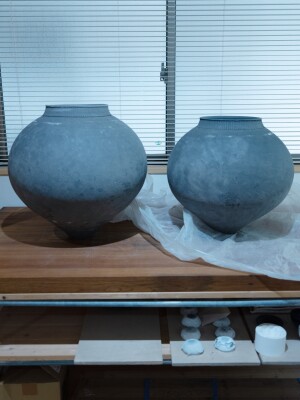
Kenta Anzai started his career as a salesperson at a medical device company, but eventually quit to study ceramics at the Kyoto College of Traditional Arts. “I wanted to work in a job where I made things,” he says. He went on to apprentice with ceramist Daniel Smith in England, and then with Taizo Kuroda, an influential figure in Japanese ceramics. Thanks to these diverse experiences, Anzai was able to explore his own aesthetic, developing a new lacquer technique. The Fukushima-based artist, 45, shapes the clay on the wheel, applies a glue-like mixture of clay and urushi, then polishes it. He repeats these steps eight to 10 times. Finally, he fires the piece and polishes it again to finish. This meticulous process, which takes about a month, gives Anzai’s work a distinctive black surface, reminiscent of Etruscan pottery. “I like things that have a natural feel and power,” he says, “things that are made with a focus on just making them.” rwguildgalleryny.com
TOHRU AND OSAMU MATSUZAKI
Father-and-son duo Tohru and Osamu Matsuzaki live and work in Mashiko, a region in Japan’s Tochigi prefecture known for its strong ties to craft traditions. Tohru, 81, trained under artist Tatsuzō Shimaoka, who was recognized by the Japanese government as a “Living National Treasure.” Osamu, 46, grew up learning from his father.
Unlike the traditional method, where a different specialist handles each step, the pair do everything themselves, from carving the wood to layering the lacquer. After carving, the wood is left to rest, continuing to breathe, sometimes for years, before the lacquer is even applied. Tohru’s idiosyncratic brushwork, influenced by the 400-year-old Negoro style, uses layering to build beauty and strength. ippodogallery.com
Sotheby’s Magazine
About the Author
Akari Endo-Gaut
Akari Endo-Gaut is a New York-based style director and creative and curatorial consultant. Born in Japan, she spent a decade in Paris, where she studied art and architecture. She specializes in decorative art and her clients span the worlds of fashion, design, hospitality and art, such as Vogue, Tiffany & Co., Graff and Guild Gallery. She is a contributing editor at Sotheby’s Magazine.