Specialists Select 10 Unmissable Artworks from The New York Sales
The fall’s biggest auctions are always a highly anticipated affair. This year, they’re even bigger than usual. Explore highlights from The New York Sales day auctions.


I naugurating Sotheby’s new home in Marcel Breuer’s Brutalist masterpiece, this November’s New York Sales features eight auctions dedicated to the last century of groundbreaking art.
The sale week is led by three single owner auctions, each of which consist of both evening and day sales. Read on for a list of highlights in the day sales, or explore evening highlights here.
On November 19, The Contemporary Day Auction will present a dynamic selection of works spanning Post-War, Abstract Expressionist, Minimalist and Contemporary movements, celebrating the artistic innovations that shaped the late 20th century and beyond.
Suspended in perfect balance, Alexander Calder’s .125 embodies the artist’s inimitable aesthetic, expressed through the captivating rhythm and cascade of 16 elements in red, orange yellow and black. Executed in 1956, this elegant mobile belongs to a rare group of three maquettes for the monumental .125 that hangs today in the International Arrivals Building at John F. Kennedy Airport in New York.
Having remained in the same family collection since its acquisition from Perls Galleries in 1976, this work’s history is as exceptional as its composition. Its inclusion in Calder’s Universe at the Whitney Museum that same year situates it within a moment of critical retrospection for the artist. For this mobile to return now to the Breuer building where that retrospective first unfolded is profoundly symbolic, reaffirming its place within the continuum of Calder’s universe.
An exquisite example of Wayne Thiebaud’s most delectable and iconic imagery, Four Sundaes embodies both the artist’s unrivaled mastery of still-life painting and his enduring meditation on the American spirit. Painted in 1963, during the most celebrated period of Thiebaud’s early career, the work epitomizes the painter’s ability to transform an ordinary subject into a vision of luminous form and nostalgic pleasure.
Across a cool white plane, four banana-split sundaes are aligned in rhythmic precision, each crowned with a single cherry and gleaming under the clarity of California light. The desserts appear simultaneously tangible and idealized – deliciously real yet suspended in time.
Executed in 2019, Pumpkin is a resplendent embodiment of Yayoi Kusama’s most celebrated motif and one of the most recognizable symbols in contemporary art. Appearing for the first time at auction, Pumpkin is cast in fiberglass and stainless steel with a hallow interior filled with circular mirrors, painted in her signature palette of radiant yellow and inky black, the work pulses with optical rhythm and formal clarity. It stands within a lineage that stretches across Kusama’s entire career – from her earliest childhood drawings of gourds in wartime Japan to the mirrored environments and monumental sculptures that have defined her global acclaim in the 21st century.
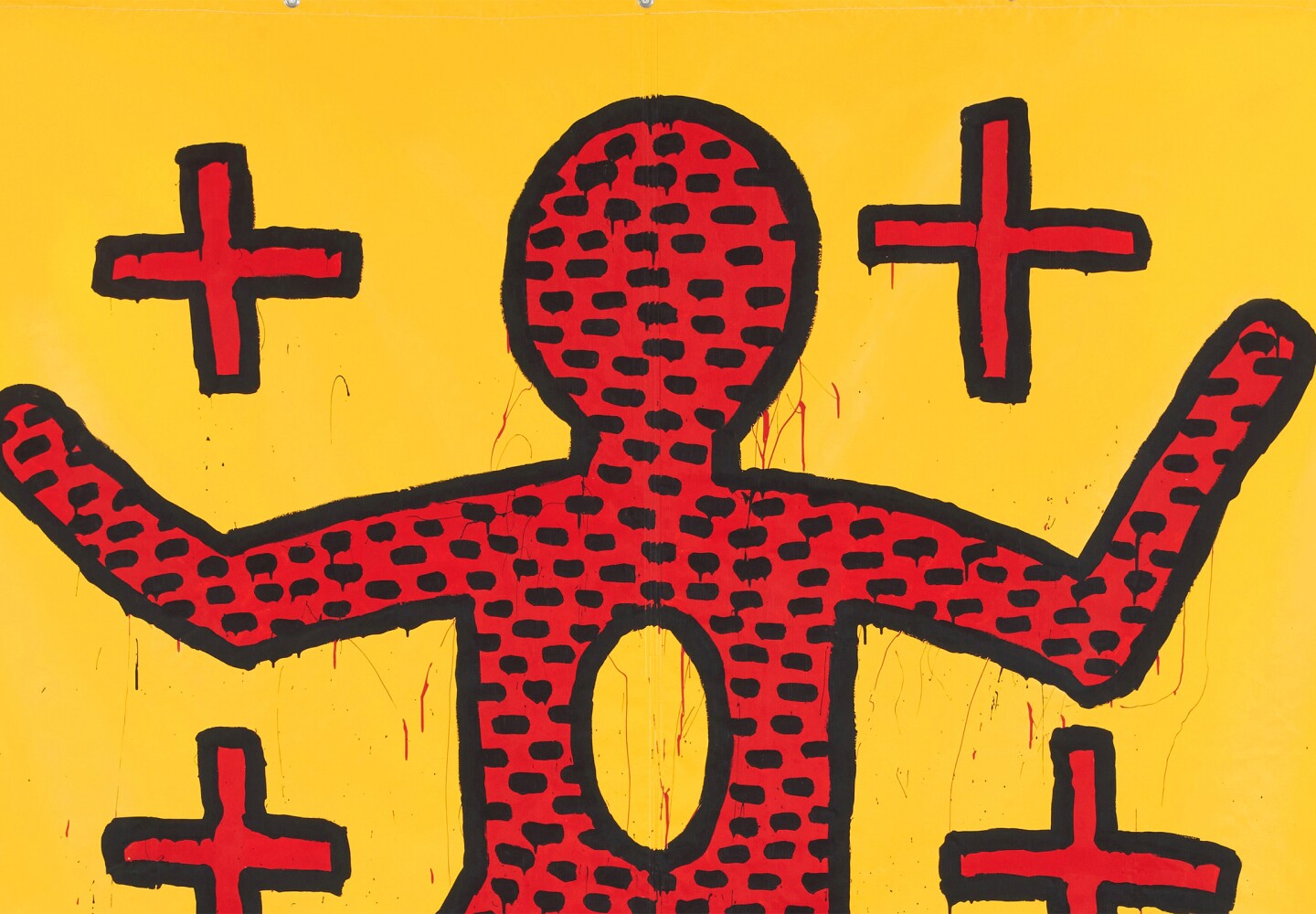
Painted in 1981, Untitled stands among the earliest and most historically significant of Keith Haring’s iconic tarpaulin works. This work embodies this critical period of production for the artist, distinguished by Haring’s guerrilla-style artistic practice that transformed urban walls into sites of dialogue between the artist and his captive audience. The composition of Untitled resonates deeply with the cultural and political climate of early 1980s New York. The figure’s hollowed torso and the surrounding crosses are charged symbols of both violence and transcendence. The present work channels the public anguish that followed the assassination of John Lennon, an event Haring learned about while at the Mudd Club.
Imposing in scale and striking in its stylization, Archaic Head (1988) exemplifies Roy Lichtenstein’s late sculptural practice, in which the artist reimagined the language of Pop through the enduring forms of art history. Cast in bronze, the work transforms the gravitas of an ancient sculptural head into the graphic idiom that had long defined Lichtenstein’s oeuvre. The result is a sculpture that is at once monumental and playful, a Pop translation of antiquity into the vocabulary of the 20th century.

On November 21, The Modern Day Auction draws together over a century of paintings, drawings and sculpture from across Europe and the Americas to showcase the best of Impressionism and the revolutionary avant-garde movements of the 20th century.
From his early Cubist explorations, Fernand Léger was deeply concerned with the dignity of the working man. By the time he returned to France in 1945 after sitting out World War II in New York, his political convictions had only strengthened, but his artistic focus had shifted. He now sought to celebrate the vitality of everyday life and the expressive power of the human figure. L’Anniversaire exemplifies this evolution: while unmistakably figural, it resists traditional representation. Instead, it affirms a modernist vision of humanity rendered through bold color, form and pictorial structure.
In his later years, Léger experimented with mosaic and stained glass – media rooted in light, movement and fragmentation. In L’Anniversaire, those influences are transposed to canvas through luminous bands of pure color that animate the composition. The vibrant chromatic language was inspired, in part, by Léger’s studio in New York’s Theater District – an environment saturated with neon light and visual rhythm.
Leonora Carrington’s The Return of Boadicea is a radiant vision of vengeance, rebirth and cosmic order – the culmination of the artist’s lifelong quest to reclaim the framework of Surrealism and its appeal to the mythical and subconsicous as a a living, generative language.
Drawing from the mythology of her childhood, Carrington depicts the legendary warrior queen Boadicea charging across a cosmic expanse in her horse-drawn chariot. Known today as Boudica, she led an uprising of native British tribes against the conquering Roman empire in AD 60-61 and, though she did not prevail, she remains a national heroine and a symbol of resistance against tyranny. Although Boudica's story must have resonated with Carrington, whose own journey took her from a sheltered English upbringing through the early Paris Surrealist group, to confinement in a Spanish psychological institution to ultimately success and creative freedom in Mexico – her painting, as is her way, resists straightforward interpretation.
Exactingly rendered and populated with the fantastical creatures for which she is most celebrated, The Return of Boadicea is an outstanding example of her expansive creative vision.
Painted with all of the hallmark technique of Maxfield Parrish’s best works, Solitude (Girls Viewing a Magnificent Landscape) is a sterling example of the artist’s unparalleled ability to render fantastical and unquestionably original landscapes. While many of Parrish’s illustrations were for commercial reproduction, this work was likely made for the artist’s own enjoyment.
Executed in impressively large scale for Parrish, it depicts two women seated beneath a towering tree, their figures rendered diminutive against a vast red mountain range. Beyond them, snow-capped peaks rise in the distance, amplifying the grandeur of the landscape and the relative petite scale of human presence within it. The warm, golden light that suffuses the scene, likely at sunset, imbues the composition with a sense of the sublime – transforming a natural setting into something ethereal and otherworldly.
One of four related works, three of which are in the Musée Picasso, Paris, Pablo Picasso’s L’Homme au béret basque is an impressively scaled gouache from the artist’s postwar output.. Executed in 1946, the year marked the beginning of Picasso’s public relationship with artist Françoise Gilot, his definitive move to the French Riviera, and a shift in artistic style following the war years spent in Occupied France with Dora Maar and Marie-Thérèse Walter. Depictions of Gilot dominate Picasso’s figurative output during this period, but men, often self-referential, occasionally appear in the guise of fauns, centaurs, sailors, and fishermen. Throughout his career, Picasso adopted a number of recurring alter-egos, and, knowing that Picasso identified as a sailor, L’Homme au béret basque takes on a new, self-referential meaning within the artist’s oeuvre, doubling as a self-portrait and metonymic representation of the artist himself.
Diego Rivera’s Woman Washing Clothes in a River Among Buzzards is one of the finest early examples of the artist’s easel painting to appear in the market in several years. An intimate vignette of everyday rural Mexican life rendered in warm earthen tones, the composition’s simplified forms and compressed spatial fields speak to Rivera’s engagement with European modernism. After returning from Europe in 1921, Rivera became invested in portraying Indigenous communities – figures central to the newly-independent nation’s cultural identity. He believed art must be accessible to all. This idea sparked an artistic revolution north of the border in years to follow.
In 1928, the work was gifted by Rivera to American artist George Biddle, likely during the pair’s sketching travels in Mexico. Biddle was deeply influenced by his time with Rivera, aesthetically and philosophically – and would soon after persuade his childhood friend, President Franklin D. Roosevelt, to establish the Federal Art Project to fund public art initiatives as part of the New Deal. The murals that arose from this project, visible in federal buildings across the US, demonstrate Rivera’s widespread influence on artists across the country. As Biddle championed public art in the United States, Rivera’s stature rose on the international stage, and by 1931, Rivera became the second artist ever to receive a solo retrospective at the Museum of Modern Art in New York.


