Let's Get Complicated: A Collector’s Guide to Technical Watches
A collector’s guide to the mechanics behind technical watches, including perpetual calendars, rattrapante chronographs, tourbillons and high complications.

At its most basic, a mechanical watch measures time. Add a complication and the movement begins doing something more. A perpetual calendar keeps track of changing month lengths and leap years. A rattrapante chronograph can time two events that begin together but end separately. A tourbillon works differently, placing the regulating organ inside a rotating cage originally developed to address the effects of gravity on a pocket watch’s rate.
Complexity is not simply a matter of counting functions. Mechanisms have to interact, draw from the movement’s available energy and fit within the limited space of a wristwatch. Combine several of them and the challenge grows. Each system still has to perform as intended while working with the movement around it.
Technical watchmaking can range from a calendar mechanically programmed years into the future to a split-seconds chronograph capable of tracking simultaneous events. Some watches put their mechanics on display, while others contain considerable complexity behind a restrained dial. Understanding what is happening inside the movement offers a better measure of a complicated watch than simply counting its functions.
| Complication | What to Know |
|---|---|
| Annual Calendar | Automatically distinguishes between 30- and 31-day months but requires one calendar correction each year at the end of February. |
| Perpetual Calendar | Mechanically tracks the date while accounting for different month lengths and leap years, requiring no calendar correction until 2100 if kept running continuously. |
| Rattrapante Chronograph | Uses two superimposed chronograph seconds hands to measure events that begin together but can end at different moments. The split-seconds mechanism adds another level of complexity to a conventional chronograph. |
| Tourbillon | Places the balance wheel, hairspring and escapement inside a rotating cage that typically completes one revolution per minute. Developed by Abraham-Louis Breguet, the mechanism was designed to counteract the effects of gravity on the accuracy of mechanical timepieces. |
| Moon Phase | Tracks the lunar cycle mechanically, often alongside calendar indications in more complicated movements. |
| Power Reserve | Indicates how much energy remains in a mechanical movement before the watch needs to be wound or generate additional power. |
| Multiple Complications | Bringing several complications into one caliber creates additional demands on space, energy and movement architecture. |
In mechanical watchmaking, a complication generally refers to any function beyond the display of hours, minutes and seconds. A date window is technically a complication, as are more complex mechanisms such as a chronograph, perpetual calendar or minute repeater. The term can describe a relatively simple addition or a mechanism made from a far more intricate network of components.
Some technically sophisticated mechanisms do not fit the definition as neatly. A tourbillon, for example, does not necessarily add another function to a watch, although it can be combined with complications such as a minute repeater, perpetual calendar or rattrapante chronograph. Instead, the tourbillon places the escapement, hairspring and balance wheel inside a rotating cage to address the effects of gravity on timekeeping. This distinction explains why its status as a complication is still debated, even though the tourbillon is closely associated with high horology.
The number of indications on the dial does not tell you how difficult a watch was to engineer. Each mechanism must fit within the caliber, receive sufficient energy and operate without interfering with the rest of the movement. As functions become more sophisticated, those demands have to be managed within the tight dimensions of a wristwatch.
Combining complications makes the problem increasingly difficult. A chronograph places different demands on a movement than a perpetual calendar, yet both may depend on the same source of power. Adding the mechanisms is only part of the work; designing them to function efficiently together is what makes movement architecture so important in complicated watchmaking.
Calendar complications become more sophisticated as the movement takes on calculations normally left to the wearer. A simple date mechanism advances through a 31-day cycle and requires correction during shorter months. An annual calendar goes one step further by distinguishing between 30- and 31-day months. It still needs one manual correction each year at the end of February.
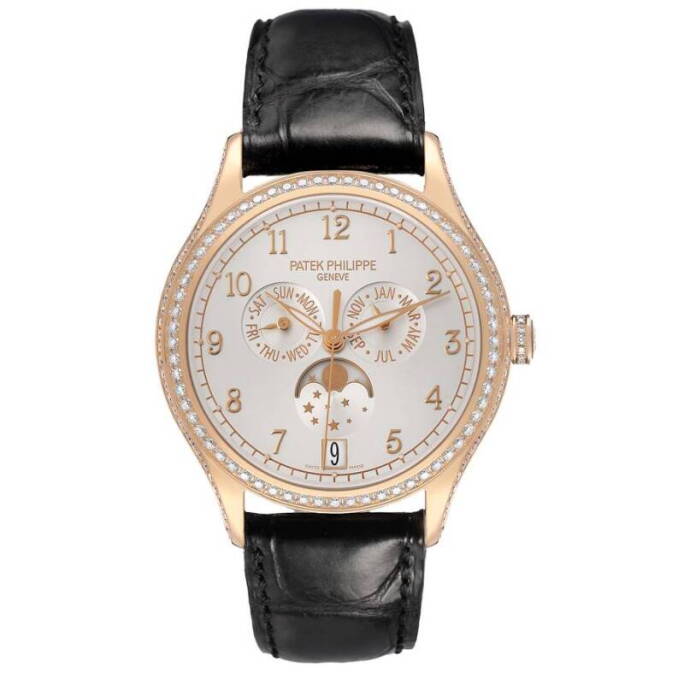
The Patek Philippe Complications Reference 4947R-001, currently offered on Sotheby’s online marketplace, puts that distinction into practice. The 38mm rose gold automatic watch combines a date, annual calendar and moon phase. Its movement automatically accounts for the differing lengths of the months from March through January, leaving February as the one point in the year when the calendar requires intervention.
A perpetual calendar takes the calculation further. It mechanically accounts for different month lengths as well as the four-year leap-year cycle. If kept running, a traditional perpetual calendar should display the correct date without manual correction until 2100, when the Gregorian calendar omits a leap year.
The Roger Dubuis Much More Quantieme Reference M34 5739, currently offered on Sotheby’s online marketplace, shows the next step in that progression. The 47mm white gold automatic watch displays the date, day of the week, month, moon phase and leap-year cycle. The movement keeps those indications synchronized as the calendar advances, including the transition from the end of February into March. Comparing the Patek Philippe annual calendar with the Roger Dubuis perpetual calendar makes the mechanical difference clear: one recognizes the regular pattern of 30- and 31-day months, while the other also accounts for February and the leap-year cycle.
A chronograph measures elapsed time independently of the watch’s primary timekeeping display. Activating a pusher starts the chronograph seconds hand; another press stops it so the elapsed interval can be read before the mechanism is reset. Doing this mechanically requires a dedicated system that can start, stop and reset the chronograph without interrupting regular timekeeping.
A rattrapante, or split-seconds chronograph, adds another level of complexity. Two chronograph seconds hands begin timing together, but one can be stopped independently while the other continues, allowing events that start simultaneously to be measured separately. The stopped hand can then catch up with its counterpart before another interval is recorded. Managing these actions adds another layer of mechanical control to the chronograph.
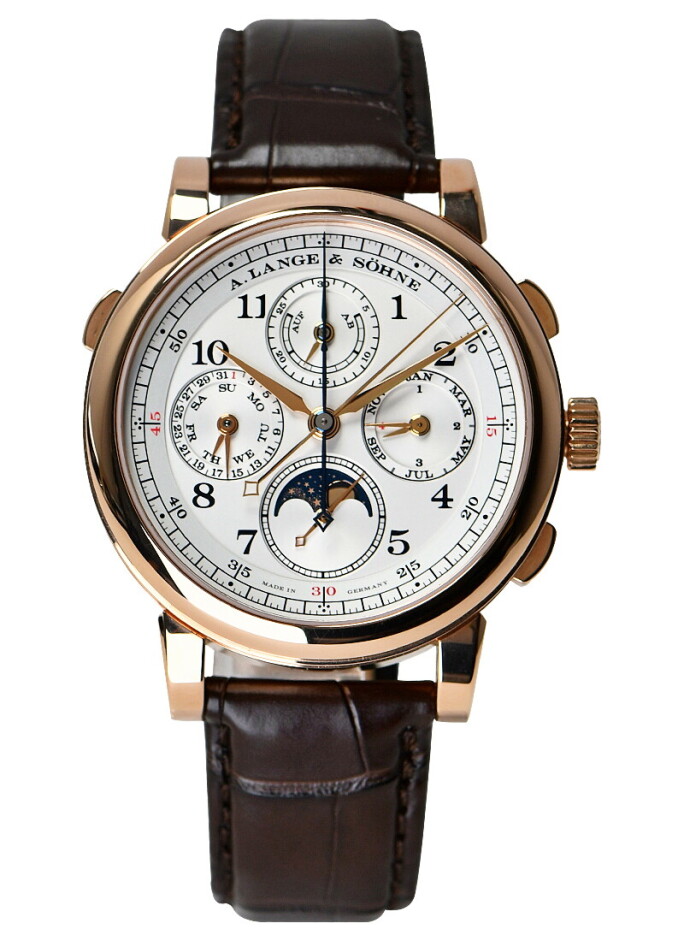
The A. Lange & Söhne 1815 Perpetual Calendar Rattrapante Reference 421.032FE brings several of these challenges into a single movement. The 41.9mm rose gold manual-wind watch combines a split-seconds chronograph with a perpetual calendar, moon phase and power-reserve indication. Here, the technical achievement is not tied to one mechanism alone. It comes from making several demanding systems operate within the same caliber.
Abraham-Louis Breguet patented the tourbillon in 1801, when pocket watches were commonly carried in a vertical position for long periods. Because gravity could affect the regulating organ differently depending on its position, Breguet placed the escapement and balance inside a rotating cage. Continually changing their orientation was intended to average out positional errors rather than letting those errors build in one direction.
The tourbillon has taken on a different role in the wristwatch. It does not provide an additional indication like a calendar or chronograph, which is why its classification as a complication remains debated. Constructing one is nonetheless demanding. The cage rotates while carrying components responsible for regulating the watch, so the assembly itself has to remain light, precise and stable while in motion. Contemporary watchmakers have expanded on the idea through flying tourbillons, multiple-axis constructions and movements organized around the rotating mechanism itself.
A flying tourbillon removes the upper bridge traditionally used to support the cage, leaving the mechanism supported from below. With no bridge covering the top of the assembly, more of the rotating mechanism is visible. In the Cartier Tank Américaine Reference W2620007, currently offered on Sotheby’s online marketplace, the tourbillon sits within the elongated geometry of the Tank Américaine. The 52mm white gold manual-wind watch places the mechanism prominently within a design still defined by the Tank Américaine's curved case and elongated proportions.
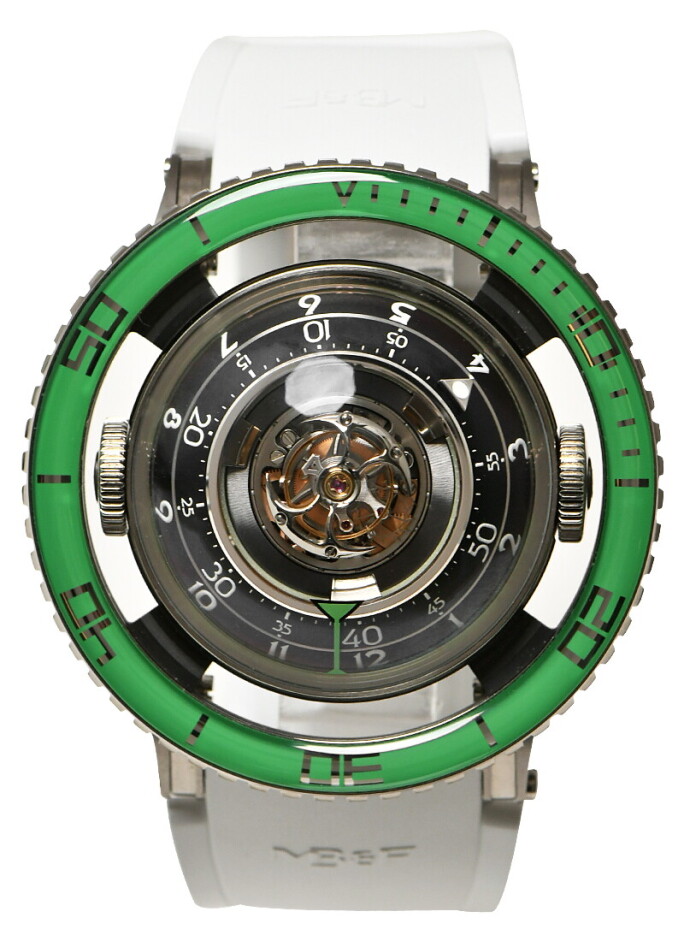
The MB&F Horological Machine N°7 “Aquapod” Reference 70.TGL.B, also currently offered on Sotheby’s online marketplace, takes an entirely different approach. Inspired by a jellyfish, the 50mm titanium automatic watch is built around a central flying tourbillon, with concentric displays for the hours and minutes arranged around it. Instead of incorporating the mechanism into a conventional dial, MB&F makes it part of the watch’s vertical architecture. Cartier works the tourbillon into an established case design; MB&F builds the watch around it. Both use the same basic mechanical principle to very different effect.
More complications do not necessarily make a watch more technically accomplished. How those mechanisms are constructed and how they work with the caliber around them can tell us much more. A watch built around a sophisticated tourbillon may present different engineering challenges than one combining several calendar functions. Available space, energy demands and movement architecture all shape how difficult the final watch is to execute.
Good complicated watchmaking also has to make complexity usable. Indications should remain legible, controls must operate precisely and additional mechanisms need to work without compromising overall performance. Those demands increase as more functions are introduced. Looking past the complication count to the way a movement is designed and integrated gives a better sense of its technical sophistication.
Complicated watchmaking asks mechanical systems to do an extraordinary amount of work within the dimensions of a wristwatch. A perpetual calendar must account for variations in the calendar, while a rattrapante adds another layer of control to the chronograph. A tourbillon poses a different problem by carrying the regulating components inside a structure that remains in constant rotation.
Once you understand what those mechanisms are doing, complication count becomes much less useful as a measure of technical achievement. Movement construction and the way different systems interact reveal more about the watchmaking involved. A restrained annual calendar and a watch built around a flying tourbillon solve very different problems, but both show how mechanical ingenuity can shape what happens on the wrist.
Complication count is only a starting point. Movement architecture, energy management and the interaction between mechanisms can reveal more about the engineering involved. A watch with fewer functions may be more mechanically demanding than one with a longer list of indications.
An annual calendar recognizes 30- and 31-day months but requires correction at the end of February. A perpetual calendar also accounts for February and the leap-year cycle, allowing the calendar to advance correctly without annual adjustment if the watch remains running.
A rattrapante adds a second, superimposed chronograph seconds hand that can be stopped independently and then reunited with the running hand. Doing this repeatedly without disrupting the chronograph requires additional control mechanisms and careful management of the movement’s energy.
Unlike a calendar or chronograph, a tourbillon does not provide an additional indication or independently activated function. It modifies the regulating system by rotating the escapement and balance within a cage. Its classification is open to debate, but the difficulty of constructing and integrating the mechanism is not.
No. The way complications are conceived and integrated matters more than the number alone. Movement construction, reliability, finishing and the demands placed on the caliber provide better context when comparing complicated watches.
Whether you're a seasoned collector or new to the world of fine watches, Sotheby’s offers a trusted, seamless way to buy and sell luxury watches on the secondary market.
Trust our worldwide network of leading watch specialists from a globally renowned auction house established in 1744.