Pricing the Priceless: How To Value Vincent van Gogh
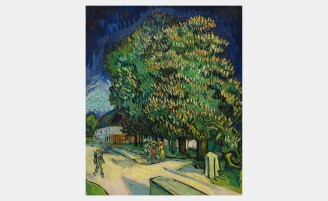
As Van Gogh’s iconic Châtaigniers en fleurs appears at auction—as part of Legendary: The Blaquier-Arrieta Collection—we are unpicking how Sotheby’s estimates a historic masterpiece for auction..

“Y ou stand in front of a picture like that and what is money?” noted the late great American collector Paul Mellon in 1958. He had just won Paul Cézanne’s Garçon au Gilet Rouge at the celebrated Goldschmidt auction, a legendary collection of Impressionist masters formed by German-American banker Jakob Goldschmidt and later consigned to Sotheby’s London by his son Erwin.
Mellon’s acquisition set a world record for a painting at auction only a few minutes after Vincent van Gogh’s Jardin Public à Arles—from the same collection—had achieved the same landmark. Sitting in the audience in the Bond Street galleries was Kirk Douglas, the Hollywood star who had portrayed Vincent two years earlier in the film Lust for Life. Dapper in his black tie, Douglas watched in awe as the hammer came down.
Few artists attract serious collectors as much as Van Gogh. The appearance of his late masterpiece Châtaigniers en fleurs—at Sotheby’s New York this November as part of Legendary: The Blaquier-Arrieta Collection—is set to draw competition from around the globe. The work, which has emerged after half a century, was painted during the brief, final period of the artist’s tumultuous life when Van Gogh was living in Auvers-sur-Oise outside Paris. It was a period during which some of his greatest works were completed, ranging from the symphonic green pastures of Les Vessenots à Auvers (now in the Thyssen-Bornemisza Museum) to the ominous Champ de blé aux corbeaux (Van Gogh Museum).
This spectacular burst of creativity was to be short-lived. By July, Van Gogh was dead by his own hand, having shot himself in the chest in the fields behind his lodgings. “The three months leading up to Van Gogh’s suicide in July 1890, months that he passed in Auvers under the care of his physician Dr Paul Gachet, stand out in his production,” notes Philip Hook, author of The Ultimate Trophy: How the Impressionist Painting Conquered the World. “Works from that short period have an agonised intensity—and a rarity—that sets them apart as the ultimate collecting trophies.”

But for the purposes of the market, how are these trophies valued? How does one quantify the mercurial and magical? Can a price be put on the priceless?
For the November sale, Châtaigniers en fleurs is officially listed as “Estimate on Request”—a term employed by auction houses to keep options open when heading into uncharted waters. “Some works of art are so rare and so special that it’s difficult to pin down an estimate range,” explains Simon Shaw, Senior Advisor at Sotheby’s New York. “In this case, this is the greatest Van Gogh that we've seen at auction since [Portrait of] Dr. Gachet in 1990. There are few comparables. An estimate “on request” is a more honest, more pragmatic way of approaching the evaluation. Critically, it also allows you to respond to the reaction of the market.”
For press purposes, however, a projected value for the painting has been given of $180 million. To arrive at that figure, Shaw described five key metrics Sotheby's used, which collectively touch on the drama of a tortured biography, a heady milieu, a sequence of esteemed associations, previous record prices and a certain indefinable je ne sais quoi.
The number of artists who have achieved prices in excess of $100 million for a single work at auction is exceedingly small. It is a privileged club that includes Picasso, Munch, Rothko, Warhol and Klimt. Van Gogh is chief among them. But what is it about these artists that puts their best works in a league entirely of their own? “Mixed bag, isn't it?” notes Shaw. But: “they are all artists that changed the way we perceive the world. They each offered a new lens through which to see the world, after which it never quite looked the same again.” Van Gogh’s eye was undeniably unique.
And then, Shaw continues, there is the bubbling cauldron of Van Gogh’s emotions and actions. “Art history is partly about aesthetics, but it's also about stories. Within Van Gogh’s life are the seeds of the great bohemian myth. Following the deaths of Vincent and Theo, who died only six months after his brother, Theo's widow, Johanna, was very successful in framing that story internationally. From Kirk Douglas through Julian Schnabel, there's an endless appetite for that story. In this increasingly depersonalized, AI-generated world that we live in, it talks about the essence of human creativity, human identity, human individuality.”
Van Gogh’s operatic blend of visual invention and human connection has resulted repeatedly in world auction records for his paintings, from the picture of the vineyard sold in the Goldschmidt Sale in 1958, to the works acquired during the heyday of Japanese interest in the late 1980s. That era witnessed the ground-breaking sales of Portrait of Dr Gachet to Ryoei Saito, chairman of the Daishowa Paper Manufacturing company, and Vase with Fifteen Sunflowers (1889) to Sompo Museum of Art, Tokyo.

Not all Van Goghs are worth such sums, of course. However, the subject matter of Châtaigniers en fleurs speaks to the artist’s seminal period of artistic fervour and to one of his favourite motifs: the life cycle of nature. Following the tumult of his time in Provence—the traumatic fights with Gauguin, the ear-slashing and the period in the Saint-Paul-de-Mausole psychiatric hospital—he hoped Auvers would reset his mind and his career. And in the early days in the town, during which he painted the glorious chestnut trees, his paintings were full of brio: these “canvases will tell you what I cannot say in words, that is, how healthy and invigorating I find the countryside”, he wrote to his brother in Paris.
Although created only weeks before his death, these final paintings “don't feel like an end at all” says Shaw, “they feel like the beginning of something. "In the late 19th century, Van Gogh set up the following century, using his external perception of the world, whether it’s a cornfield or a branch of blossom, to refract and communicate how he actually felt,” says Shaw. “He uses the external world to help him understand and express how he feels inside. And he does so with such authenticity that we connect directly with his feeling 136 years later.”

Rarity has several sub-factors: the number of extant works by an artist, the condition and size of the work at hand, and whether any comparable works have appeared on the market. Put simply, great collectors desire unique, large, perfectly preserved works, incomparable with others available on the market. “Being able to index rarity is very important for buyers today,” says Shaw. “Because of the nature of Van Gogh’s life and death, the overwhelming majority of his works were never commercialized.” In one sense, rarity is a numbers game. “Van Gogh painted for less than ten years. And he's only working in this period, arguably his most important chapter, for some 70 days. There are only eight landscapes from that period in private hands. And this is certainly one of the biggest, one of the greatest, one of the most successful of all of those.”
Another important narrative thread with the greatest artworks is how they got from the studio to the saleroom: who owned the work and when, where has it hung (or sat, or been stored) and are we sure of those facts? The provenance is a timeline to inspire confidence. And in the case of Châtaigniers en fleurs, the provenance is excellent: the picture went first to Vincent’s brother, Theo, and later his widow Johanna, before it passed through the hands of esteemed gallerists Paul Cassirer of Berlin and Wildenstein & Co in New York, as well as celebrated collectors—Prince Alexandre Berthier, Berlin publisher Samuel Fischer, French oil executive Marcel Kapferer, Hollywood producer George “Buddy” Gard de Sylva and American philanthropist Harriet Harris-Jonas—before finally entering the collection of the Buenos Aires-based Blaquier-Arrieta family.
Is the appeal of an amazing provenance that a buyer’s name is added to an esteemed historical record? “I'm sure that's part of it,” acknowledges Shaw. “You join the blockchain of Vincent van Gogh.”
Talking to Jackie Wuschlager, art critic for the Financial Times, Oliver Barker, Sotheby’s European Chair, recently explained that truly iconic works are beginning to reappear after many decades cocooned in “dynastic collections” formed in the mid 20th century. Châtaigniers en fleurs is perhaps the perfect example of a privileged group of works with what Barker calls “provenances that pass the test.”

Finally, acknowledges Shaw, there is a metric that cannot be defined. Certain works have a profound but intangible quality. “At the heart of Vincent is an enigma or a mystery that we are unable to quite grasp. There's a kind of unknowable magic at the center. And I think that is definitely the case with this picture.”
In his memoir Breakfast at Sotheby’s: An A-Z of the Art World, Philip Hook recalled a disconcerting moment in his auction house career. “I was once asked to value the Shchukin Collection, held partly in the Hermitage and partly in the Pushkin museums in Russia. It contained some of the greatest works of 20th-century art ever painted. When I was confronted with Matisse’s The Dance, I had to pause. Where does one start?” Are some works beyond valuation? The Mona Lisa, perhaps. Can you put a number on Michelangelo’s David?”
“Well, there are certain works which are today worth more by a considerable margin than any work that has ever been sold,” says Shaw. “The Mona Lisa is worth many, many, many multiples of Leonardo’s Salvator Mundi, the current record price. Is there somebody in the world with $10 billion to spend on a work of art? Probably, but it's never happened.”
In this whole push-pull evidentiary process of valuation, the relationship between financial value and artistic merit is, and has always been, a fluid and subjective matter. During Van Gogh’s lifetime his paintings were near worthless. The only named painting he ever sold was La Vigne Rouge (1888) which was acquired by the Belgian painter and collector Anna Bloch, sister of Eugene Bloch, Van Gogh’s fellow Impressionist. Anna paid a modest 400 Francs. In a letter to his brother—who bankrolled him and represented him to collectors—Vincent complained that Anna really should have had a “friends” discount.
And, one should remember that on the other side of the auction fence, financial value has another value altogether. For the seller, what does it mean? Well, in 1958, when Erwin Goldschmidt was asked about the stellar results achieved by his late father’s collection—including his record breaking Van Gogh—he pondered what one might do with such a windfall. “I don’t know what I’m going to do with the money,” he told reporters. “All anyone can do is eat three meals a day.”