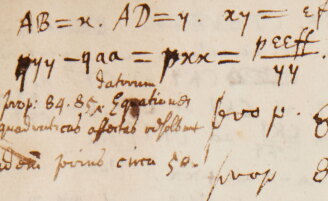
Our upcoming Reason and Revolution Auction features original, centuries-old works from some of the most innovative and inspiring scientists on the planet. We’re tracing how these definitive texts helped to rewrite our history—whether we tend to appreciate it or not.
Our upcoming Reason and Revolution Auction features original, centuries-old works from some of the most innovative and inspiring scientists on the planet. We’re tracing how these definitive texts helped to rewrite our history—whether we tend to appreciate it or not.
O
n a rainy day in 1985, my father brought home the greatest technological advancement I had ever seen: A Video Cassette Recorder. My family could now watch Ghostbusters literally anytime, no longer beholden to the whims of HBO programming. It was an incredible breakthrough. As far as I was concerned (at the age of 5), television had always existed and so had movies, refrigerators, and indoor plumbing. The VCR, however, had only just become affordable enough to hit critical mass. It was the first time I experienced the arrival of a transformative invention at the same time as all my neighbors. And then the internet reached middle-class suburban households nearly a decade later and I got to experience what it felt like to live through a truly seismic scientific breakthrough.
Looking back, the internet is unquestionably among the most monumental, consequential feats of science and engineering in the 20th century. Many of us who were around for its onset are still grappling with the full scope of its impact on modern life. Anyone born during the 21st century, though, would not necessarily feel the same way. The introduction of Instagram was a watershed moment for Gen Z, but the internet itself was always there—like television, refrigerators, and indoor plumbing. (But not the VCR, which sputtered out into obsolescence just under the millennial wire.)
It seems there’s nothing particularly miraculous about a major breakthrough one didn’t personally witness. The further along in time from the moment of discovery, the less impressive the discovery. And once something becomes a loadbearing part of society’s firmament, it ossifies into a foregone conclusion. Humanity was always going to figure it out, it seems, so the actual details of how it happened appear almost incidental.
Cultural amnesia should not be inevitable, however. The antidote for blithely accepting that mankind was predestined to stream podcasts on Netflix is to trace the scientific epiphanies that happened first. Exploring the Reason and Revolution auction at Sotheby’s provides us with a chance to revel in the vibrancy of history as it reverberates in the present. Engaging directly with first editions from giants like Isaac Newton and Galileo Galilei amplifies their inestimable influence on those who later stood on their shoulders.
To hold in one’s hands these landmark works in their original form is to be flung back through time into an advanced society being born. It collapses centuries of distance between the moment of discovery and the moment at hand, making concrete and un-ignorable the fact that these were indeed real people who unlocked mindblowing breakthroughs at a hinge point for humanity. The more time spent lingering on their crucial contributions, the harder it is to avoid seeing their fingerprints on every aspect of How We Live Now.
Let’s examine a typical day in the third decade of the 21st century: Running errands requires the use of Google Maps to plan a route. In the split-second before the app spews out immaculate directions, we should probably thank Nicolaus Copernicus.
An page from Nicolaus Copernicus' De revolutionibus orbium colestium, Nuremberg, 1543, first edition. Estimate: $700,000 - $1,000,000.
In what would be an epochal 1543 text, De revolutionibus orbium coelestium—or On the Revolutions of the Heavenly Spheres—Copernicus unveiled his heliocentric theory, explaining that Earth is not the stationary center of the universe but rather a planet that rotates on its axis while orbiting the sun. This was more than a reset for our ideas about outer space. It gave scientists a radically different way to think about Earth itself—not as a main stage on which the grand cosmic ballet plays out, but as just one twirling dancer among many.
That paradigm shift opened the door to a new era of increasingly precise calculations about where Earth is at any given moment, how it moves, and where other objects in the solar system should be. Over the centuries that followed, those calculations became the foundation for orbital mechanics, eventually allowing NASA to send rockets and satellites into space—and for us to use those satellites to find our way around Earth.
Next up, the weather. If it turns out to be an unexpectedly crisp fall day, we know to wear a sweater. This, too, is an occasion to thank an astronomer: Johannes Kepler.
Kepler, Johannes, Astronomia nova aitiologitos …, Prague or Heidelberg, 1609, first edition, contemporary vellum, the Chasles copy. Estimate: $400,000 - 600,000
In his seminal 1609 work, Astronomia Nova, Kepler picked up where Copernicus left off. He revealed that planets travel in elliptical orbits—rather than perfect circles, as previously believed—and obey mathematical rules. His work helped change astronomy from astrology-tinged math into a predictive science, showing that the complicated choreography of the universe could be described with elegant equations.
The implications of that idea captured the imaginations of later astronomers, who tackled those mathematical descriptions and developed ever more precise ways of tracking objects in space. The same basic problem Kepler confronted—figuring out exactly how things move through the universe—would eventually become essential to keeping track of satellites in orbit. Today, weather satellites circle Earth along carefully calculated paths, gathering the observations meteorologists rely on to tell our phones whether today is going to be especially chilly or not.
Galilei, Galileo, Sidereus nuncius …, Venice, 1610, first edition of the foundation of modern astronomy. Estimate: $250,000 - 350,000 .
Backing out of a parking spot has been made infinitely safer and easier thanks to the rearview camera–which has only been a standard feature since 2018 but already feels like it’s always existed. It doesn’t take 20/20 hindsight, though, to see that modern cameras trace their roots back to Galileo and his telescope.
While he didn’t invent photography, Galileo was a pivotal innovator in building instruments that allow humans to see far beyond the limits of our natural vision. His bespoke telescope revealed mountains on the moon, moons orbiting Jupiter, and countless stars previously invisible from Earth. That same impulse to build instruments that reveal what cannot be seen with the naked eye now undergirds everything from cameras to medical imaging.
Speaking of cars, these now ubiquitous vehicles are one of Newton's greatest unintentional legacies. If Copernicus helped us understand our place in the universe, Kepler showed how celestial bodies move, and Galileo pushed us to see beyond our sight, Newton helped us figure out how pretty much everything else moves. In his 1687 text Principia Mathematica, Newton formulated his three laws of motion and described how gravity operates throughout the universe. In doing so, he transformed motion itself from something humans could observe into something they could calculate and even predict. The same math that describes an apple falling from a tree applies to a car driving to Ikea or a rocket leaving Earth.
Newton, Isaac, Sir, Philosophiae naturalis principia mathematica, London, 1687, first edition, contemporary vellum. Estimate: $500,000 - 700,000.
Had any of these astronomers been unable to see their pursuits to the finish, other scientists almost certainly would have stepped up to fill the void, but maybe not for years, decades, or even centuries. Where would we be then?
Nourishing an appreciation for our scientific ancestors adds vital context to the present. It also provides a fresh perspective for the future. As we stand at what feels like another hinge point for humanity, thanks to a convergence of breakthrough technologies, every major new finding can be disseminated instantly, rather than circulated at a glacial pace via vellum-bound rag-paper. It took generations for Copernicus's ideas to be tested and refined into a new understanding of the cosmos, but the way his scientific descendants built on those ideas has yielded an information environment where today’s engineers can speed-run that process. Change now happens at the pace of discovery. For the first time in history, just about everyone has a chance to witness and debate in real time the emergence of tomorrow’s foregone conclusions.