A Guide to Identifying J.R.R. Tolkien First Editions
Explore the rare world of J.R.R. Tolkien first editions and learn how to authenticate early printings of The Hobbit, The Lord of the Rings, and more with expert insights.

Identifying a J.R.R. Tolkien first edition requires more than checking the publication date. Edition, impression, publisher information, binding and dust-jacket details can all help establish where a copy falls within a book’s publication history. With titles such as The Hobbit and The Lord of the Rings, small bibliographic differences can separate a first impression from later printings.
The distinction between first edition and first impression is especially important. A first edition may encompass multiple impressions produced from the same setting of type, while the first impression represents the earliest printing. Tolkien’s major works were reprinted as demand grew, with corrections and physical changes introduced along the way.
For The Hobbit, identifying the 1937 George Allen & Unwin first impression means checking details including the binding, dust jacket, maps and specific textual points. The Lord of the Rings requires a volume-by-volume approach. Knowing which features to inspect makes it easier to distinguish Tolkien’s earliest printings from the many editions that followed.
| What to Check | Why It Matters |
|---|---|
| Edition & Impression | A first edition can include multiple impressions. The first impression identifies the earliest printing within that edition. |
| Publisher & Date | Early Tolkien editions should be checked against the correct publisher, publication date and copyright-page statements. |
| Textual Points | Misprints, corrections and other textual differences can help distinguish one impression from another. |
| Binding & Dust Jacket | Cloth color, jacket design, printed price and other physical details can help identify the correct issue. |
| Maps & Other Components | Maps and other elements should be checked for their presence, placement and correct format for the edition. |
| Condition | Once the correct edition and impression are established, condition and the survival of original components can significantly affect desirability. |
A first edition refers to the first published form of a book, but that edition may be printed more than once. Each printing is an impression, making the first edition, first impression the earliest copies produced. This distinction matters with Tolkien because successful titles were reprinted quickly, and later impressions can differ substantially in scarcity and value.
Identifying the correct impression requires examining the book itself. Start with the title and copyright pages, then compare the publisher information, publication statements and known textual points with established bibliographic references. The binding, dust jacket, printed price and maps can provide further evidence. Because the relevant identifiers vary by title, The Hobbit and each volume of The Lord of the Rings need to be assessed individually.
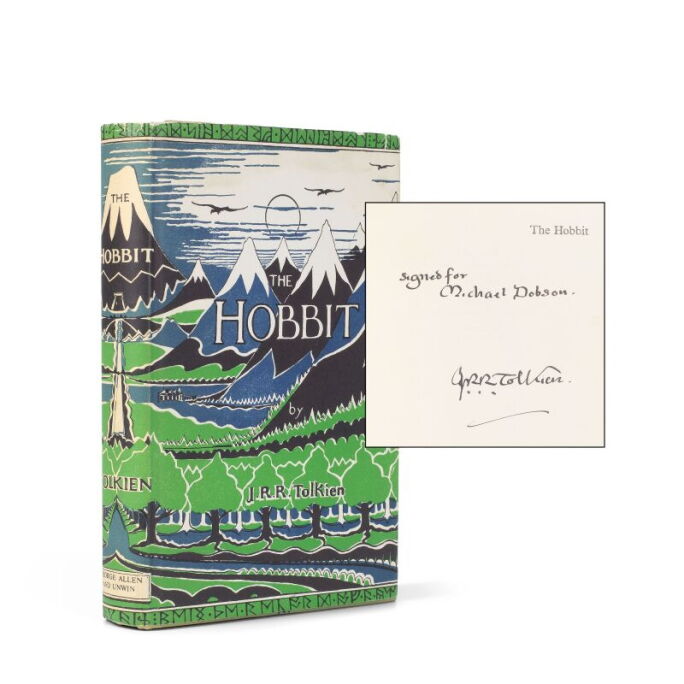
George Allen & Unwin published The Hobbit on 21 September 1937 in an initial run of 1,500 copies, which sold out by December. First-impression copies are bound in light green cloth, while the original dust jacket features Tolkien’s illustration of the Lonely Mountain and the price “7s 6d” on the front flap. The title page names "George Allen & Unwin Ltd", and the copyright page is dated "1937".
Several internal details can help confirm the first impression. On page 193, “Dodges” appears instead of “Dodgins,” an error corrected in the second impression. The maps are printed in red and black and appear opposite the title page and at the end of the book. Because later impressions introduced textual and physical changes, these points should be considered together rather than relying on the 1937 date alone.
The Lord of the Rings was first published by George Allen & Unwin across three volumes: The Fellowship of the Ring and The Two Towers in 1954, followed by The Return of the King in 1955. Each volume went through multiple impressions, so assembling a true first-edition, first-impression set requires identifying all three books individually.
Published on 29 July 1954, The Fellowship of the Ring had an initial print run of 3,000 copies. A first-impression copy carries the 1954 publication details, while the original Tolkien-designed dust jacket is priced “21s net.” Textual points can provide additional confirmation, including the correct spelling of “Frodo” on page 424; the “Fodo” error appears in a later impression.
The Two Towers followed on 11 November 1954, with 3,250 copies in the first printing. The copyright page states “First Published in 1954,” and the volume runs to page 352. A signature mark “4” at the bottom of the final page is another point used to identify the first impression.
Published on 20 October 1955, The Return of the King had the largest initial printing of the trilogy at 7,000 copies. First-edition copies carry “1955” on the title page and “First Published in 1955” on the copyright page. First-impression identification also depends on more granular textual and typographical points, including the signature mark on page 49 and differences within the index that were revised in subsequent impressions.
A complete first-edition, first-impression set requires the correct printing of all three volumes, each published separately over the course of 1954 and 1955. Because the books circulated independently, finding The Fellowship of the Ring, The Two Towers and The Return of the King together in comparable condition can be more difficult than locating an individual first impression.
Original dust jackets are an important part of that equation. Jackets were vulnerable to fading, tears and loss, so sets retaining all three can be significantly more desirable than copies assembled without them. Condition should also be considered across the set: matching first impressions with their original components create a different collecting proposition from mixed-impression sets assembled from later printings.
Tolkien first editions extend well beyond The Hobbit and The Lord of the Rings. The Silmarillion, published posthumously in 1977 and edited by Christopher Tolkien, is one of the most significant later releases. First-edition, first-impression copies state “First published 1977” and were issued with a dust jacket priced at £4.95. Its larger print run means it is more readily available than Tolkien’s earliest books, making condition and the original jacket important considerations.
Later posthumous publications include Unfinished Tales (1980) and The History of Middle-earth series (1983–1996), alongside collections of Tolkien’s letters and other writings. Each has its own publication history, so identifying a first impression requires checking the bibliographic points for the individual title rather than applying the markers used for The Hobbit or The Lord of the Rings.
Identifying a Tolkien first edition starts with establishing the edition and impression, then confirming the bibliographic details specific to that title. Publication statements, textual points, bindings, maps and dust jackets can all help distinguish an early printing from the editions that followed.
For The Hobbit and The Lord of the Rings, small differences can have substantial significance, especially when assessing first impressions. Comparing several identifying points—and considering the condition and completeness of the copy—provides a stronger basis for understanding where a Tolkien book fits within its publication history.
A first edition can include multiple printings, or impressions. A first edition, first impression is the earliest printing of that edition and is often the version collectors prioritize.
The 1937 George Allen & Unwin first impression was bound in light green cloth and has specific textual, map and dust-jacket points. The original jacket is priced “7s 6d.”
No, but an original dust jacket can significantly affect desirability and value, especially for early copies of The Hobbit and The Lord of the Rings.
Yes. A set can contain first editions from different impressions, although a complete first-edition, first-impression set is scarcer and generally more desirable.
Some can be. Edition, impression, condition, scarcity and the presence of the original dust jacket all matter when assessing later and posthumously published Tolkien books.
Whether you’re a seasoned bibliophile or new to the world of collecting, Sotheby’s offers a trusted, seamless way to buy and sell rare books and manuscripts on the secondary market.
Trust our worldwide network of leading book specialists from a globally renowned auction house established in 1744.