A Guide to Identifying Edgar Allan Poe First Editions
Identify Edgar Allan Poe first editions by checking publisher imprints, title pages, bindings, pagination and other key bibliographic details.

Identifying an Edgar Allan Poe first edition can require considerably more than confirming a publication date. Poe’s books appeared through different publishers and in changing formats during his lifetime, beginning with the anonymously published Tamerlane and Other Poems in 1827. Each title has its own set of bibliographic points that can help distinguish an original edition from later publications.
Those details can include the publisher and place of publication, title-page wording, pagination, wrappers or binding and other physical features specific to the book. Completeness can matter as well. Tales of the Grotesque and Arabesque, for example, was issued in two volumes, while surviving copies of Poe’s earliest poetry books present an entirely different set of identification challenges.
This guide focuses on six important Poe publications, from Tamerlane and Other Poems through Eureka: A Prose Poem, and the features used to identify their first editions. Examining those points together provides a more reliable approach than relying on the publication date alone.
| What to Check | Why It Matters |
|---|---|
| Title Page & Imprint | Publisher, place of publication and date are often central to identifying the correct Poe edition. |
| Format & Binding | Original wrappers, boards or cloth can help distinguish an edition and affect the desirability of a surviving copy. |
| Pagination & Collation | Page count and the arrangement of a book’s contents can help confirm that a copy matches the correct edition. |
| Textual & Typographic Points | Certain Poe editions contain details that were changed or corrected in later publications. |
| Advertisements & Other Components | Publisher’s advertisements and other integral material can help establish completeness and, in some cases, issue. |
| Condition & Completeness | Once the edition is identified, condition and the survival of original components can have a substantial effect on value. |
A first edition is the first published form of a work, but identifying one of Poe’s books requires checking the bibliographic points associated with that specific title. His books were issued by different publishers and in formats ranging from paper wrappers to multi-volume sets. There is no single marker that identifies every Poe first edition.
Start with the title page and imprint, checking the publisher, place and publication date against established bibliographic references. From there, examine the book’s pagination, binding or wrappers and any title-specific features. Advertisements and other integral material can also matter. Because surviving copies may have been rebound, repaired or separated from their original components, several points should be considered together before identifying a copy as a first edition.
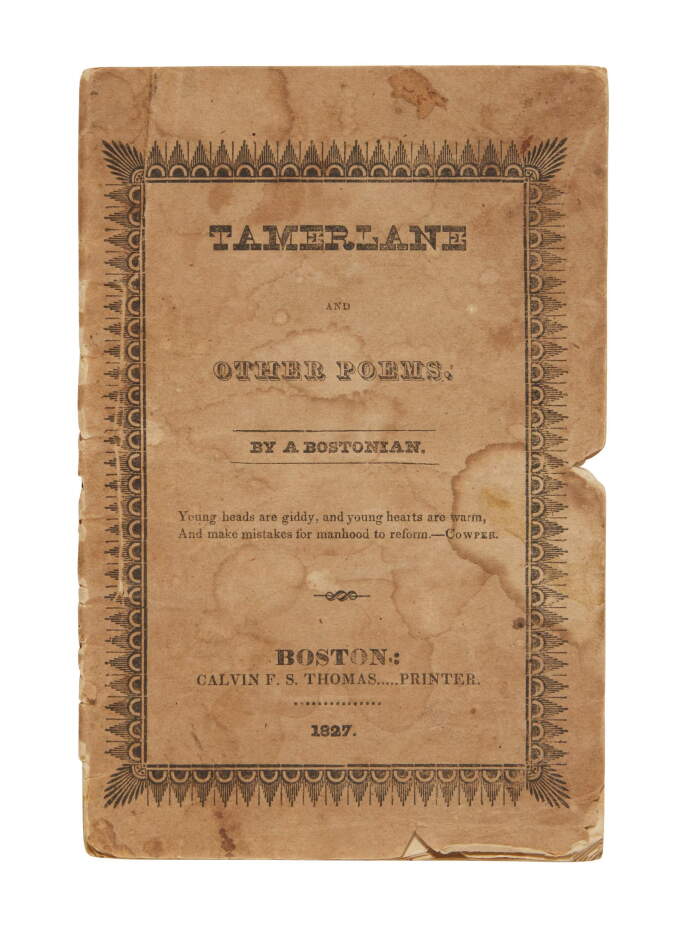
Poe’s first published book, Tamerlane and Other Poems, appeared anonymously in Boston in 1827 under the byline “By a Bostonian.” Calvin F. S. Thomas printed the slim volume, with the printer’s imprint appearing on the title page. The original edition was issued in paper wrappers with the title printed on the front and no attribution to Edgar Allan Poe.
The edition is believed to have consisted of fewer than 50 copies, with only about a dozen known to survive. Its modest production and extremely low survival rate make identification especially consequential. For a potential copy, the title-page imprint, wrappers and complete contents should be examined together and compared with detailed bibliographic references rather than relying on the 1827 date alone.
Poe’s second book, Al Aaraaf, Tamerlane, and Minor Poems, was published in Baltimore in 1829 by Hatch and Dunning. The title page of the first edition gives Baltimore as the place of publication, names Hatch and Dunning and carries the date 1829. Poe financed the publication himself, and the edition was produced on a limited scale.
First-edition copies contain 40 pages and were issued in drab paper wrappers without advertisements. Copies retaining those original wrappers are especially desirable, since early books of this type were vulnerable to damage or later rebinding. As with Tamerlane and Other Poems, the imprint, pagination and physical format should be considered together when identifying a surviving copy.
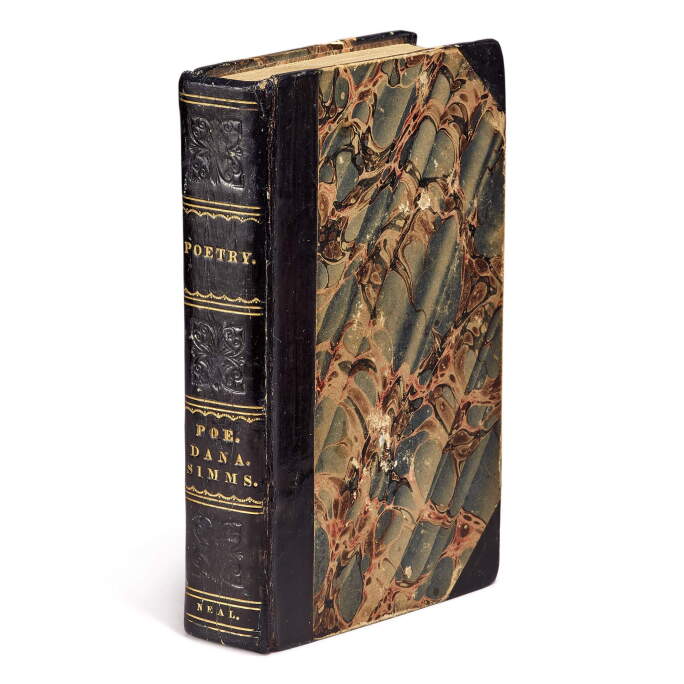
Published in New York in 1831, Poems by Edgar A. Poe was issued by Elam Bliss while Poe was at West Point. The title page identifies the author as “Edgar A. Poe” and gives the publisher as “Elam Bliss, 128 Broadway.” These details, together with the 1831 publication date, are central to identifying the first edition.
The book was originally issued in cloth-covered boards with a paper spine label, although surviving copies may have been rebound or otherwise altered. The collection includes early versions of poems Poe continued to revise, including “To Helen” and “Israfel.” For identification, the title-page imprint and physical format should be checked together, with the survival of the original binding adding another important consideration when assessing a copy.
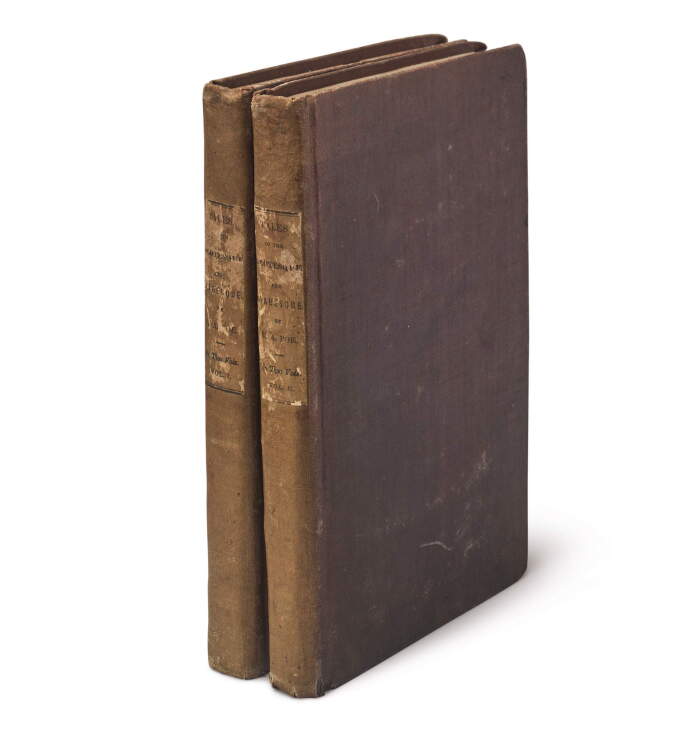
Poe’s first published collection of short stories, Tales of the Grotesque and Arabesque, was issued in two volumes by Lea and Blanchard in Philadelphia in 1840. First-edition title pages identify Lea and Blanchard as the publisher and carry the 1840 date. Copies were issued in paper-covered boards as well as cloth bindings.
Completeness is especially important with this title because the two volumes can become separated. Both should be examined individually to confirm that they belong to the correct edition and form a complete set. Publisher’s advertisements associated with Volume II can provide additional bibliographic evidence, while the bindings should be assessed carefully since surviving copies may have been rebound.
Following the publication of “The Raven” earlier in 1845, The Raven and Other Poems was published later that year by Wiley and Putnam in New York. The first-edition title page identifies Wiley and Putnam as the publisher and carries the date 1845. The collection brought “The Raven” together with other poems by Poe, including “Eulalie” and “The Coliseum.”
First-edition copies were issued in cloth with a blind-stamped design, with surviving examples found in different binding colors. Because bindings can be altered or replaced over time, the title-page imprint and other bibliographic points should be established before relying on the exterior alone. Copies retaining their original bindings in strong condition are generally more desirable than comparable rebound examples.
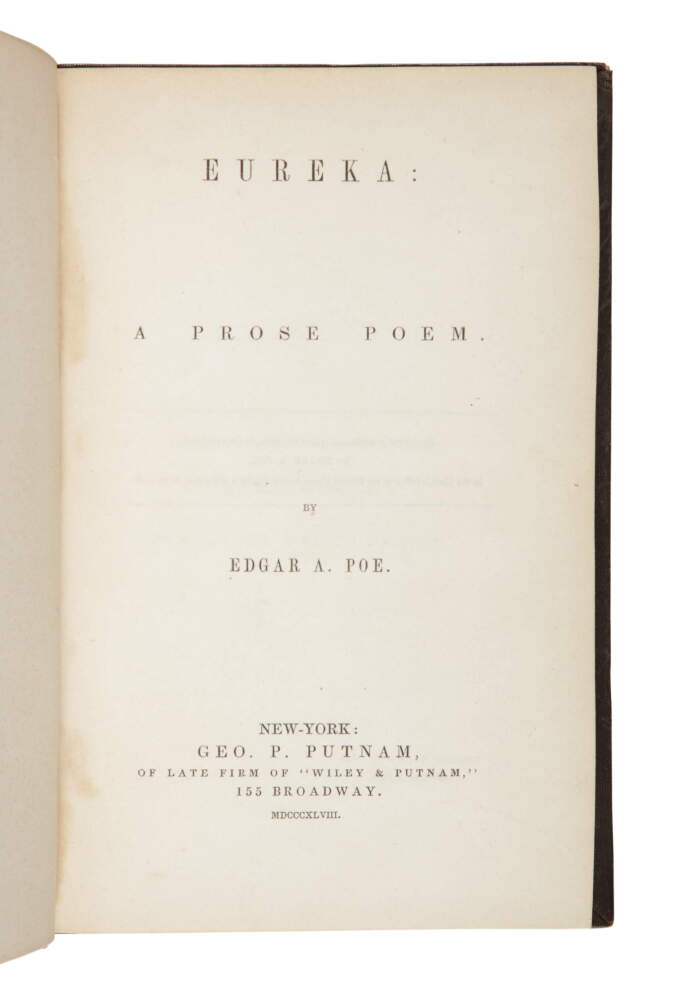
Published in New York in 1848, Eureka: A Prose Poem was issued by George P. Putnam near the end of Poe’s life. The first-edition title page reads “Eureka: A Prose Poem. By Edgar A. Poe,” with Putnam named as the publisher and 1848 as the publication date. The book contains 143 pages and was issued in cloth with gilt lettering on the spine.
Eureka differs sharply from the poetry and fiction for which Poe is best known. The work presents his ideas about the universe and its origins in a form that moves between scientific speculation and philosophy. For first-edition identification, however, the bibliographic evidence remains central: the title-page imprint, pagination and original binding should be considered together when assessing a copy.
Edgar Allan Poe’s publication history makes title-specific research essential when identifying a first edition. An 1827 Tamerlane and Other Poems presents very different bibliographic evidence from an 1845 The Raven and Other Poems or an 1848 Eureka. Publisher imprints, pagination and original physical features should be assessed in relation to the individual book.
No single detail should establish authenticity on its own. Comparing several bibliographic points can help distinguish a first edition from a later publication, while condition, completeness and the survival of original bindings or wrappers become important once the edition has been established.
Check the title-page imprint, publisher, publication date and physical format against bibliographic references for that specific title. Pagination, bindings, wrappers and advertisements may also help confirm the edition.
Tamerlane and Other Poems (1827) is Poe’s scarcest first edition. Fewer than 50 copies are believed to have been printed, with only about a dozen known to survive.
It can. A first edition may remain bibliographically significant after rebinding, but copies retaining their original wrappers, boards or cloth are generally more desirable, especially for Poe’s earliest books.
The 1840 first edition was issued in two volumes. A complete set containing both correct volumes is generally more desirable than an individual or mismatched volume.
No. The date alone is not enough to establish a first edition. The Wiley and Putnam imprint and other bibliographic points should also be checked before identifying a copy.
Whether you’re a seasoned bibliophile or new to the world of collecting, Sotheby’s offers a trusted, seamless way to buy and sell rare books and manuscripts on the secondary market.
Trust our worldwide network of leading book specialists from a globally renowned auction house established in 1744.