Live Auction: 18 November 2026 • 6:00 PM • New York

By Desmond Corcoran, London, 30 September 2026
This old quote was more than borne out on a late December afternoon in 1974 when Carlos Pedro Blaquier and Nelly Arrieta de Blaquier walked into my gallery, The Lefevre Gallery, on Bruton Street. They had been shopping for shooting paraphernalia at Holland & Holland which was then on the opposite side of the road and were on their way to the Wildenstein Gallery on Bond Street. At the time, we had a Christmas exhibition of 19th and 20th Century Paintings and in the window was a Bonnard still life which caught their eye. They duly bought the painting and while giving my partner, Martin Summers, delivery instructions, Carlos Pedro happened to mention that they were looking for a Gauguin. We had just purchased an important late Brittany Gauguin, Promenade sentimentale, from the Vanderbilt family in the United States which was due to be delivered the following morning. Martin said to Carlos Pedro: "If you come back tomorrow at the same time, we might be able to help you."

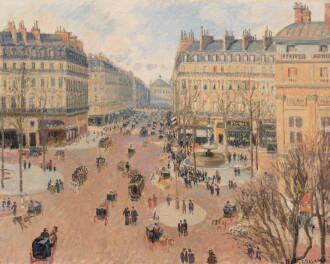
"A window on the street is as though an opening into heaven."
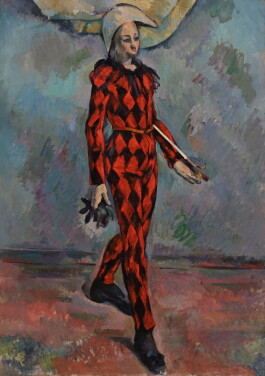
Thence, the fairytale began, and many major paintings followed over the next eight years until the unfortunate break-out of the Falklands War. A mutually beneficial business relationship started, and a burgeoning lifelong friendship developed. One of the high points was the purchase, the following year, of Paul Cézanne's Arlequin, which my friend Jacob Rothschild had just given us to sell.
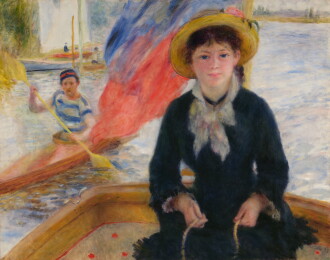
Among the great paintings that flowed to Buenos Aires were an important Henri de Toulouse-Lautrec (from the Lasker Collection which we had just purchased), Pierre-Auguste Renoir's En Canot (Jeune fille à la barque), also from the Lasker Collection, and a sumptuous pastel by Edgar Degas, Avant la course, from the Brody Collection in Los Angeles.
Over the years, Martin Summers, my wife Josephine and I made many trips to Buenos Aires and to the Blaquier-Arrietas' magical ranch, La Biznaga, in the province of Buenos Aires. We became great friends with Carlos Pedro, Nelly and their family. Nelly would remark when I arrived in Buenos Aires: "Have you come to visit your babies?" as the collection was known.
With the outbreak of hostilities, all communication sadly ceased. However, soon after the Falklands War was over, the telephone rang one day and it was Carlos Pedro. Although their collecting urge had somewhat tailed off by then, they did subsequently buy, some years later and at my instigation, a beautiful small Derain painting of Collioure which was in an auction in New York.
The friendship continued even after the collecting stopped. Nelly had always dreamt of a major auction encompassing her collection; the forthcoming auction is a fair representation of that dream. I have fond memories of their beautiful apartment in Buenos Aires in the Plaza San Martín, glowing with masterpieces, stunning French silver and beautiful gold boxes. Quite apart from the great wines and wonderful food, I think that helping form the Blaquier-Arrieta Collection was without doubt one of the high points of my career, something never to be forgotten.

By Joachim Pissarro
"It is not what is available that shapes art, but what an artist chooses to find meaningful."
This epigraph by one of the great curators of The Museum of Modern Art, Kirk Varnedoe, not only crystallizes the extraordinary strength and potent richness of the Blaquier-Arrieta Collection, but it also says something else. Carlos Pedro Blaquier and Nelly Arrieta de Blaquier were not only visionary collectors, but they were also what one could call “curator’s collectors.” They not only had a capacity to identify one chef d’oeuvre after another, but, somehow, through time, distilled patience and tireless personal engagement, they created a collection that was more than a collection. What I mean is that they had somehow succeeded in creating an ensemble that appeared to be indissociable: the Blaquier-Arrieta Collection could be compared to a Matisse painting: every part, every element, was absolutely indispensable to the whole. In a sense, they managed to recreate this swath of history—the seminal few decades at the end of the nineteenth century and early twentieth century—that formed the bedrock of modernism. The Blaquier-Arrieta Collection stands today as a magnificent gem, that in its totality would tell, better than any written volumes, the fascinating story of the passage from Impressionism to Post-Impressionism and the plunge into Modernism. Today, Sotheby’s offers one of the last rare opportunities to admire this exceptional achievement.
One of the remarkable features of this group of works is that, not only does each masterpiece scintillate on its own particular merits and visual strengths, but the entire collection itself holds together as The Lady and the Unicorn, the spectacular six-panel medieval tapestry at the Paris Musée de Cluny. That great marvel created circa 1500, is another superlative example of a masterwork that mediated an earlier tectonic shift, from theocentric devotion to Renaissance concerns with human experience and critical thinking.
The paintings selected here are not only a perfect encapsulation—a kind of pantheon—of the key moments of transformation from Impressionism to Post-Impressionism which itself formed the foundation of a hundred years of creative production to come; these works also reflect and express the deep-seated metaphorical and literal revolution of infrastructure of western society at the end of the nineteenth century—a portentous premonition that dictated the era we are fully immersed in today. In France, those unprecedented changes took place at a staggering rate and are exemplified by the travaux haussmanniens, the rebuilding of Paris, helmed by Baron Haussmann under Napoleon III. This almost incomprehensibly vast project redeveloped the capital from its cramped and unsanitary medieval environs into a planned urban layout of broad boulevards, avenues, grand buildings and elaborate facades. Concurrently, industrialization, technological invention and expanded railways advanced and connected the country as never before, ushering in the Belle Époque.
To reveal some of the fascinating inner dialogues interwoven within the fabric of this collection, we will consider several case studies that illustrate its uniqueness, in a sequence that notes some of the revolutionary personal relationships between the artists. These divining lines connect and enrich the artistic explorations, sociological concerns and aesthetic discourses as a new century approached. One collective association is the confounding of expectation: presumed intellectual and contextual cartographies, established means of perceiving the world through art are withheld, rerouted, or disappeared. Even the spectator is made complicit in the process of destabilizing the canon, the academy and the very meaning of things, by the adjustment of our position relative to what we are seeing. Motifs, signifiers and geographic locations often begin as traditional subjects but discard or are separated from their definitions through the creative process—painting reassigns matter, as these visionary artists were reshaping how the new age of human progress was perceived and understood.
We will see how a household object, or individuals, and even an entire city become other. In this beguiling, almost magical milieu of experimentation and the forging of new expressive means, even the critical language employed to discuss these unprecedented ideas had to evolve; nothing is at its seams; there is more than meets the I, and we will go beyond a shadow in a doubt. These fascinating multi-layered shifts of understanding and newly formed semblances, intercrossing each other, have made this collection a paragon of modernity that still powerfully resonates in us as we approach each of its singular masterpieces.