
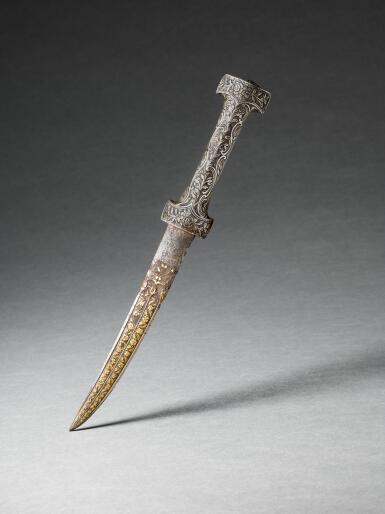
An Ottoman dagger with gold inlaid blade, Turkey, 16th century, with silver hilt, 18th century
Auction Closed
April 30, 03:48 PM GMT
Estimate
30,000 - 40,000 GBP
Lot Details
Description
the gently curving tapered blade with central rib dividing the face into two panels decorated with gold inlay, with bands of scrolling vine issuing lotus palmettes and rosettes, the reverse with inscriptions within lobed cartouches, the lower forte with traces of chiselled and inlaid palmette decoration, the later silver hilt of waisted form decorated with repousse floral sprays reserved on a stamped ground, traces of gilding
31.5cm.
inscriptions
In Persian, in fine nasta’liq: a quatrain, and a couplet in praise of the dagger (neither poet identified), and a benedictory phrase:
dawlat bad u sa‘adat
‘May there be wealth and happiness [for the owner]’
The blade on this dagger belongs to a group of rare early Ottoman daggers associated with the Ehl-i Hiref craftsman's guild that was developed in Istanbul under Sultan Mehmed II.
The gold inlay of the fine quality applied to this blade can be found on a dagger formerly in the Sultan’s treasury in Istanbul (Elgood 1979, p.66, fig.61). That blade is divided down its centre with a pronounced mid-rib which divides the decoration, which is composed solely of poetic couplets set inside lobed cartouches.
This type of gold inlaid decoration represents the height of Persian-inspired Ottoman artistry in the first half of the sixteenth century.
A Persian blade of the late fifteenth century with fine split leaf arabesques and mounted on an eighteenth century Ottoman hilt is in the Furusiyya Foundation of Art (Mohamed 2007, inv R-269 p.159) and another with a Persian-influenced blade of the sixteenth century is in the Staatliche Kunstsammlungen in Dresden (Schckelt 2010, inv. nr.Y 115, p.210).
A related dagger was offered in these rooms, 24 April 2024, lot 183.
You May Also Like


