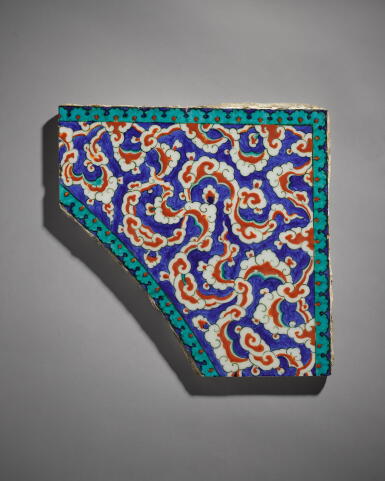
An Iznik polychrome pottery tile spandrel, Turkey, circa 1580
Auction Closed
April 30, 03:48 PM GMT
Estimate
100,000 - 150,000 GBP
Lot Details
Description
painted in underglaze cobalt blue, white, turquoise and relief red, outlined in black, with scrolling cloud bands within a frieze of of lobed motifs, intact
30.4 by 29.9cm.
Ex-private collection, France, by repute acquired by descent
Acquired by the present owner in 2005
The elongated cloud bands decorating this tile were derived from Chinese models that became available through the acquisition of porcelain and other goods, particularly from the Yuan and early Ming periods. These were re-interpreted by Iznik potters and took on new decorative functions. The striking overall cloudband design on the present tile, which is painted in a raised bole red with a white border against a cobalt blue ground, is the result of a complex process that requires multiple firings and exemplifies the mature style of Iznik pottery of the third quarter of the sixteenth century.
The motif was popular, and the flexibility of these freely drawn clouds lent itself to the spandrel format. Comparably drawn cloud bands on both a turquoise and red ground can be seen in the tomb of Sultan Selim II, built circa 1574 (Denny 1998, p.98, p.51). The same design on a cobalt ground is used in the spandrels of a tile panel in the mausoleum of Murad III, circa 1600, (Denny 2004, p.112) although the clouds there are more tightly drawn with a less liberal use of relief red than the present tile.
Unlike the above, where the cloud design is painted onto a more commonly found square tile, the present tile is shaped to fit a specific space such as a door, window or mihrab. For spandrel tiles with floral designs, see a pair sold in these rooms, 23 October 2024, lot 212, and a spandrel tile with arabesques and palmette and cloudband border sold at Christie’s, London, 28 October 2021, lot 90.
You May Also Like