
Property from a Private European Collection
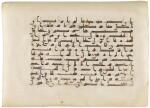
A Qur'an leaf in Kufic script on vellum, perhaps Damascus, 9th century
Auction Closed
April 30, 03:48 PM GMT
Estimate
8,000 - 12,000 GBP
Lot Details
Description
text: Qur'an, surah al-maidah (V), verse 112 to 119
Arabic manuscript on vellum, 14 lines to the page written in elongated Kufic script in black ink, vocalisation in the form of red dots, verses marked by triangular clusters made up of 3 gold dots, fifth verse markers in the form of a stylised letter ‘ha’ in gold, tenth verse markers in the form of a large illuminated polychrome rosette inscribed with the word ‘ashr'
33.5 by 25cm.
This beautiful leaf comes from a rare Qur’an, executed in a distinctive and unusual script that bears similarities to François Déroche's 'group F.1' in his categorisation of early Arabic scripts used for copying the Qur’an (see Déroche 1992, p.42). The characteristics of this style are a consistent mashq, or ‘stretching’, of the letter forms, which at times give the appearance of an extended connecting line, and which Déroche notes is a feature typical of leaves from Damascus. Other characteristics of the individual letters are a relatively extenuated alif, and a predominantly circular mim. However, the rounded forms and widening tips of some letter ends, such as the terminal nun and the waw, and the almost symmetrical shape of the lam-alif form are an additional unusual feature of this leaf, which perhaps correspond more closely to the D.Vc script, with similar characteristics to what is frequently referred to as ‘Western Kufic’ script.
Certain decorative elements are present in this leaf which are commonly found in other Kufic leaves of a more standard calligraphic format, but of the same period: for example, the verse markers in the form of three gold dots arranged loosely in a pyramid form, and the fifth verse marker, in the shape of a gold letter ha, corresponding to the number 5 in the abjad system.
The attribution of this style of script to manuscripts predominantly produced in Damascus appears to be a feasible suggestion, given that the majority of leaves with a different style of Kufic script are believed to have come from North Africa. The leaves exhibiting the closest style to the script in the present leaf come from a well-known Qur’an dated to the end of the eighth century AD; see Déroche 1992, cat.66, pp.120-2. According to Déroche, the script has certain similarities with a milestone in Tbilisi dated to 100 AH/718-19 AD, as well as an inscription dedicated to the caliph al-Mahdi, dating to 160 AH/776-7 AD (op.cit., p.42).
A number of leaves from the same manuscript were sold in these rooms: 23 October 2019, lot 105; 1 May 2019, lots 6 and 7; 7 October 2015, lot 210; 9 April 2014, lot 17; 9 October 2013, lot 45, and 6 October 2010, lots 1 and 2.
You May Also Like