
Leonard A. Lauder, Collector
Kurt Schwitters
Ohne Titel (Komposition auf Holz) (Untitled, Composition on Wood)
Auction Closed
November 19, 12:41 AM GMT
Estimate
120,000 - 180,000 USD
Lot Details
Description
Leonard A. Lauder, Collector
Kurt Schwitters
(1887 - 1948)
Ohne Titel (Komposition auf Holz) (Untitled, Composition on Wood)
assemblage with oil, leather, wood, stone, nails and newsprint on panel
10 ⅞ by 8 ⅞ in. 27.5 by 22.5 cm.
Executed in 1947.
Rose Fried Gallery, New York
The Hanover Gallery, London (acquired in 1956)
Ewan Phillips Fine Art, London (acquired in 1956)
G. David Thompson, Pittsburgh (acquired from the above by 1966)
Parke-Bernet, New York, 24 March 1966, lot 80 (consigned by the above)
Acquired at the above sale by the present owner
Karin Orchard and Isabel Schulz, Kurt Schwitters, Catalogue raisonné, 1937-1948, vol. 3, Ostfildern, 2006, p. 579, illustrated
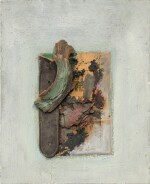
Executed in 1947, just one year before his death, Ohne Titel (Komposition auf Holz) is a rare example of Kurt Schwitters’ late period assemblage—a culmination of his lifelong dedication to his self-developed principle and practice, Merz. Richly textured, sculptural in form, and imbued with a haunting lyricism, this compact, yet deeply resonant work speaks to the power of Schwitters’ innovative vision, one that established him as the historic precursor of postwar Neo-Dada. As with the present work, Schwitters was the first avant-garde artist to collapse the boundaries between painting, sculpture and everyday objects.
Originally developed in the fractured milieu of post-World War I Germany, Schwitters’ Merz collages are typified by the combination of found objects and refuse with traditional art media. The term Merz, which Schwitters invented, came to embody the Dadaist principle of chance and has antiestablishment undertones in its challenge to conventional notions of beauty. Unlike some of his Dadaist contemporaries, Schwitters also prioritized traditional aesthetic principles of form and color in his compositions (see figs. 1 and 2). In Ohne Titel, Schwitters crafts a sense of quiet tension through the projection and recession of sculptural elements, transformed from everyday detritus and combined with swaths of dark and light pigment.
The emotional tenor of the present work is unmistakably shaped by the artist’s experience during World War II. Having fled Nazi Germany for Norway in 1937 and then Britain in 1940, Schwitters was arrested and interned at various camps in England and Scotland, including Hutchinson Camp on the Isle of Man, a converted boarding school housing German and Austrian intellectuals, artists, and refugees. While initially isolating, the camp and its meager art supplies became an unlikely crucible for creativity in Schwitters’ practice.
It was during and after this internment that his Merz works took on a new depth of introspection. Stripped of his homeland, studio, and many of his materials, the artist developed an even more tactile and improvisational approach—one visible in Ohne Titel. Here, Schwitters applies oil to nails, leather, and salvaged wood with a masterful sense of material dialogue. The curved, almost vegetal wood fragment emerging from the weathered surface echoes both resilience and fragility. The earthen palette of subdued greys, umbers, and ochres suggests the muted solemnity of postwar displacement. Thus, even within this restraint lies remarkable vitality.
Further distinguishing Ohne Titel is the composition’s elegant economy: a restrained surface charged with presence. Its intimate scale invites close inspection, revealing traces of the artist’s hand and the careful, almost reverential assembly of tactile elements. It is both a relic and a revelation—part painting, part object, and entirely Schwitters’ divination. Far from being purely abstract, the present work can be read as a meditation on exile, survival, and the act of rebuilding through fragments. Acquired in 1966 from the Parke-Bernet sale of the renowned collection of G. David Thompson, Ohne Titel was one of the first works acquired by Leonard A. Lauder. Today, it stands as both a powerful testament to the creative act and marks a watershed moment in the development of the collector’s eye.
You May Also Like