
Leonard A. Lauder, Collector
Pablo Picasso
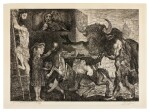
La Minotauromachie
Auction Closed
November 19, 12:41 AM GMT
Estimate
1,200,000 - 1,800,000 USD
Lot Details
Description
Leonard A. Lauder, Collector
Pablo Picasso
(1881-1973)
La Minotauromachie
signed Picasso in ink (lower right) and inscribed (une des trente épreuves du tirage) (lower left)
etching with scraper and engraving on Montval laid paper
plate: 19 ½ by 27 ¼ in. 49.6 by 69.3 cm.
sheet: 22 ¼ by 30 ⅜ in. 56.4 by 77.3 cm.
Executed in 1935, a richly inked impression of the seventh (final) state.
Private Collection, Europe
Sotheby’s, London, 5 December 1984, lot 205 (consigned by the above)
Ronald Lauder, New York (acquired at the above sale)
Estée Lauder, New York (acquired from the above)
Thence by descent to the present owner
Christian Zervos, ed., "Picasso 1930-1935," Cahiers d’art, 1936, p. 85, another impression illustrated
Paul Eluard, À Pablo Picasso, Geneva and Paris, 1944, pl. 102, another impression illustrated
Wilhelm Boeck and Jaime Sabartés, Picasso, London, 1952, p. 401, another impression illustrated
Exh. Cat., Los Angeles County Museum of Art, Sixty Years of Graphic Works, 1966, no. 181, p. 76, another impression illustrated
Georges Bloch, Pablo Picasso, catalogue de l’œuvre gravé et lithographié, 1904-1967, vol. I, Bern, 1968, no. 288, pp. 86 and 87, another impression illustrated
André Fermigier, Picasso, 1969, no. 161, p. 243, another impression illustrated
Francis Ponge, Pierre Descargues and Edward Quinn, Picasso, Paris, 1974, p. 212, another impression illustrated
Timothy Hilton, Picasso, London, 1975, no. 166, p. 225, another impression illustrated
Brigitte Baer, Picasso peintre-graveur, vol. III, Bern, 1986, no. 573, frontispiece and p. 24, another impression illustrated
Sebastian Goeppert and Herma C. Goeppert-Frank, Minotauromachy by Pablo Picasso, Geneva, 1987, another impression illustrated
Brigitte Baer, Picasso peintre-graveur, addendum au catalogue raisonné, Bern, 1996, no. 573, p. 28, another impression illustrated
Brigitte Baer, Picasso The Engraver, New York, 1997, no. 68, p. 83, another impression illustrated
Brigitte Léal, Christine Piot and Marie-Laure Bernadac, The Ultimate Picasso, New York, 2000, no. 711, p. 292, another impression illustrated
Kathleen Brunner, Picasso Rewriting Picasso, London, 2004, pp. 8 and 20-21, another impression illustrated
Exh. Cat., Malaga, Museo Picasso, Picasso. Toros, 2005, p. 84, another impression illustrated
Stephen Coppel, Picasso Prints—The Vollard Suite, London, 2012, p. 37, another impression illustrated
Often described as one of the most important graphic works of the twentieth century, La Minotauromachie is Picasso’s paramount achievement in printmaking. Visually stimulating and technically brilliant, the subject matter is also extraordinarily complex, evading conclusive interpretation of the work’s ultimate meaning. This rare work is infrequently seen on the market with most impressions now held in museums or permanent collections around the world.
La Minotauromachie was executed at a time of significant turmoil in Picasso’s personal life. His marriage to Olga Khokhlova was about to come to a crisis point with Olga’s discovery that his young lover, Marie-Thérèse Walter, was pregnant. It was in the period leading up to this revelation that Picasso produced La Minotauromachie, a time that he would later describe as “la pire époque de ma vie” (the worst period of my life). Between the winter of 1934 and the summer of 1935 Picasso virtually ceased painting. Printmaking, however, appears to have provided Picasso with a much-needed physical involvement with his creative endeavor; the intensity of the etching process—scratching, burnishing, reworking—serving as a natural outlet and distraction.
The image of Marie-Thérèse permeates Picasso’s work of the late 1920s and early 1930s (see fig. 1). She was his inspiration for the Suite Vollard with her image appearing repeatedly throughout the series as well as in paintings and drawings from the period. The Suite Vollard can be seen as an important precursor to La Minotauromachie, with many of the themes and characters explored in the series incorporated into this masterpiece (see fig. 2). The most significant of these is the Minotaur. Generally recognized as a representation of the artist himself, the Minotaur has its roots in Greek mythology. It was a character that had intrigued Picasso for some time and was appropriated by him in various guises: sometimes lustful and sexually predatory, other times merry and sociable or introverted and vulnerable. The Minotaur that we see in La Minotauromachie allies itself most obviously with the latter manifestation. No longer convivial or erotically charged, the beast appears tamed and subdued, shielding his sight from the scene illuminated by the young girl with the candle. In this respect, this Minotaur is most akin to the “blind Minotaur” of the Suite Vollard.
If one draws a symbolic parallel between the Minotaur’s subdued demeanor in La Minotauromachie and Picasso’s psychological state at the time, it becomes apparent that the revelation of Marie-Thérèse Walter’s pregnancy—an event to which Picasso was outwardly ambivalent—provoked in him a profound sense of emotional paralysis. This internal conflict was likely compounded by the knowledge that the affair and its consequences would irrevocably disrupt his already fragile domestic life. As Sebastian Goeppert and Herma C. Goeppert-Frank observe, “Marie-Thérèse’s pregnancy sharpened awareness in Picasso of the innate antinomy of birth and creation, of the rivalry between man and woman, and of life and death…” highlighting the existential dualities that permeate the work (Sebastian Goeppert and Herma C. Goeppert-Frank, Minotauromachy by Pablo Picasso, Geneva, 1987, p. 11).
This interpretation is reinforced by the juxtaposition of the dying horse and the collapsed torera—whose figure unmistakably evokes a pregnant Marie-Thérèse. Here, the scene does not offer a redemptive or cyclical vision of life and death, but rather one marked by brutality and existential dread. The Minotaur’s inability to engage with the moment, his symbolic recoil from the child’s illumination, signifies a deeper psychological dissonance. Set within the symbolic arena of the bullfight—a recurrent and personally resonant motif for Picasso—La Minotauromachie stages a visceral drama between creation and annihilation, vulnerability and violence. On the periphery of the composition, a bearded man (often interpreted as a self-portrait) and two young girls bearing doves—potential emblems of peace or innocence—witness the unfolding spectacle. Within this tableau, the Minotaur’s transformation becomes inevitable. As Goeppert and Goeppert-Frank aptly conclude, “the Minotaur can no longer remain a Minotaur. Confronted with the truth the girl reveals to him, he has not closed his eyes, and he can go neither forwards nor backwards. His only recourse is to take off his bull’s head as though it were a mask and wear his human visage again” (ibid., p. 104).
Further testifying to its unique place within Picasso’s oeuvre, La Minotauromachie served as a visual source for Picasso’s greatest work of art, Guernica (see fig. 5), which he painted two years later in response to the Spanish Civil War and which re-uses many of the motifs seen in this print, such as the Minotaur, the terrified horse and the beacon held by Marie-Thérèse.
Picasso worked intensively on the plate for La Minotauromachie at the studio of Roger Lacourière in Paris over a number of weeks between March and May 1935, producing a total of seven states of which the present work is the seventh and final state (see below). The artist was reluctant to release any impressions except to his closest friends, and even pretended to his most trusted dealers that he had not completed work on the plate. Picasso’s reluctance to formally edition La Minotauromachie is perhaps indicative of the emotional investment the artist had put into the work and the deep personal significance with which he regarded it.
Baer cites approximately 55 impressions of La Minotauromachie in its final state. At least half are held in museums including the Musée Picasso, Paris; The Metropolitan Art Museum, Tokyo; The Art Institute of Chicago; Museum of Fine Arts, Boston; The Museum of Modern Art, New York; Ashmolean Museum, Oxford; Philadelphia Art Museum and the National Gallery, Washington, D.C. The present work is distinguished not only by its superb execution but also for Picasso’s defined signature and hand-written inscription. Acquired by descent from Estée Lauder, La Minotauromachie has remained in the present collection for decades.
You May Also Like