

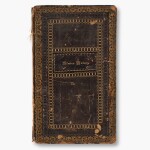
Torelli, La Merope tragedia, Paria, 1589, Italian polychrome presentation binding for Cardinal Michele Bonelli
Auction Closed
October 11, 11:51 PM GMT
Estimate
6,000 - 9,000 USD
Lot Details
Description
Torelli, Pomponio. La Merope tragedia del conte Pomponio Torello, detto nell’ Academia de gli Innominati di Parma il Perduto. Parma: Erasmo Viotti, 1589
First edition of Torelli’s tragedy Merope, dedicated to Ranuccio I Farnese, by Girolamo Alessandrini, Vice principe of the Parmesan Accademia degli Innominati (Parma, 20 January 1589). The author, Conte sovrano di Montechiarguolo (1539–1608), a courtier, diplomat and tutor to the Farnese, was unofficial head of the academy, the leading cultural institution in Parma. He was a frequent lecturer there on Aristotle’s Poetics and Ethics, and Merope, the first of his five tragedies, adheres to Aristotle’s recommendations about arousing tragic pity, and follows an imagined Greek model in framing the story in continuous action without designated act divisions. Merope was presented in manuscript to the academy in 1587, and its first “performance” was likely a recitation before the Innominati, not on a stage.
This richly decorated binding bears the gilt and polychromed armorial insignia of Michele Bonelli (1541–1598), the grand-nephew of Antonio Ghislieri, who had been elected Pope on 8 January 1566 with the name of Pius V. Michele had professed to the Dominican life in 1559, and in March 1566 was installed by Pius as Cardinal-Priest of Santa Maria sopra Minerva. Several years later, in 1573 or 1575, Pomponio Torelli married Isabella Bonelli (1554–1591), Cardinal Bonelli’s sister. The binding most probably was commissioned by Pomponio Torelli in 1589 for presentation to his brother-in-law. It presumably is the volume recorded in a posthumous inventory of the Cardinal’s library, taken in 1598, as “La Merope Tragedia del Torello in 4.o” (Biblioteca Apostolica Vaticana, Vat. Lat., 6063, cc. 72v–92 [c. 89 recto]).
Cardinal Bonelli bequeathed his library to a nephew, Lodovico Bonelli, a prelate of the Dominican order, then residing in SS. Apostoli, with the obligation not to alienate it, and, in the absence of direct successors, to deliver it to S. Maria sopra Minerva. After Lodovico’s death, in 1608, the library was duly deposited. In 1813, upon suppression of the monastery, it was reclaimed by Pio Bonelli Crescenzi (1757–1837). The books seem to have flooded onto the market immediately; by 1817, Dibdin could remark in The Bibliographical Decameron about the “gaiety of attire” of the Cardinal’s books. One of Michele Bonelli’s bindings—on Thomas Aquinas, Quaestiones disputatae de potentia dei (Lyon 1557); now British Library, c.47.k.8—realized a good price in Libri’s sale in 1859, knocked down to Boone for £16 (lot 133). Another—on Angelo Faggi, Poesis christiana autore (Padua 1565)—was lauded in Techener’s Histoire de la Bibliophilie (1862), and by the end of the century, William S. Brassington’s History of the Art of Bookbinding (1894) pronounced that the Cardinal’s library had become “illustrious for the richest bindings of books.”
In 1928, Tammaro De Marinis described six bindings embellished with either Cardinal Bonelli’s name or arms, attributing four to Florentine shops, and one each to Rome and Venice. All six were dedication copies (either to Cardinal Bonelli, or to Pius V), and De Marinis presumed that the donors had commissioned the binding themselves. More volumes have since come to light. They include a book dedicated by its editor to Pius V, and a manuscript dedicated by the author to Cardinal Bonelli, both in Venetian bindings, both evidently gifts. Two books bound in vellum with painted armorials, probably were also gifts (Dublin, Chester Beatty Library, 928; London, National Art Library, A.L.1649-1888). Another dozen books are in Roman bindings, commissioned no doubt by Bonelli himself. Five of them are plainly decorated: three with the Cardinal’s arms and letters F.M.B.C.A,10 and two with their armorial centerpieces and corner-pieces composed by tools associated with the Soresini shop (offered in our rooms, 20 May 2014, lots 31, 55). Six others are extravagantly tooled: two Dominican missals, both in the British Library (C.66.i.13, C.47.k.19a); a fine manuscript of Vergilius (ex Phillipps-Bodmer, sold in our rooms, 5 July 2005, lot 82); and three others.
4to (229 x 169 mm). Italic and roman types, 25 lines plus headline. collation: A4 B–H8: 60 leaves (H8 blank). Title-page with woodcut vignette of Farnese coat of arms; register with woodcut Viotti device on H7r, historiated woodcut initials. (Some mostly marginal foxing, tiny chips to top and lower margin of title-page.)
binding: Italian red goatskin (233 x 174 mm), ca. 1589, for Cardinal Michele Bonelli, polychromed in the French style, frame of 5 gilt and multiple blind fillets, in center intricate interlaced strapwork pattern against a painted gold criblé pattern, strapwork colored dark brown, with azured and outline tools painted in red, green, or blue, central oval cartouche with the Cardinal’s arms, traces of 2 pairs of ties, edges gilt with twin row of dots, title and author lettered on the fore-edge. (Rebacked to style, corners repaired.)
provenance: Cardinal Michele Bonelli (armorial supralibros) — presumably Ludovico Bonelli — S. Maria sopra Minerva, Rome — Pio Camillo Bonelli Crescenzi, marchese di Cassano e duca di Montanara e Salci (1757–1837) — Charles van der Elst (1904–1982; Ader Picard Tajan & Claude Guérin with Dominique Courvoisier, Paris, 16 September 1988, lot 180), purchased by — unidentified owner (FF 17,000). acquisition: Purchased from H. P. Kraus, New York, 1996.
references: Edit16 38971; USTC 859648; Mortimer, Italian, no. 564; for more on Bonelli's and Pius V's bindings, see De Marinis, “Einbände für Michael Bonelli Kardinal von Alessandria,” in Jahrbuch der Einbandkunst 2 (1928), pp. 160–108 & Pls. 30–32; De Marinis, La legatura artistica in Italia nei secoli XV e XVI (Florence, 1960), no. 1940 bis.
You May Also Like
![Fernandez [de Palencia], Diego | First edition of an early history of Peru, signed by the author](https://sothebys-md.brightspotcdn.com/dims4/default/90fff90/2147483647/strip/true/crop/1602x2000+0+0/resize/150x187!/quality/90/?url=http%3A%2F%2Fsothebys-brightspot.s3.amazonaws.com%2Fmedia-desk%2Fwebnative%2Fimages%2Fb7%2F35%2F7eae757d4dad810ca75855199acd%2Fn12191-dlys7-t2-02.jpg)


![[Lisbon] | First edition of this example of early Portuguese printing](https://sothebys-md.brightspotcdn.com/dims4/default/4e303ba/2147483647/strip/true/crop/1688x2000+0+0/resize/150x178!/quality/90/?url=http%3A%2F%2Fsothebys-brightspot.s3.amazonaws.com%2Fmedia-desk%2Fwebnative%2Fimages%2Fd3%2F5b%2F592391de4d1885e74698f63e54d2%2Fn12191-dlyzw-t2-01.jpg)
![[Order of Avis] | The rules of the Portuguese military-religious order](https://sothebys-md.brightspotcdn.com/dims4/default/025c8cc/2147483647/strip/true/crop/1669x2000+0+0/resize/150x180!/quality/90/?url=http%3A%2F%2Fsothebys-brightspot.s3.amazonaws.com%2Fmedia-desk%2Fwebnative%2Fimages%2Fad%2F77%2F6dae14674f79ad94fcb73cc6d30f%2Fn12191-dlyrg-t1-03.jpg)
![[Bible, Polyglot] | A full set of the Complutensian Polyglot, the first polyglot bible](https://sothebys-md.brightspotcdn.com/dims4/default/5ebde0c/2147483647/strip/true/crop/2000x2000+0+0/resize/150x150!/quality/90/?url=http%3A%2F%2Fsothebys-brightspot.s3.amazonaws.com%2Fmedia-desk%2Fwebnative%2Fimages%2Fdf%2F4b%2F95d871d94bf0af4de7339860e50a%2Fn12191-dlyr7-t1-11.jpg)


