Property from the Collection of Leslie and Peter Warwick, Middletown, New Jersey
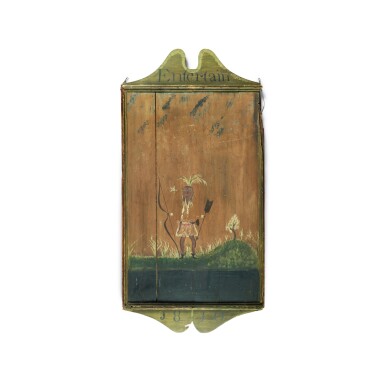
A Paint-Decorated 'Rounds' Tavern Sign, Rehoboth, Massachusetts, Dated 1810
Lot Closed
January 25, 08:27 PM GMT
Estimate
5,000 - 7,000 USD
We may charge or debit your saved payment method subject to the terms set out in our Conditions of Business for Buyers.
Read more.Lot Details
Description
oil on pine board
dated 1810
height 62 in. by width 31 in.
double-sided, inscribed Entertainmt in top double-arch pediment and the date 1810 in the bottom scrolled molding; the sign depicting a Native American warrior standing in a landscape holding a large bow and arrow and with a dagger and tomahawk in his belt and a yellow star with pinwheel to the left of his head.
Please note that this lot will not be on view during the sale exhibition. It is located at our Long Island City, New York storage facility. If you would like to examine it in person before the sale please make an appointment with the Americana department at 212-606-7130.
Please note that we have a new registration process and we highly recommend registering early to the sale. If you encounter any difficulty, please contact the Bids Department at bids.newyork@sothebys.com or call +1 (212) 606-7414 for assistance.
Tony Sassi, Gloversville, New York;
Tony Costantino of Clarendon House Antiques, W. Rutland, Vermont;
CRN Auctions, Cambridge, Massachusetts, November 16, 2003, lot 175;
Susan MacKay of MacKay & Field, Chaplin, Connecticut, 2003-2010;
Gail Lettick of Pantry & Hearth Antiques, Woodbury, Connecticut;
Frank Depasqua, Kocian DePasqua American Antiques and Fine Art, Philadelphia Armory Show, 2012.
Leslie and Peter Warwick, "A Tavern Sign Revealed," Antiques & Fine Art, Autumn 2014, pp. 153-4;
Rehoboth Antiquarium Society, October 2015;
Leslie and Peter Warwick, Love At First Sight: Discovering Stories About Folk Art & Antiques Collected by Two Generations & Three Families, (New Jersey: 2022), pp. 289-91, fig. 478a-80.
Elder Sylvester Round (1762-1824) was the pasture of the Six-Principal Baptist Church in Rehoboth, Massachusetts. He built a house in 1782 at 150 Tremont Street and added an adjoining tavern for his first son, Rufus, circa 1800. Rounds Church was less than a mile from the tavern, which provided refreshments after the long services. The tavern licensing records of Rehoboth show that Elder Round was licensed to sell liquor in 1802, 1808, and 1809, while his son, Rufus was licensed to run a tavern from 1806-1810. In 1811 Sylvester sold the house and tavern to Rufus for a $100 and Rufus sold the tavern to Seth Ballou for $600 in 1820. Ballou sold the property to Elijah J. Sandford in 1821, who sold it to Grenville Stevens in 1829.
Rufus Rounds' tavern sign bears the image of Sachem Massasoit on either side wearing deer skins and a feathered headdress. A pouch of tobacco and a thick chain of white wampum hangs around his neck and he carries a long knife and a hatchet in his belt while gripping his bow in his right hand and a downward arrow in his left hand indicating a wish for peace. The star over his right shoulder indicates that Massachusetts is one of the thirteen original states. This image is the state seal of Massachusetts adopted by Governor John Hancock in 1780.
Sachem Massasoit was born between Bristol and Warren, Rhode Island, which is about 16 miles south of the tavern on Anawam Street. Rehoboth was bought from Massasoit in 1641 by the original settlers making it possible that the sign was originally at this tavern's location. In March 1621, three months after the Pilgrims arrived in Plymouth, Massasoit negotiated a treaty guaranteeing the Pilgrims security in exchange for their alliance against Massasoit's enemies, the Narragansetts. The Pilgrims and Massasoit's tribe would not attack each other and would deliver offenders to each other. The Pilgrims would receive assistance if attacked and would render assistance if Massasoit's tribe was attacked. Massasoit needed the Pilgrim's assistance because his tribe had been 90% wiped out a couple years earlier by smallpox and viral hepatitis brought by English fishermen. This treaty was kept for 40 years until Massasoit died in 1661 when he was 80. He was humane, honest, and endeavored to keep his people peaceful. There are only three other known tavern signs with Indian images on them and several weathervanes bearing Massasoit's image made by Harris & Co. and W. A. Snow & Co in Boston.
You May Also Like