Property from a Distinguished Spanish Private Collection | Provenant d'une prestigieuse collection particulière espagnole
Juan Pantoja de la Cruz and Workshop | Juan Pantoja de la Cruz et Atelier
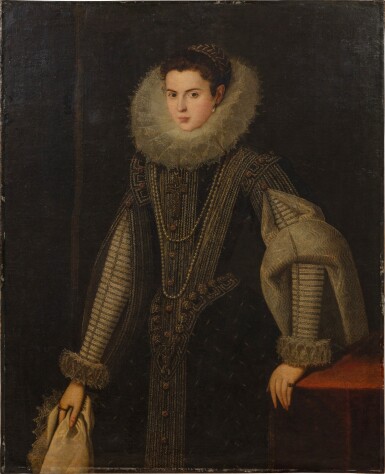
Portrait of a woman of the court, once identified as Isabelle de Valois | Portrait d’une femme de cour, autrefois identifiée comme Isabelle de Valois
Auction Closed
June 13, 02:06 PM GMT
Estimate
20,000 - 30,000 EUR
Lot Details
Description
Juan Pantoja de la Cruz and workshop
Valladolid 1553 - 1608 Madrid
Portrait of a woman of the court, once identified as Isabelle de Valois
Oil on canvas
111,5 x 90,3 cm; 43⅞ by 35½ in.
____________________________________________
Juan Pantoja de la Cruz et atelier
Valladolid 1553 - 1608 Madrid
Portrait d’une femme de cour, autrefois identifiée comme Isabelle de Valois
Huile sur toile
111,5 x 90,3 cm ; 43⅞ by 35½ in.
XI Count del Puerto;
Thence by descent to XII Count del Puerto;
Thence by descent to XVIII Duchess de Villahermosa;
Thence by descent to IV Duke de Luna;
Thence by descent to the current owner.
____________________________________________
XIe Comte del Puerto ;
Par descendance au XIIe Comte del Puerto ;
Par descendance à la XVIIIe Duchesse de Villahermosa ;
Par descendance au IVe Duc de Luna ;
Par descendance à l'actuel propriétaire.
G. Martinez Sierra, Juan Pantoja de la Cruz, Madrid 1923, pl. 18 (titled Retrato de Dama).
____________________________________________
G. Martinez Sierra, Juan Pantoja de la Cruz, Madrid, 1923, pl. 18 (sous le titre Retrato de Dama).
Born in Valladolid, Juan Pantoja de la Cruz probably moved to Madrid at a very young age. Here he trained and began to work in the workshop of the court portrait painter Alonso Sánchez Coello. He inherited and perpetuated the elder artist’s style and compositional formulas. When Alonso died in 1588, he took over his role as principal court portrait painter during the reigns of Philip II and Philip III. He accompanied Philip III when he moved the court to Valladolid, between 1601 and 1606.
Following the principles of Sanchez Coello, who was himself influenced by the sober art of his master Antonio Moro, Pantoja de la Cruz evolved a vision of the dynastic portrait that emphasized the importance and rank of his models rather than exploring their psychological traits. His art sought to transmit the impression of an imposing and solemn presence through deliberately hieratical poses and the decorative opulence of clothing and jewellery, minutely detailed as in the present painting.
Although it is not signed (like many works of the artist’s early years) the present portrait, whose quality is remarkable, has remained for several generations in the same aristocratic Spanish family’s collection. The pose reflects the customary usage for court portraits, in three-quarter view, the face turned towards the viewer, accentuated by a clear light and the finely worked ruff.
____________________________________________
Né à Valladolid, Juan Pantoja de la Cruz s’est probablement installé très jeune à Madrid, où il s’est formé et a commencé à travailler dans l’atelier de son aîné, le portraitiste de cour Alonso Sánchez Coello. Il en hérite un style et des formules de composition qu’il perpétuera par la suite. A la mort de ce dernier, en 1588, il devient à son tour le principal portraitiste de la cour, sous les règnes de Philippe II puis de Philippe III. Il accompagne par ailleurs ce dernier lorsque celui-ci déménage la Cour à Valladolid, entre 1601 et 1606.
Suivant les principes de Sanchez Coello, lui-même influencé par l’art sobre de son maître Antonio Moro, Pantoja de la Cruz développe une vision du portrait dynastique destiné à imposer la grandeur du modèle et son rang, plus qu’à chercher à rendre compte de sa psychologie. Son art cherche plus à transmettre une impression de prestance et de solennité à travers le hiératisme volontaire des poses et la richesse ornementale des vêtements et des parures, extrêmement travaillés comme c’est le cas ici.
Bien que non signé (comme un grand nombre d'œuvres des débuts de l’artiste), le présent portrait, resté depuis plusieurs générations dans la même collection aristocratique espagnole, est d’une qualité remarquable. La pose reprend celle des portraits de cour habituels, vu de trois-quarts, le visage tourné vers le spectateur, mis en valeur à la fois par une lumière franche et par la fraise finement ouvragée.
You May Also Like


