
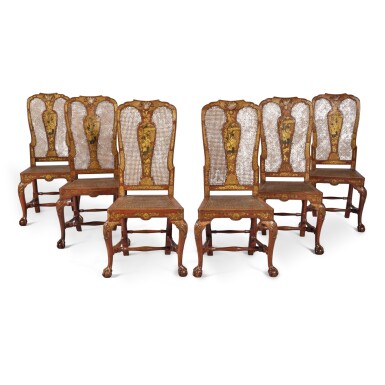
A Set of Six George II Gilt and Scarlet Japanned Side Chairs Attributed to Giles Grendey, Circa 1730
Auction Closed
June 18, 08:33 PM GMT
Estimate
30,000 - 50,000 USD
Lot Details
Description
decorated throughout with gold chinoiserie scenes on a scarlet japanned ground with figures and floral motifs, the vase-shaped splat and tapering caned seat standing upon cabriole front legs terminating in ball and claw feet united by stretchers connecting the back legs
height 44 in.; width 19 ¼ in.; depth 20 in.
111.8 cm; 48.9 cm; 50.8 cm
Private Collection, London;
Rolleston, London
The influence of the East on European culture cannot be overstated. The taste in England for all things 'Indian' (that is, Chinese), became firmly established after the restoration of the monarchy in the 1660s at a time when tea-drinking became extremely fashionable in London. Goods including silk, porcelain, tea, spices and lacquerware were initially supplied by Portuguese traders who held a virtual monopoly of trade with China until the end of the 17th century. The Dutch traders were a little more successful than the English in circumventing by nefarious means this monopoly, both countries trading with Chinese merchants in Formosa and at Bantam in Java.
Demand quickly outstripped supply in the early part of the 18th century, which was significantly curtailed during the Spanish War of Succession (1702-1713). London joiners profited immensely from a thriving local trade which arose in England with wares that were decorated to imitate oriental lacquer. The methods used by the English proponents of this art were outlined in a book published in 1688 by John Stalker and George Parker entitled A Treatise of Japanning and Varnishing Being a compleat Discovery of those Arts with The best way of making all sorts of Varnish for Japan Wood...The Method of Gilding, Burnishing and Lacquering..... The volume also included 'Above an Hundred distinct Patterns for Japan-work in Imitation of the Indians, for Tables, Stands, Frames, Cabinets, Boxes, &c.'. Although dated several decades after Stalker and Parker's publication, the influence of the Treatise on the present chairs is clear and the decoration draws heavily on a fascinating series of plates illustrating Oriental scenes, pursuits, flowers, trees, birds, animals and butterflies.
Foremost amongst the London cabinet-makers of the 18th century espousing this taste was Giles Grendey of Clerkenwell (1693-1780) whose large and prolific workshop catered for the strong demand both domestically and abroad for furniture in this manner. It is very possible, with their caned backs and seats, that the current chairs were made for export where caned furniture remained a popular feature into the 1740s, particularly on the Iberian peninsula. Arguably Grendey's most celebrated commission was a large set of scarlet and gold japanned furniture comprising over seventy-seven items, including at least fifty side chairs similar to the present set, supplied to the Duke of Infantado at Lazcano Castle, northern Spain. The suite was largely dispersed beginning in the 1930s and several chairs are now in public collections, including a side chair in the Metropolitan Museum, New York (37.115), and six side chairs and two armchairs at Temple Newsam House, Leeds.1
A similarly conceived pair of chairs, though green and gilt-japanned, is in the collection of Colonial Williamsburg.2 A set of six chairs with more elaborate crestings and higher backs denoting a slightly earlier date are illustrated by Partridge Fine Arts in their 1988 Summer Exhibition catalogue, no.10, p.30-32 whilst a black-japanned example is illustrated in Bowett's Early Georgian Furniture.3
1 C. Gilbert, Furniture at Temple Newsam House and Lotherton Hall, Leeds, 1978, vol. I, no.61, p.79-81; one armchair illustrated in A. Bowett, Early Georgian Furniture 1715-1740, Woodbridge 2009, p.36, plate 1:26.
2 Illustrated in H. Huth, Lacquer of the West (Chicago 1971), figs. 88-89.
3 A. Bowett, op. cit., p.158, pl. 4:29.
You May Also Like


