
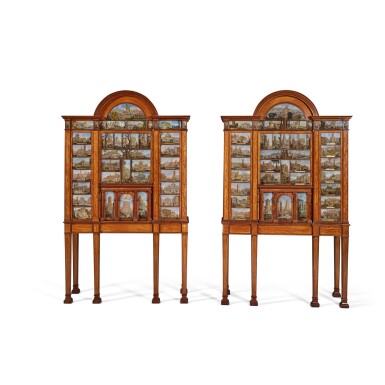
A Pair of George III Satinwood, Amaranth, Mahogany and Italian Painted Glass Cabinet on Stands, late 18th Century
No reserve
Auction Closed
October 15, 06:30 PM GMT
Estimate
100,000 - 150,000 USD
Lot Details
Description
the arched façades mounted with Italian painted glass panels depicting Roman, Neapolitan and Venetian vedute and classical and architectural capricci including wonders of the ancient world, with a central door opening to a cupboard with two shelves; the sides with doors opening to an arrangement of six mahogany-lined drawers; on later tapering square legs with concave moulded block feet
height 81 1/4 in.; width 49 in.; depth 18 3/4 in.
206.5 cm; 124.5 cm; 47.5 cm
Captain E.G. Spencer-Churchill (1876-1964), Northwick Park, Blockley, Gloucestershire;
Christie's House Sale, 28-30 September 1964, lot 127 (with later oak chest of drawers bases);
Christie's London, 30 June 1977, lot 153;
John Keil, London;
Ann and Gordon Getty Collection, Wheatland, California, acquired 1978;
Christie's New York, 19 October 2023, lot 209.
London, The Grosvenor House Antiques Fair, 14-24 June 1978, John Keil Ltd. Stand 46; illustrated in the exhibition catalogue
Cabinets decorated with painted glass panels were first documented in Naples during the 17th century, and like similar cabinets mounted in other precious material such as tortoiseshell, ivory and pietre dure, this type of furniture could serve a useful storage function for documents, currency and collected objects but also reflected the wealth and status of its owners and was prominently placed in formal reception rooms. Such cabinets were particularly popular in Spain, like the Kingdom of Naples part of the Habsburg dominions at the time, but they also appealed to Northern Europeans including English collectors on their Grand Tour, like Sir Thomas Isham, 3rd Bt (1657-1681).
The early history of the cabinets is unknown, but the high quality of workmanship and use of expensive tropical woods like satinwood and amaranth would suggest they were made by one of the important London workshops, and their simple architectonic form has invited comparisons with the Kimbolton Cabinet, mounted with Florentine pietre dure panels and commissioned in 1771 by Elizabeth, Duchess of Manchester (1730-1832) to designs by Robert Adam and executed by the firm of Ince & Mayhew (now in the Victoria & Albert Museum W.43:1,2-1949). The pair was formerly in the collection of Northwick Park, Gloucestershire, a Jacobean house with William & Mary, Palladian and early 19th century extensions acquired by Sir James Rushout, 1st Baronet (1644-1698) in 1683, and descended in the Rushout family until inherited by Captain Edward George Spencer-Churchill (1876-1964), a cousin of Winston Churchill and grandson of the widow of George Rushout, 3rd Baron Northwick.
You May Also Like


