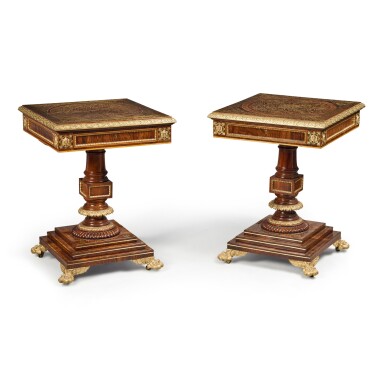
A Pair of Regency Gilt Bronze Mounted and Brass-Inlaid Indian Rosewood Occassional Tables, Circa 1815
No reserve
Auction Closed
October 15, 06:30 PM GMT
Estimate
60,000 - 100,000 USD
Lot Details
Description
each of square form with frieze drawer on a turned baluster column with gadrooned base raised on a stepped plinth on winged paw bronze feet with castors; the tops inlaid in première and contre partie
height 29 1/2 in.; width 22 1/2 in.
75 cm; 57 cm
Possibly supplied to Henry Nevill, 2nd Earl of Abergavenny (d.1843) for Eridge Castle, Sussex in the early 19th century, or alternatively acquired by Guy Larnach-Nevill, 4th Marquess of Abergavenny (d.1954) for Eridge Place, East Sussex circa 1938;
Christie’s London, 18 November 1993, lot 170;
Ann and Gordon Getty, San Francisco;
Christie’s New York, The Ann & Gordon Getty Collection: Volume 4, 23 October 2022, lot 564.
C. Hussey, ‘Eridge Park, Sussex – II’, Country Life, 30 September 1965, p. 819, fig. 4.
The brass inlay of these richly ornamented tables would have been perceived by Regency eyes as romantically, even nostalgically historical. For perspective, these tables were made around 1815, at which point the ascension of Louis XIV to the French throne was over 160 years in the past, and in the meantime European society had been irreversibly changed by the French Revolution and Napoleonic Wars. The same chronological distance of 160 years separates the current date from the mid-Victorian period. This is the feeling that underpinned the revival of elaborate ‘Boulle’ inlay in furniture, so named after Royal Cabinetmaker to Louis XIV André-Charles Boulle (1642–1732), the master of the technique. To the Prince of Wales (later George IV), this style of ornament expressed the grandeur and stability of an absolutist golden age for France that was a far cry from the constitutional monarchy he was to lead.
The taste for Boulle furniture filtered down from the top, and cabinetmakers in Britain were soon creating excellent ‘Buhl’ pieces to satisfy demand. The leading makers included Thomas Parker, who made pieces for royal residences including Windsor Castle, John McLean, and particularly Louis Le Gaigneur (fl.c.1814-21). A French émigré recorded as having a shop in Marylebone from 1814-15, his high-quality pieces are rarely recorded or marked; however, the few extant signed examples in the Royal Collection (RCIN 35289) and with Brighton Borough Council1 show that his interpretation of the Louis XIV style was creatively individual, with clear assimilation of the latest Regency fashions.
An attribution to Louis Le Gaigneur is strengthened by the very similar pattern of marquetry on the top of a different table attributed to him formerly with Norman Adams.2 Indeed, the marquetry is identical aside from the centre of the panel, which depicts dancing figures under a canopy in the Jean Bérain manner popular during the Louis XIV period. In addition, the Norman Adams example features a closely similar guilloche gilt-bronze border to the present example. A table with a description closely matching the present model sold Christie’s London, 8 February 1951, lot 131 (not illustrated in the catalogue).
Two pairs of tables of this form are discernable in a photo of Eridge Park in Country Life that was shot in 1965.3 Eridge Park underwent a period of significant renovation during the Regency under Henry Nevill, 2nd Earl of Abergavenny (1755–1843), but it is also possible these tables entered the house after it was rebuilt in the Neo-Georgian style after 1938. They later formed part of the exceptional collection of Ann and Gordon Getty in San Francisco.
1 C. Gilbert, Pictorial Dictionary of Marked English Furniture 1700–1840, Leeds 1996, p.304-5.
2 C. C. Stevens and S. Whittington, 18th Century English Furniture; The Norman Adams Collection, Woodbridge 1994 rev. ed., p.304.
3 C. Hussey, ‘Eridge Park, Sussex – II’, Country Life, 30 September 1965, p. 819, fig. 4.
You May Also Like