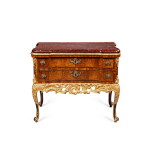
A George III Gilt-Bronze Mounted Padouk Serpentine Commode attributed to John Cobb, Circa 1760
No reserve
Auction Closed
October 15, 06:30 PM GMT
Estimate
30,000 - 50,000 USD
Lot Details
Description
the top with moulded edge above three graduated mahogany-lined drawers and a serpentine apron, on splayed feet; sides with carrying handles; handles and escutcheons later
height 34 3/4 in; width 44 in.; depth 26 in.
88 cm; 111.5 cm; 66 cm
With Dick Turpin, London;
Christie’s London, The Legend of Dick Turpin Part I, 9 March 2006, lot 150.
Though the overall form of this commode is a familiar one, this commode is actually quite an unusual example of its type for a few reasons. The shape is typical for English commodes in the ‘French’ manner, taking inspiration from the latest fashions across the Channel with its flat-edged serpentine angles, splayed feet and shaped apron. The use of gilt metal mounts is also classically French, with some English examples including them in a greater profusion, but the present lot restricting itself to the feet cappings known as sabots (literally ‘clogs’ or ‘hooves’). The furniture makers most associated with commodes in this style are John Cobb, who was taken to court in 1772 for smuggling French furniture into England,1 and Henry Hill of Marlborough. The present lot’s detailed brass handles depicting laurel leaves are very similar to those on a commode made by John Cobb for Alscot Park in Warwickshire.2
This commode, however, is notable in its use of padouk instead of the more typical mahogany. Much like mahogany, padouk was a hardwood with attractive patterns to its grain that made it desirable for wooden furniture, and was not native to Europe. While mahogany was shipped from Central America, padouk had to be shipped from South East Asia, with this long trade route rendering the timber all the more precious.
The other unexpected feature of the present commode is the geometric arrangement of its veneers. This arrangement of veneers is known as frisage in French, and is a consistent characteristic of much of the richly veneered furniture of the Louis XV period. Often the frisage places the veneers on the diagonal to form diamond shapes, a style called en carré or en losange (‘square’ or ‘lozenge-form’) when they form a closed square and en fougère (fern-form) when they create an open X-shape. The continual repetition of the rectangular veneer arrangement means that examples of frisages en carré and frisages en fougère attractively alternate across the drawers, and are echoed by larger book-matched examples of the same style of frisage on the sides and the top. This is a surprising sight on an English piece, with most instances of decorative frisage marquetry being found on the work of the French émigré craftsman Pierre Langlois3 and on very occasional instances of commodes that employ the popular exotic timber kingwood that was popular in France.4 One would more typically expect drawer fronts to be veneered with one piece of mahogany, sometimes all from the plank so that the grain looks unified.
1 ‘Cobb, John (1715–1778)’, BIFMO, 21 September 2022. Available at: <https://bifmo.furniturehistorysociety.org/entry/cobb-john-1715-78> [accessed 23 July 2025]
2 Pictured in L. Wood, Catalogue of Commodes, London 1994, p.51, fig.35.
3 Important Pierre Langlois commodes, for instance, include one in the Royal Collection (RCIN 2549) with two doors centred by a frisage en carré, while another in the V&A (W.8:1 to 4-1967) has a central marquetry panel on a frisage en fougère ground.
4 English commodes using kingwood as the principal wood (and not only for cross-banding) are exceptionally rare and will all employ overtly French frisage. Examples at auction include Sotheby’s London, 9 September 2020, lot 48; Sotheby’s London, 8 July 1994, lot 90; Sotheby’s London, 7 May 1993, lot 149
You May Also Like