Property From A Private Belgian Collection
Jean Degottex
Suite Rose-Noir (XVII)
Lot Closed
June 7, 01:09 PM GMT
Estimate
40,000 - 60,000 EUR
Lot Details
Description
Jean Degottex
1918-1988
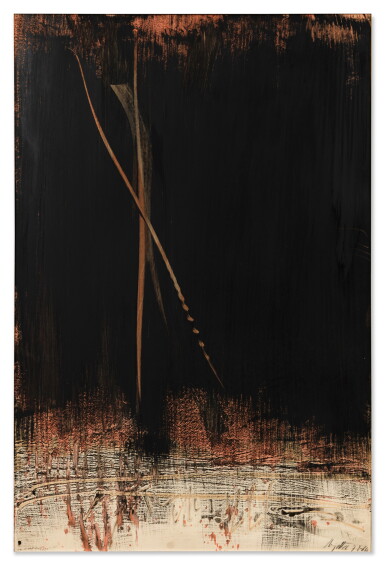
Suite Rose-Noir (XVII)
signed and dated 7.8.64 ; signed, titled and dated 7.8.64 on the backing board
oil on cardboard mounted on cardboard
120 x 80 cm ; 47 1/4 x 31 1/2 in.
Executed in 1964.
A certificate of inclusion in the forthcoming Catalogue Raisonné established by the Mr. Dominique Bollinger in the name of the Comité Jean Degottex will be delivered to the buyer.
_________________________________________________________
Jean Degottex
1918-1988
Suite Rose-Noir (XVII)
signé et daté 7.8.64 ; signé, titré et daté 7.8.64 sur le panneau de dos
huile sur carton monté sur carton
120 x 80 cm ; 47 1/4 x 31 1/2 in.
Exécuté 1964.
Un certificat d'inclusion au Catalogue Raisonné actuellement en préparation délivré par Monsieur Dominique Bollinger au nom du Comité Jean Degottex sera remis à l'acquéreur.
Private Collection, Belgium
Thence by descent to the present owner
________________________________________
Collection Particulière, Belgique
Par descendance jusqu'au propriétaire actuel
Jean Frémon, Degottex, Paris, 1986, p. 133 and 286, illustrated
_________________________________________________________
Jean Frémon, Degottex, Paris, 1986, p. 133 and 286, illustré
Suite Rose-Noir (XVII) attests to a year of despair and isolation in the artist's life. This work belongs to a series that was initiated in 1964, in the aftermath of a tragic event that will have an enormous impact on the artist throughout the 1960s. In 1963 his daughter Frederique dies in a car accident. Consequently, a succession of Xs appear in Degottex's paintings. The X that encompasses the composition is not only evocative of the death of his daughter, but also attests to the artist's profound anger. On the verge of suicide, Degottex adopts a violent gesture. The spontaneity of the line, which almost seems to lacerate the surface of the canvas, evokes the artist’s never ceasing suffering and torment.
"One day, he got up and traced, with a black felt pen against the heavy white door of the studio, an X followed by a question mark. This X, the unknown, the mystery, embodying not the revolt but the amazement, the incredulity in the face of emptiness, he kept it on display until the demolition of his workshop, twenty years later " (Maurice Benhamou, Jean Degottex, FAGE, 2009, p.16)
If the composition is invaded by darkness, the artist integrates however light touches of color. The title of the work refers in particular to the bursts of pink that appear at the ends of the canvas. As Robert Calle points out "Something of the rose remains in the memory of the painter, passes through the use he makes of its color: the tender glow of the rose pierces in spots or in line, over time, and from far away, in the work, as a reminder a tribute to the supreme beauty of the flower, to the perfect creation, unsurpassed by Nature" (Robert Calle, Degottex Signes et Métasignes 1954-1967, Carré d'art, 1992, p.9).
The notion of space is also a key to understanding Degottex's work. The drips on the verge of the lower part of the painting attest to a desire to transcend the canvas. This overflow allows the observer to feel immersed in the composition. "The gesture created its own space and radically and materially modified the preconceived space" (Text by Jean Degottex, Paris, April 1961.)
_________________________________________________________
Suite Rose-Noir (XVII) atteste d’une année de désespoir et d’isolement dans la vie de l’artiste. Cette œuvre appartenant à une série entamée en 1964, est réalisée au lendemain d’un évènement tragique qui marquera l’artiste tout le long des années 60. En 1963 sa fille Frédérique décède dans un accident de voiture. C’est alors qu’une succession de X font leur apparition dans les toiles de Degottex. Le X qui surplombe la composition est non seulement évocateur de la mort de sa fille, mais atteste également de la colère éprouvée par l’artiste face à ce drame. Au bord du suicide, Degottex adopte un geste violent. L’élan du tracé allant jusqu’à lacérer la surface de la toile fait songer à la profonde souffrance qui ne cesse de tourmenter l’artiste.
« Une fois, il se leva et traça, au feutre noir contre la lourde porte blanche de l’atelier, un X suivi d’un point d’interrogation. Ce X, l’inconnu, le mystère, marquant non point la révolte mais la stupéfaction, l’incrédulité devant la béance, il le garda sous les yeux jusqu’à la démolition de son atelier, vingt ans plus tard » (Maurice Benhamou, Jean Degottex, FAGE, 2009, p.16)
Si la composition semble plongée dans l’obscurité, l’artiste y intègre néanmoins certaines nuances de couleurs. Le titre de l’œuvre renvoie notamment aux éclats de rose qui figurent aux extrémités de la toile. Comme le souligne Robert Calle « Quelque chose de la rose subsiste dans la mémoire du peintre, passe à travers l’emploi qu’il fait de sa couleur : l’éclat tendre du rose perce en taches ou en tracé, au cours du temps, et de loin en loin, dans l’œuvre, comme un rappel un hommage à la beauté suprême de la fleur, à la création parfaite, insurpassable de la Nature » (Robert Calle, Degottex Signes et Métasignes 1954-1967, Carré d’art, 1992, p.9).
La notion d’espace est également un élément clé dans la compréhension de l’œuvre de Degottex. L’écoulement au niveau de la partie basse de la peinture atteste d’une volonté de sortir de la toile. Ce dépassement permet à l’observateur de se sentir immerger au sein de la composition. « Le geste créait son propre espace et modifiait radicalement et matériellement l'espace préconçu » (Texte de Jean Degottex, Paris, Avril 1961.)
You May Also Like