
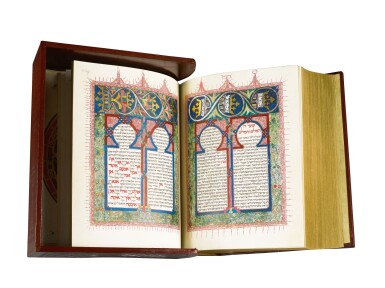
The Kennicott Bible with Accompanying Commentary Volume, London: Facsimile Editions, 1985
Lot Closed
June 27, 02:16 PM GMT
Estimate
5,000 - 7,000 USD
Lot Details
Description
Limited facsimile edition—number 181 of 550 copies stamped and signed by the publisher—of “the most lavishly illuminated Hebrew Bible to have survived from medieval Spain.”
The Kennicott Bible takes its name from Benjamin Kennicott (1718-1783), the Oxford canon who acquired this exquisite manuscript from the Earl of Panmure and subsequently, in April 1771, sold it to Oxford’s Radcliffe Library, which then transferred it to the Bodleian Library in 1872. The book, which includes the text of both the entire Hebrew Bible and Rabbi David Kimhi’s (1160-1235) popular grammatical treatise Sefer mikhlol, was produced over the course of about ten months by the master scribe, vocalizer, and masorator Moses ben Jacob Ibn Zabara in collaboration with the illuminator and illustrator Joseph Ibn Hayyim. It was completed in the northwestern Spanish city of La Coruña in 1476 on behalf of Isaac ben Don Solomon di Braga, who apparently took it with him into exile after the Spanish expulsion of 1492.
Not only is Ibn Zabara’s text bold and clear, with the micrographic Masorah periodically inscribed in geometric patterns, but Ibn Hayyim’s playful (even humorous), colorful, and intricate artistic program—inspired by that of the famed Cervera Bible, as well as by Islamic, Christian, and secular motifs—bears elegant witness to the multiculturalism of pre-expulsion Spain. The present sumptuous facsimile edition represents the culmination of five-and-a-half years of exacting efforts by Michael and Linda Falter to produce a work of “unparalleled consummate beauty.” It is accompanied by a commentary volume coauthored by Bezalel Narkiss and Aliza Cohen-Mushlin, both of the Center for Jewish Art at the Hebrew University of Jerusalem, analyzing paleographical, codicological, and art-historical aspects of the book hailed by experts as “the finest illuminated Hebrew manuscript in existence.”
Physical Description
Facsimile Volume: 460 folios (approx. 11 1/2 x 8 3/4 in.; 292 x 222 mm) (modern foliation: 1-17, 17a, 18-143, 143a, 144-151, 151a, 152-266, 266a, 267-281, 281a, 282-332, 332a, 333-412, 412a, 413-453) printed by offset lithography (in up to eleven colors) on specially milled Italian, 160-gsm, neutral pH “vegetable parchment” paper, each leaf’s opacity, feel, and thickness almost matching that of the original manuscript; 238 (of the total 922) pages illuminated with lively colors, burnished gold, and silver leaf applied by hand; twenty-four canonical book headings; forty-nine parashah headings structured with gold in different motifs featuring zoomorphic figures in many colors; twenty-seven lavishly illuminated arcaded pages framing the text of the Sefer mikhlol; nine fully illuminated carpet pages; 150 psalm headings, numbered and illuminated with gold and silver. Fine Italian morocco goatskin box-binding over specially prepared boards, lightly worn; minutely detailed interlacing geometric designs in Hispano-Moresque style on all six sides embossed with hand-cut brass dies; spine in seven compartments with raised bands; hand-sewn head- and tail-bands; the facsimile number (181) blind-stamped by hand on the inside of the back cover using minute steel dies; facsimile edges gilt with 24-carat gold leaf. With four annexed sample facsimile folios (ff. 5, 7, 10, 29) and two annexed blanks decorated with borders taken from f. 8v and intended for inscription of family records.
Commentary Volume: 97 pages (12 1/4 x 9 3/4 in.; 310 x 250 mm) printed on mould-made, cold-pressed Magnani 160-gsm paper, plus an unbound limitation slip stamped and signed by Michael Falter, the paper somewhat foxed. Bound in blind-tooled fine morocco goatskin, lightly worn; title stamped in blind on upper board; blind-tooled spine in seven compartments with raised bands; paper edges deckled.
Facsimile and Commentary Volumes enclosed in a blue cloth, velvet-lined presentation portfolio box, scuffed, stained, and threadbare in places; clasp on fore-edge damaged and threadbare; title stamped in blind on upper board.
Literature
Leila Avrin, “Art for the Masses: Hebrew Facsimile Publishing,” Antiquarian Bookman 77,15 (April 21, 1986): 1807-1812, at p. 1812.
Leila Avrin, “Illuminated Hebrew Manuscript Facsimiles,” Ars Orientalis 20 (1990): 189-195.
Cecil Roth, “A Masterpiece of Medieval Spanish-Jewish Art: The Kennicott Bible,” Sefarad 12,2 (1952): 351-368.
Yael Zirlin, “Review of The Kennicott Bible,” Jewish Art 12-13 (1986-1987): 355-356.
Facsimile Editions Website (https://facsimile-editions.com/kb/)
MS Oxford, Bodleian Library, Kennicott 1 (https://iiif.bodleian.ox.ac.uk/iiif/viewer/5e43568d-e01e-444c-870f-485b90b25b5c#?c=0&m=0&s=0&cv=0&r=0&xywh=-4093%2C0%2C14219%2C7385)
You May Also Like

![Christian Zervos I Pablo Picasso. Œuvres de 1895 à [1972], 1949-1978, 33 volumes in 34, a fine set of the Picasso catalogue raisonné](https://sothebys-md.brightspotcdn.com/dims4/default/06933b3/2147483647/strip/true/crop/5248x6618+0+0/resize/150x189!/quality/90/?url=http%3A%2F%2Fsothebys-brightspot.s3.amazonaws.com%2Fmedia-desk%2F3f%2Fde%2F6099508648ca893ef15bb2391c55%2Fl26402-dlds8-t2-03.jpg)
![[Bible, Polyglot] | A full set of the Complutensian Polyglot, the first polyglot bible](https://sothebys-md.brightspotcdn.com/dims4/default/5ebde0c/2147483647/strip/true/crop/2000x2000+0+0/resize/150x150!/quality/90/?url=http%3A%2F%2Fsothebys-brightspot.s3.amazonaws.com%2Fmedia-desk%2Fwebnative%2Fimages%2Fdf%2F4b%2F95d871d94bf0af4de7339860e50a%2Fn12191-dlyr7-t1-11.jpg)


