
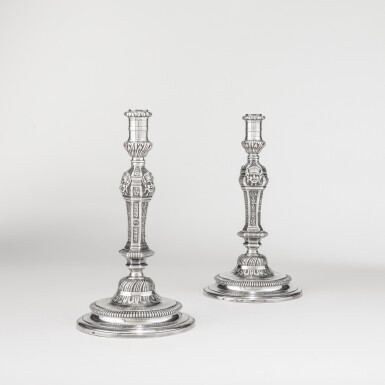
A pair of French silver candlesticks, the widow Pétronille Tiron, Lille, 1736-1737
No reserve
Auction Closed
November 6, 07:36 PM GMT
Estimate
8,000 - 12,000 EUR
Lot Details
Description
leaf-capped waisted sconces, the shaped triangular columns capped with masks depicting King Midas, above alternating husked and foliate panels, knopped hexafoil girdles, on gadrooned and banded lobed spreading circular bases engraved with coat-of-arms, fully marked,
24cm, 9½in.
1120gr., 36oz
CANDELABRA BY TIRON
This pair of candelabra is marked for Pétronille-Thérèse Pacot, daughter of the renowned silversmith Elie Pacot, whose work is also featured in this sale (see lot 36). Following tradition, as the daughter of a silversmith, she married another silversmith, Pierre Tiron, in 1707. Tiron, originally from Paris, trained under the silversmith Rougemont but later moved to Lille, where he received his master’s status “by recommendation of Prince Eugene and other foreign powers.” Whether this privilege stemmed from his father-in-law’s strong connections with Lille’s occupiers or his Parisian network remains unknown. Tiron introduced the innovative Régence style to Lille, influencing his father-in-law’s work. He died in the 1730s, leaving Pétronille to take over the workshop. Widows could continue running a workshop by adopting their late husband’s hallmark and adding a “V” for widow.
This pair of candelabra features Régence-style decoration, somewhat late for 1736, incorporating the rare motif of Midas masks with large ears. The earliest examples of candelabra with this decoration appeared in Paris around 1706. One of the first was crafted by Louis Duperier, a friend of Jean-François Tiron, Pierre’s brother, explaining the motif’s presence in Lille. The design draws from the ancient myth of King Midas, who, favoring Pan’s flute over Apollo’s lyre, was punished by the god with donkey ears. He hid them under a hat, which the god Echo later blew away, revealing his shame.
Pétronille used this Midas mask motif at least two other times: on a pair of candelabra from the same year, held at the Louvre Museum (inv. OA9683), and on another pair at the Hermitage Museum in Saint Petersburg.
Interestingly, these same Midas heads appear on another piece in the collection, a magnificent silver pot-à-oille marked for Thomas Farren, London, 1726, engraved with royal arms (lot 58). This suggests that Huguenot silversmiths brought their decorative vocabulary with them during their exile to England from 1685 onward, where it was appreciated by English patrons, including the king himself.
You May Also Like


