Cartier, New York
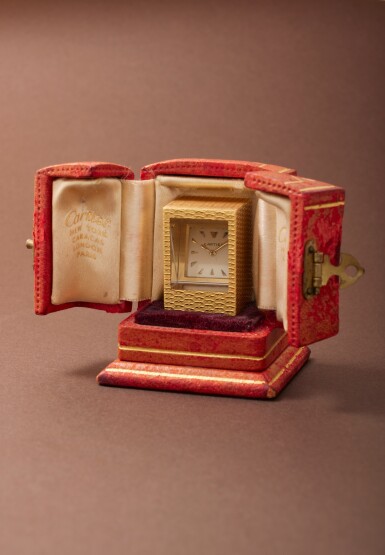
A fine and unusual yellow gold miniature prism mystery clock with fitted presentation box, Circa 1950s
Auction Closed
June 15, 08:08 PM GMT
Estimate
15,000 - 30,000 USD
Lot Details
Description
Dial: silvered dial with applied gold faceted indexes, gold hands
Caliber: European Watch and Clock Co. Inc. mechanical, 15 jewels
Movement number: 917'410
Case: 18k yellow gold rectangular case with engine-turned decoration, polished bezel, rock crystal prism, winding crown to base, base secured by four gold screws to case sides monogramed JMF, base signed Cartier and marked 18k
Case number: outer base engraved 1'265, 400, 003, and 18k, inside base stamped 8, movement holder stamped 553'278 on the outside and inside with Le Coultre & Cie. maker's mark, inside walls of the prism stamped 8 and 278
Size: 28 x 18 x 18 mm
Signed: case with Le Coultre & Cie. maker's mark and signed European Watch and Clock Co. Inc., movement signed European Watch and Clock Co. Inc., dial signed Cartier
Box: yes
Papers: no
Accessories: Cartier red Moroccan leather fitted presentation box with gold tooled decoration, inside printed 'NEW YORK CARACAS LONDON PARIS'
A part of Cartier's Pendule Mystérieuse family, Cartier's mystery prism clock works on the principles of an underwater periscope by employing two carved rock crystal prisms to reflect and refract light. Like the Mystery Clocks and earlier Comet clocks, it relied on illusion to captivate its audience, though its mechanism was fundamentally distinct. While the Mystery Clocks used transparent rock crystal discs to create the impression of floating hands, the prism clock employed a carefully arranged system of internal mirrors to project a concealed dial. Viewed from the front, the clock clearly displays the time, using a series of mirrors to project the hidden dial into the viewer’s line of sight. From the back, however, it reveals its illusion—appearing entirely transparent, with no visible indication of a timekeeping mechanism.
The mechanism was invented by Gaston Cusin, and the patent (no. 827'259) for the prism clock was delivered on 4 January 1937. Born in 1897, Cusin was a talented and inventive watchmaker who made his first clock at the age of 14. Cusin joined Maurice Coüet’s workshop, when the Cartier affiliated atelier relocated to Paris’s rue Lafayette in 1919. The ability of the mystery clocks to delight with its seemingly magical illusion, and refined craftsmanship exemplifies the groundbreaking innovation of Cartier’s horological mastery.
The marks on the base of the present clock indicate that it was retailed in Cartier's New York flagship, and this is further confirmed by the original leather presentation box with NEW YORK being the first location printed on its satin lining. The presentation box further marks an interesting chapter in Cartier's history with the inclusion of CARACAS in the list of iconic flagships just under New York. This inclusion speaks to the Maison’s engagement with a well-traveled North American clientele and acknowledges the significance of the Caracas boutique, which opened in the 1950s as Cartier’s first boutique in South America during Venezuela’s golden era.