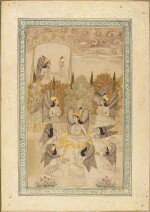

A gathering of angels on a terrace, possibly an illustration of a Falnama subject, India, Deccan, Golconda or Bidar, early 18th century
Auction Closed
April 24, 03:45 PM GMT
Estimate
12,000 - 18,000 GBP
Lot Details
Description
ink drawing on paper with use of colours and gold, mounted on an album page with borders of green and cream paper decorated with meandering floral motifs in gold
drawing: 28.2 by 17cm.
leaf: 36.8 by 26.8cm.
Sotheby’s, London, 11 July 1973, lot 42
The composition of this scene consists of a principal angel seated on a throne on a terrace, with further angels kneeling in devotion or offering refreshments, while two standing angels hold peacocks. In a pavilion behind a screen of bushes a young male figure sits with another angel. The scene is somewhat unusual and distinctive and may relate to a Falnama subject.
There are two texts in the Falnama (Book of Omens or Book of Divination) which in illustrated versions have iconography similar to that of the present drawing. Both describe aspects of Paradise and both are highly auspicious omens. In one, a principal angel is seated on a central throne with other angels ministering and offering refreshments (see e.g. Farhad and Bagci 2009, no.57, pp.194-5, and p.298, folio 13a), while in the other, Imam 'Ali is included in the scene with the angels in Paradise (Farhad and Bagci op.cit., p.292, folio 55b). The presence of the male figure in the pavilion in the present drawing may refer to Imam 'Ali, although the absence of a halo or other indication of sanctity might suggest otherwise. That Falnama illustrations were being produced in the Deccan at this period is attested by the important seventeenth century Golconda manuscript of the Falnama in the Nasser D. Khalili Collection, in which the first of the omens described above is illustrated with closely related iconography (MS. 979, see Leach 1998, p.225, f.30b, described as 'The Queen of the Peris in Paradise', see also Parikh 2022).
The style of the present drawing points to Golconda or perhaps Bidar in the first quarter of the eighteenth century. Stylistically related works are illustrated in Zebrowski 1983, nos.195-9, pp.224-6.
You May Also Like


