
From a pied-à-terre, avenue Montaigne
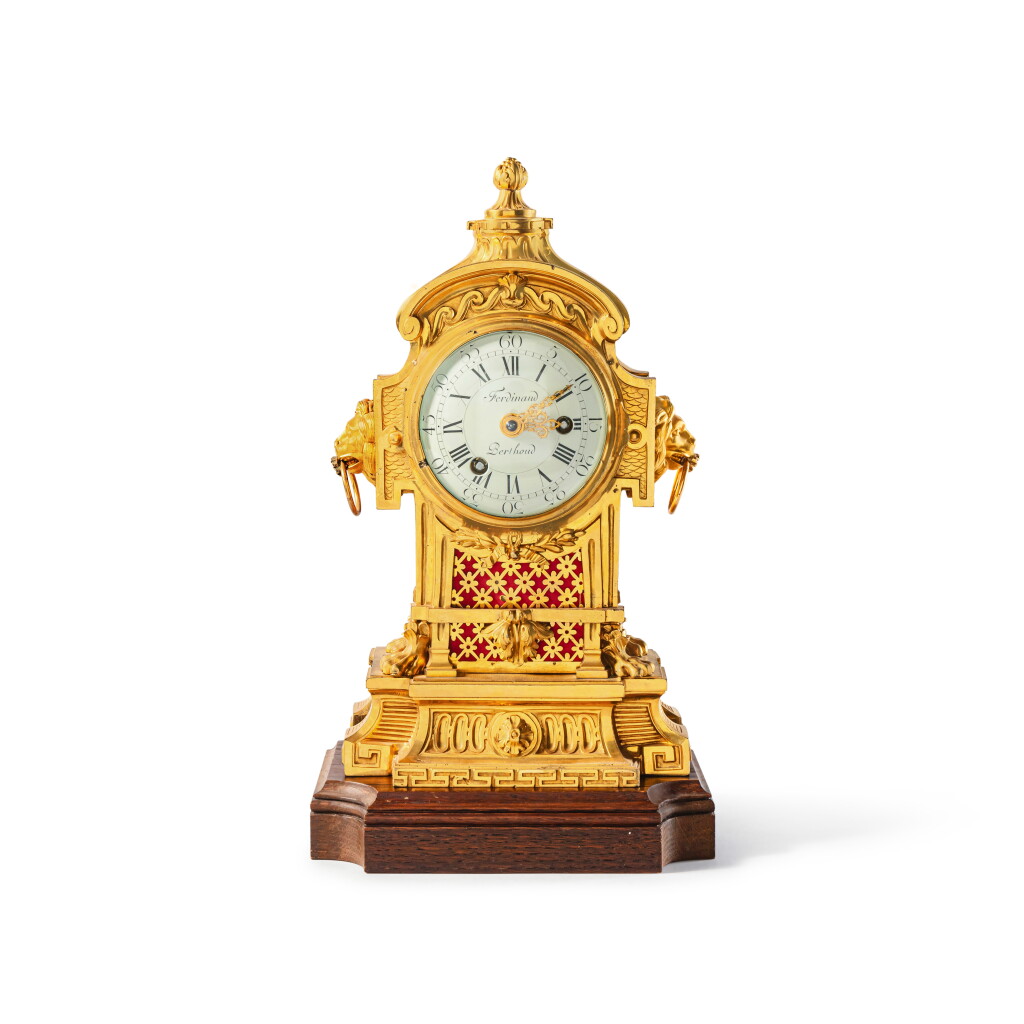
A Louis XVI gilt-bronze mantel clock, circa 1770
Lot Closed
September 23, 12:18 PM GMT
Estimate
6,000 - 10,000 EUR
We may charge or debit your saved payment method subject to the terms set out in our Conditions of Business for Buyers.
Read more.Lot Details
Description
the sides mounted with lion's masks ring handles, the case decorated with simulated scales, scattered flowers, and lions' paws, set on a base with Greek key motifs and scuff plates, on a rouge griotte marble base, the white enamel dial signed Ferdinand Berthoud
Haut. 37 cm, larg. 20 cm ; Height 14 1/2 in, width 8 in
Related literature
P. Kjellberg, Encyclopédie de la pendule française du Moyen Age au XXe siècle, Paris, 1997, p.188, fig E.
Ferdinand Barthoud, received master in 1754.
Considered one of the leading Parisian watchmakers of the second half of the 18th century and the early 19th century, Berthoud is renowned for his decisive role in precision watchmaking. After learning his trade in his brother's workshop, he began working as an independent craftsman in 1745 and obtained his master's certificate in December 1753. In 1764, his career took a decisive turn when he was appointed ‘clockmaker-mechanic to the king and the navy’. From then on, he concentrated his research on marine chronometry and developed clocks and watches for the ships of the royal fleet.
The author of reference works on the art of watchmaking, he enjoyed great official recognition: Louis XVI showed his esteem for him by purchasing all his tools and parts for 30,000 livres. For his clocks, Berthoud collaborated with the greatest bronze casters and engravers of his time, including Caffieri, Martincourt, Osmond, Saint-Germain and Gouthière.
Today, his creations are among the masterpieces of the most prestigious international collections, including the Victoria and Albert Museum in London, the Metropolitan Museum of Art in New York, the Louvre Museum in Paris and the Pavlovsk Palace in Saint Petersburg.
This clock is characteristic of the ‘Greek taste’. Appearing in the 1750s, it responded to critics who, denouncing the extravagances of Rococo, aspired to rediscover the ‘noble simplicity’ of the masters of Antiquity. In December 1754, the publication in the Mercure de France of a "supplication aux orfèvres, Ciseleurs, sculpteurs en bois pour les appartements et autres [...] " by Louis-Sébastien Mercier, was a veritable plea for straight lines, respect for proportions and balance, and an urgent reminder of the nobility of the ancient ornamental repertoire.
Reusing the entire vocabulary of Greek taste (frieze of posts, Greek moldings, claw feet), this clock is a true homage to this style.
You May Also Like


