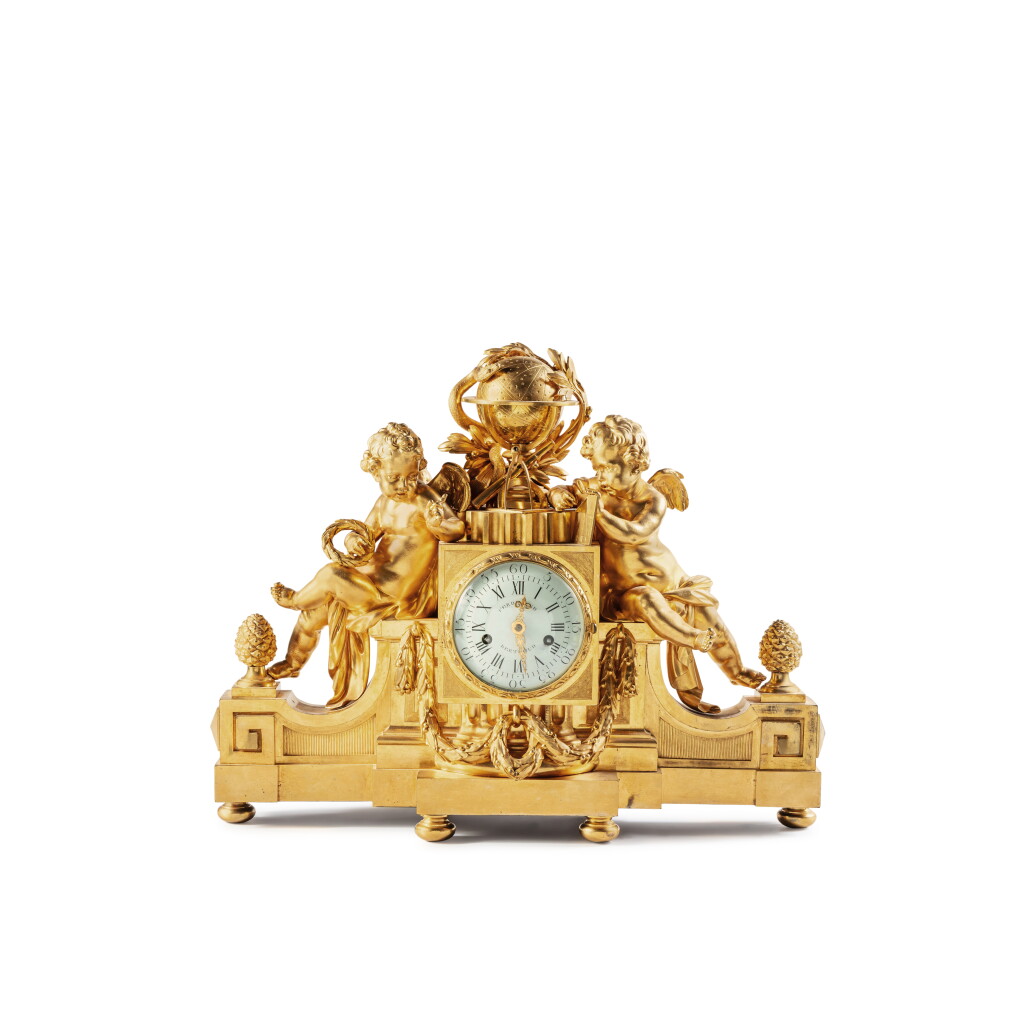
A A Louis XVI gilt-bronze striking mantel clock, circa 1785, the movement signed Ferdinand Berthoud
Lot Closed
September 23, 01:47 PM GMT
Estimate
15,000 - 25,000 EUR
We may charge or debit your saved payment method subject to the terms set out in our Conditions of Business for Buyers.
Read more.Lot Details
Description
the case with two putti representing Eloquence and Astronomy, surmounted by a sphere with a serpent, a branch, a book and various astronomical instruments, the white enamel Roman and Arabic dial signed FERDINAND BERTHOUD , the movement signed Ferdinand Berthoud A PARIS
Haut. 48 cm, larg. 56 cm, prof. 20 cm; Height 19 in, width 22 in, depth 8 in
Christie’s, Amsterdam, 13 December 2012, lot 727
Ferdinand Berthoud (1727–1807), clockmaker, received master in 1754.
Born in Switzerland in 1727, Ferdinand Berthoud settled in Paris, where he became a master watchmaker in 1754. Considered one of the greatest French watchmakers of the 18th century, he was appointed watchmaker to the king and inspector general of machines for the Navy in 1786.
A renowned specialist in marine clocks and clock mechanics, Berthoud was a member of many prestigious institutions, including the Royal Society of London (1764). He participated in the creation of a royal clockmaking factory in Paris (1786) and sat on the Temporary Arts Commission (1793). From 1766 onwards, he designed all the clocks and watches for the royal fleet, notably creating a clock for the King's Council Chamber at Versailles. He also wrote numerous scientific treatises and articles, contributing in particular to Diderot's Encyclopédie.
A similar model by Berthoud, decorated with putti in a similar style, is kept in the Frick Collection (see Ottomeyer & Pröschel, Vergoldete Bronzen, Munich, 1986, p. 171). Another very similar clock, representing Eloquence and Astronomy, with an openwork dial and a few decorative variations, is illustrated in Tardy, French Clocks the World Over, Paris, 1985, vol. II, p. 22.
You May Also Like