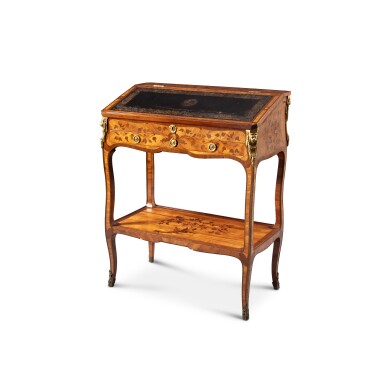
A Louis XV gilt-bronze mounted tulipwood, kingwood and amaranth veneered writing desk, circa 1750, stamped by Nicolas Petit
No reserve
Lot Closed
September 23, 12:24 PM GMT
Estimate
6,000 - 10,000 EUR
We may charge or debit your saved payment method subject to the terms set out in our Conditions of Business for Buyers.
Read more.Lot Details
Description
opening with one drawer, the hinged top opening with four drawers with an embossed leather top decorated with ducal coat-of-arms, stamped three times N.PETIT
Haut. 125 cm, larg. 99 cm, prof. 54 cm ; Height. 49 1/4 in, width. 39 in, depth. 21 1/4 in
Collection of the Counts of Stanhope and Chesterfield, according to the coat-of-arms stamped on the leather top, probably Philip Stanhope, 4th Earl of Chesterfield (1694–1773);
Maurice Segoura Gallery, Paris.
P. Kjellberg, Le Mobilier français du XVIIIe siècle, 1989, p. 644, fig. B
A. Droguet, Nicolas Petit, Paris, 2001, p. 33
Nicolas Petit, cabinetmaker, master in 1761.
Philip Stanhope, IVth Earl of Chesterfield, real name Philip Dormer Stanhope (1694-1773), British statesman, diplomat and man of letters, best known for his Letters to his Son and Letters to his Godson, a guide to manners, the art of pleasing and the art of succeeding in the world.
Philip Stanhope began his political career in 1728 as ambassador to Holland. Returning to England the same year, Chesterfield began a parliamentary career as a fervent opponent of Sir Robert Walpole. Despite his marital relationship with the King, he fell out of favor at court until he demonstrated his statesmanship during his short term (August 1745-April 1746) as Lord-Lieutenant of Ireland. After a term as Secretary of State (1746-48), he gradually withdrew from public life due to increasing deafness, although he was largely responsible for Britain's decision to adopt the Gregorian calendar in 1752.
Strongly influenced by the spirit of the Lumières period, he became friends with Voltaire in particular, and a number of Jean-Jacques Rousseau's ideas can be found in his various writings.
You May Also Like