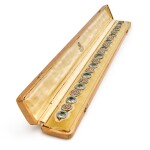
An emerald and diamond-set gold bazuband, formerly in the collection of Maharani Jindan Kaur, North India, first half 19th century
Auction Closed
October 26, 12:30 PM GMT
Estimate
120,000 - 150,000 GBP
Lot Details
Description
of typical form, the central hexagonal panel set with a large emerald, carved on reverse and set with a cut-diamond eight-petalled rosette, flanked by foliate panels each set with further cut-diamonds and a large cabochon ruby, the reverse decorated with flowering poppy plants in red, green and white enamels, gold enamelled borders and suspension loops, with pendant pearl
9cm. width
emerald: 4.3cm. max. diam.
John Brogden, jeweller, London, (1820-84).
By descent to his daughter.
Private collection, UK.
The bazuband is a traditional form of Indian jewellery worn around the upper arm and can be found on ancient Indian sculpture as early as the Gandharan period. Either worn singly or in a group, bazubands of the three panel form such as the present example first appeared during the Mughal period. An illustration of jewellery found in an album compiled for Colonel Gentil in 1774 now in the Victoria & Albert Museum shows a bazuband of very similar design to the present lot (see Stronge, Smith & Harle 1988, p.29).
This bazuband was reputedly in the collection of Maharani Jindan Kaur (1817-63), wife of Maharaja Ranjit Singh (1780-1839). Jindan Kaur Aulakh was born of humble origins in Chachar Gujranwala, apparently a girl of extreme beauty she became Ranjit Singh's seventeenth wife in 1835 and gave birth to her only child Duleep Singh in 1838. Ranjit Singh died just ten months later and after the deaths of the eldest sons, Duleep took to the throne in 1843, aged just five years old, with Jindan Kaur as regent. After the first Anglo-Sikh war, the British retained Duleep as ruler but imprisoned Jindan Kaur in Chunnar fort in Uttar Pradesh, where she later managed to escape from, disguised as a servant. Jindan Kaur sought refuge in Nepal and was eventually reunited with her son in 1861, who negotiated the return of her jewels, comprising of over six hundred pieces. Isabella Fane who met Ranjit Singh and his wives in 1837, commented on their dress and jewels "in gauzes with gold borders, and their arms... covered with bracelets. Their ears, noses and foreheads were also much ornamented" (John Pemble (ed.), Miss Fane in India, 1985, pp.209-10).
The current lot was acquired by John Brogden, the renowned London jeweller, who showcased a range of jewellery at the Great Exhibition in 1851 and was one of the most prolific Victorian manufacturing jewellers during the second half of the nineteenth century.
You May Also Like