
Property of a European Collector
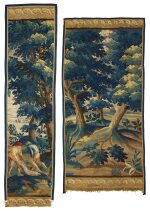
Two small Flemish ‘Country Life’ landscape tapestry fragments, after David II Teniers, Oudenaarde or Lille, first quarter 18th century
Lot Closed
May 23, 01:08 PM GMT
Estimate
3,000 - 5,000 GBP
Lot Details
Description
Property of a European Collector
Two small Flemish ‘Country Life’ landscape tapestry fragments, after David II Teniers, Oudenaarde or Lille, first quarter 18th century
Each panel is a vertical section from a larger tapestry which would have small figures in a woodland setting depicting general activities: the narrower panel is woven with two men with fish, with the woodland and fields in the background; the wider panel only depicts woodland, with distinct bark on the trees, both panels have a section across the top edge visible of a border with golden scrolling double ribbon enclosing a stylised flowerhead,
(Qty 2)
Panel of narrow rectangular format approximately: 310cm. High, 79cm. Wide; other larger panel approximately: 300cm. High, 145cm. Wide;
Panel of narrow rectangular format:
The Princely House of Liechtenstein
Vienna, before 1944.
Schloss Vaduz, Liechtenstein, 1944.
Vienna, 1944.
Schloss Vaduz, Liechtenstein, 1953.
Alserbachpalais, Vienna, 1954.
On loan to the Savoyen Convent, Vienna;
Sold Christie's, Amsterdam, Property from the Collection of the Princely House of Liechtenstein, 1 April 2008, lot 176;
where acquired by the present owner.
Other larger panel:
The Princely House of Liechtenstein
Vienna, before 1944.
Schloss Vaduz, Liechtenstein, 1944.
Vienna, 1953.
Schloss Vaduz, Liechtenstein, 1953.
Alserbachpalais, Vienna, 1954.
On loan to the Savoyen Convent;
Sold Christie's, Amsterdam, Property from the Collection of the Princely House of Liechtenstein, 1 April 2008, lot 178;
where acquired by the present owner.
Judocus de Vos (1661-1734) was from an established Brussels weaving family and is thought to have obtained the ‘Teniers’ cartoons from the weavers Jacob van de Borcht and Jeroen Le Clerc (d.1722) and Jacob Van der Borcht, who were responsible for the earliest weavings of the Teniers tapestries. De Vos reproduced them and altered them in various weavings, which included the interpretations and representation of The Fish Quay. The two figures of the men with fish are taken from the De Vos composition of the subject ,known as Fish Market on the quay side, and in this tapestry have been placed in a woodland setting and not, as in the original designs, set within a more appropriate fishing related setting. For a tapestry of the whole scene, see Sotheby’s, New York, 9 June 2017, lot 84 and and H.C. Marillier, Handbook to the Teniers Tapestries, London, 1932, p. 16-17, pl.10.
For discussion of the Teniers tapestries and extent of their influence, see Guy Delmarcel, Flemish Tapestry, London, 1999, Scenes of Country Life ‘after Teniers’, pp.352-361.
See other ‘Country Life’ tapestries in this sale which are from this series, and are of different sizes.
The Savoyisches Damenstift
These tapestries were for many decades on loan from the Collection of the Princely House of Liechtenstein to the Savoyisches Damenstift, which had been founded by Theresia Anna Felicitas, Princess of Liechtenstein (1694-1772) who was the fourth daughter of Prince Johann Adam of Liechtenstein.
Princess of Liechtenstein was married in 1713 to Prince Thomas Emanuel of Savoy-Carignan, a nephew of the famous Prince Eugene. Widowed as early as 1729, she had a large fortune, which she used for various charitable purposes. In her will, written in 1769, she created the Savoyisches Damenstift that was to house, in the Princess's Vienna residence, twenty noblewomen facing reduced circumstances. The 20 nuns were to be of old nobility, between 15 and 40 years old at the time of admission, possess no more than 4000 gulden in assets and be orphans or fatherless. They lived in the convent building, had to perform devotional exercises and wear black clothing with the order's emblem, but were allowed to go out, travel and even marry.
The former duchess's residence at Johannesgasse 15 served as the convent’s quarters, but it soon became too small for all the women and their numerous servants, so the neighbouring property was acquired in 1783.


