
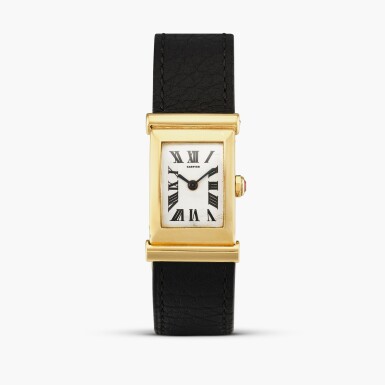
Cartier, London
An unusual yellow gold deeply curved rectangular driver’s wristwatch with integrated gold deployant buckle, Circa 1966-67
Auction Closed
April 24, 04:23 PM GMT
Estimate
400,000 - 550,000 HKD
Lot Details
Description
Cartier, London
An unusual yellow gold deeply curved rectangular driver’s wristwatch with integrated gold deployant buckle, Circa 1966-67
Dial: white dial signed Cartier, stretched black radial Roman numerals, blued steel épée hands
Calibre: 7’’’ calibre K20508 movement signed Audemars Piguet, damascened Côtes de Genève decoration, lever escapement, 20 jewels, free sprung Gyromax balance, adjusted to 4 positions and temperatures, flat hairspring, Kif Flectcor shock absorber
Movement number: 86'882
Case: 18k yellow gold curved rectangular case, chamfered bezel, hooded lugs, the lower lugs integrating the deployant clasp’s closure, curved case back, octagonal winding crown set with faceted ruby cabochon, case back secured by four screws to case sides
Case number: inside case back numbered 6'950, • 10213 •, London hallmarks for 18k gold, date letter ‘l’ for 1966-67, bezel interior numbered • 10213 •
Closure: black unsigned leather strap and 18k yellow and pink gold deployant buckle integrated into the lower lug and formed to the curvature of the case back
Size: 31 mm length x 17 mm width
Signed: case, dial and movement
Accessories: Cartier presentation box and travelling pouch
Driver’s wristwatches, among the earliest examples of purpose-made tool watches, are a fascinating blend of watchmaking ingenuity and motoring culture. Designed to meet the specific needs of automobile enthusiasts, these watches allowed drivers to read the time without taking their hands off the wheel – an elegant yet practical solution for an era when motoring was not only a means of transport but also a symbol of sophistication and adventure.
Inspired by Cartier Paris’s 1933 driver’s watch, this 1966 Cartier London model revived the avant-garde spirit of its predecessor. By the time this Driver’s model was introduced in 1966–67, Cartier London was entering its most experimental period, producing some of the brand’s most distinctive and unconventional wristwatches. While the fashion for driver’s watches had been short-lived in the later Art Deco period, Cartier London’s decision to reintroduce the concept in 1966 aligns with their exploration of heritage models as part of their pursuit to develop new and creative wristwatch designs. This model closely follows the original’s curved rectangular case, a form specifically designed to sit at an angle on the wrist, ensuring optimal legibility while driving. Its hooded cylindrical lugs, seamlessly integrated into the case structure, contribute to its sleek profile and echo the aerodynamic contours of automobiles from the golden age of motoring.
One of the watch’s most ingenious design features is the integration of a curved deployant buckle into the case itself. The lugs beneath the 6 o’clock position serve a dual purpose, cleverly forming part of the hinged closure for the deployant clasp, which is discreetly nestled into the curvature of the case back. This design maintains the watch’s clean, streamlined aesthetic, allowing it to ‘float’ seamlessly on its leather strap. Without the pronounced curvature of the case back, such a design would not have been possible. Such is the significance of this model within Cartier’s storied history that it was reintroduced in the late 1990s as part of the prestigious Collection Privée Cartier Paris (CPCP), a series dedicated to reviving the brand’s historic designs with high-quality mechanical movements.
The movement in this watch was ordered by Cartier directly from Audemars Piguet. According to the Audemars Piguet Archives, the movement was produced in 1962 and formed part of an order of six movements supplied to Cartier London in October 1963. Interestingly it was noted by George Gordon in Cartier – A Century of Wristwatches that the actor Stewart Granger ordered three Driver’s wristwatches from Cartier in the 1960s. In her book The Cartiers, Francesca Cartier Brickell notes that Granger also ordered a Crash watch from Cartier London but returned it after a week, finding its distorted dial too difficult to read.
François Chaille & Franco Cologni, The Cartier Collection: Timepieces, Paris: Flammarion, 2006. See p. 289 for an early Paris example dated to 1934.
Cartier in Motion, Curated by Norman Foster. Madrid: Ivory Press, 2017. See p. 219 for an early Paris example dated to 1934. Assumed to be the same watch as shown in the Cartier Collection above.
George Gordon, Cartier - A Century of Cartier Wristwatches, Hong Kong: Timeless Elegance, 1989. See pp. 178-179 for a similar example of the model numbered 034242 and op. cit. p. 453 image nos. 151-153 for black and white (possibly archival) images of the 1933 Paris version of the model.
卡地亞 倫敦
獨特黃金長方弧形駕駛員腕錶,備一體式金錶扣,約1966-67年製
附帶盒子及旅行袋子