
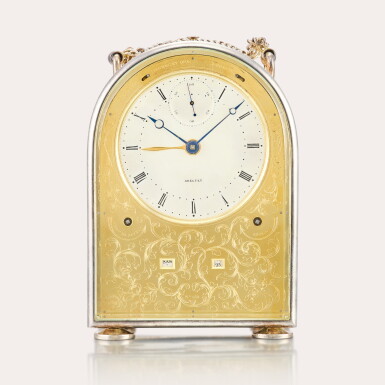
A very rare and exceptionally fine silver humpback Pendule Portique grande and petite sonnnerie carillon clock with alarm, day/date indication and ruby duplex escapement
No. 150 | Sold to Monsieur Paschkoff aide de camp de l’Empereur de Russie on 31 August 1843 for Fr. 3,000
Auction Closed
November 9, 08:49 PM GMT
Estimate
250,000 - 500,000 CHF
Lot Details
Description
49’’’ x 37’’’ gilt-brass humpback shaped movement, double toothed barrel for going and strike trains, ruby duplex escapement, bi-metallic compensation balance with gold timing and poising screws mounted to the backplate, blued steel Breguet balance spring, Breguet à rouleaux calendar work, gong strike for grande/petite sonnerie striking the hour on two gongs and the quarter on a third gong and repeat, separate alarm train wound and set through dial sounding on a bell beneath the movement
matte silver dial, black Roman numerals, concentric outer and inner pearled rings for minutes and alarm, blued steel Breguet hands and gold feuille alarm indicator, recessed subsidiary seconds at XII with Arabic 10-second calibrations, gilt-brass surround with apertures for day and date amid decoratively engraved scrolling flowers and foliage, two further apertures for winding and setting alarm time, two slides above dial for grande/petite sonnerie and strike/silence selection
silver humpback case, the arched top with repeating pusher and chain handle, shuttered winding aperture to hinged back door, glazed hinged front, bun feet
Measurements
height 145mm
width 100mm
Accompaniments
with Breguet certificate no. 3492 dated 30 December 1976, associated travel case and Breguet 250th anniversary certificate
Antiquorum New York, 20 September 2001, lot 148.
The Breguet archives record that production of this clock began in December 1834 and was completed in 1842. It was sold on 31 August 1843 to Mr Paschkoff, noted in the Archives as an aide de camp to Nicholas I, Emperor of Russia.
The Paschkoffs, a well-known Russian noble family had one of their seats at Paschkoff (Pashkov) House in Moscow, a neoclassical mansion built in 1784–1787 for Pyotr Pashkov, a retired officer of the Semenovsky Guards and the son of an orderly of Czar Peter I. From 1862, Pashkov House contained the library of the Rumyantsev Museum and later became the Russian State Library, where it continues to serve as one of the institution’s foremost historic buildings.
Breguet’s principal style of carriage clocks were the wooden or metal pendules de voyage in the Empire style. From around 1813, these were joined by a third type, the so-called humpback or pendules portiques, with plain arched cases and chain handles, usually in silver. This latter form was revived later in the 19th century by Jump and James Ferguson Cole and, indeed, by Breguet themselves in the 20th century.
Breguet displayed carriage clocks at the Paris Exhibition of 1819, including models with alarm, repeating, calendar, and moon-phase indications.1 At the French Industrial Exposition in Paris in 1844, the firm showed a variety of carriage clocks that featured grande and petite sonnerie, alarm, and calendar functions.2 A particularly fine example, the extremely complex movement of this clock incorporates a special ruby duplex escapement.
1 Allix, Charles, Carriage Clocks, Their History and Development, Woodbridge: ACC, 1974, p. 42
2 Ibid. p. 45.