Property from a European Aristocratic family | Provenant d'une prestigieuse collection européenne
Hispano-Flemish School, early 16th century | Ecole hispano-flamande du début du XVIe siècle
An Altar wing | Panneau de retable
Lot Closed
June 14, 01:02 PM GMT
Estimate
15,000 - 20,000 EUR
Lot Details
Description
Hispano-Flemish School, early 16th century
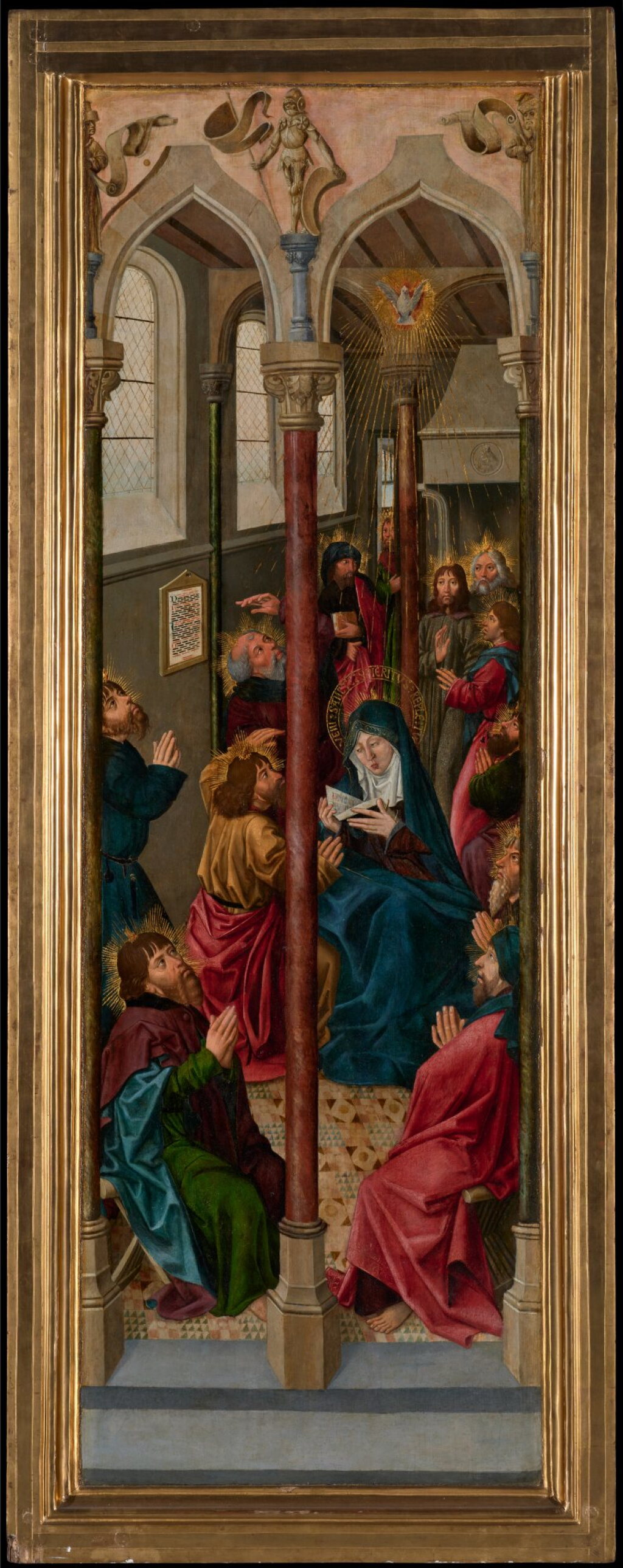
An Altar wing:
Recto: The Pentecost;
Verso: The Virgin
Oil on panel, verso en grisaille, in an integral frame
168 x 54,5 cm; 66⅛ by 21½ in.
____________________________________________
Ecole hispano-flamande du début du XVIe siècle
Panneau de retable :
Recto: La Pentecôte ;
Verso: La Vierge
Huile sur panneau, verso en grisaille, dans un cadre intégral
168 x 54,5 cm ; 66⅛ by 21½ in.
In the collection of the family of the present owner since the second half of the 19th century.
____________________________________________
Dans la collection de l'actuel propriétaire depuis la seconde moitié du XIXe siècle.
Kept in the same family since the nineteenth century, this beautiful altarpiece panel is a remarkable testimony to the relations and artistic exchanges between Northern Europe and the Hispanic regions.
Pentecost is often depicted in altarpieces as the final episode in a programme about the life of Christ or the manifestations of the Holy Spirit. This masterly composition is obviously inspired by models that circulated in Europe through engraving, in particular La Pentecôte engraved with a burin by Maître E. S. (c. 1420-c. 1468) or by Durer (1471-1528). The use of gold, which radiates from the dove symbolising the Holy Spirit to the halo of the Virgin and the apostles, links this altarpiece more closely to the Spanish taste.
____________________________________________
Conservé dans la même famille depuis le XIXe siècle, ce beau panneau de retable témoigne remarquablement des relations artistiques et des échanges entre l’Europe du Nord et les régions hispaniques.
La Pentecôte est souvent représentée dans les retables comme dernier épisode d’un programme sur la vie du Christ ou sur les manifestations du Saint Esprit. Cette composition réalisée avec une grande maîtrise s’inspire nettement des modèles qui ont circulé dans l’Europe entière par le biais de la gravure, notamment La Pentecôte gravée au burin par Maitre E. S.(c. 1420-c. 1468) ou encore par Durer (1471-1528). L’utilisation du doré irradiant de la colombe symbolisant le Saint Esprit vers les auréoles de la Vierge et des apôtres, rattache davantage ce retable au goût espagnol.