Circle of Girolamo Campagna (1561-1607)
Venus Marina
Lot Closed
June 17, 01:20 PM GMT
Estimate
3,000 - 5,000 EUR
Lot Details
Description
Circle of Girolamo Campagna (1561-1607)
Northern Italian, 16th century
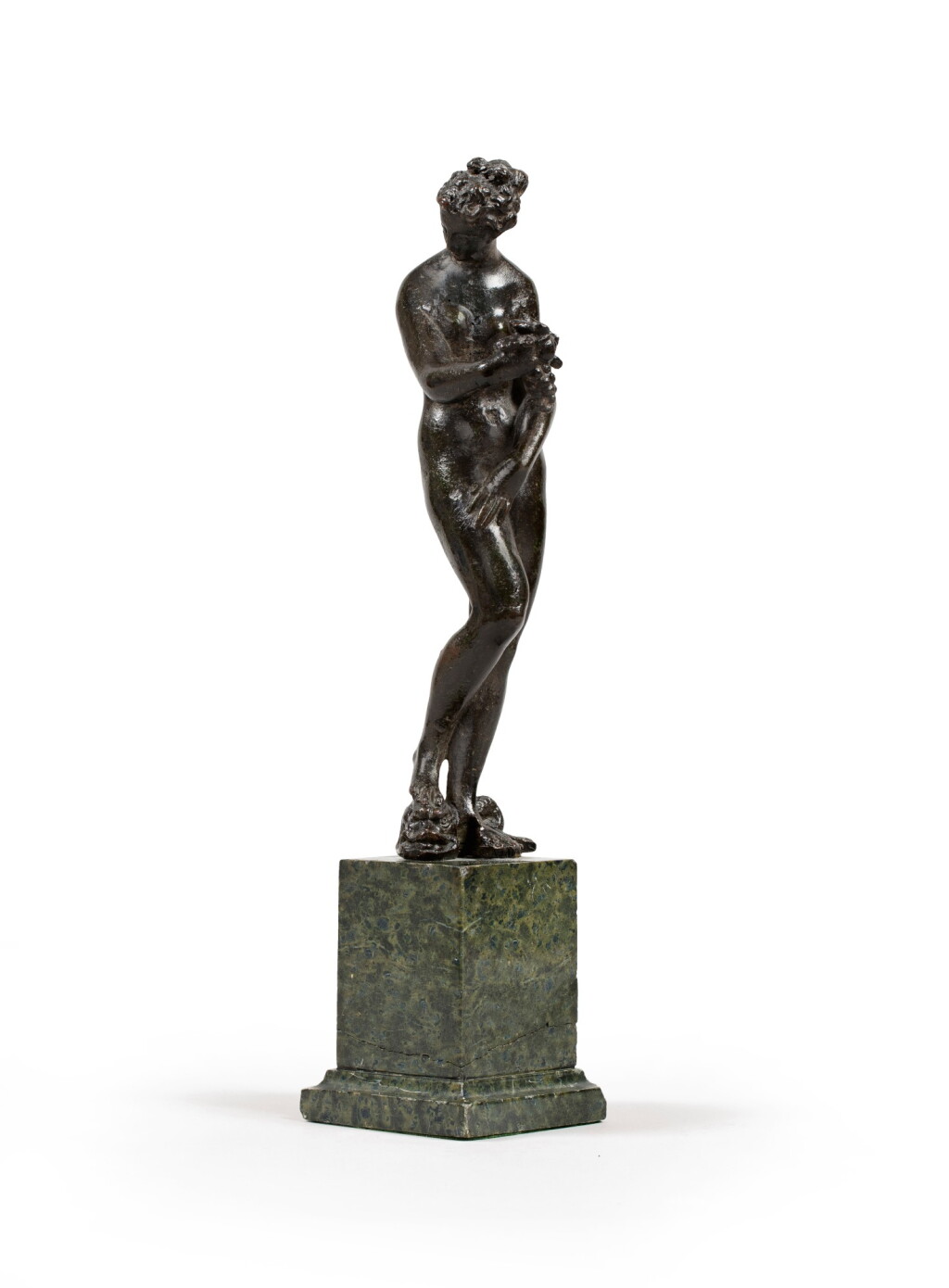
Venus Marina
bronze dark brown patina, on a green verde antico marble base
Venus is holding a grape in her left hand
H. (bronze) 24 cm, 9½ in. ; H. (overall) 32,2 cm, 12⅔ in.
____________________________________________
Cercle de Girolamo Campagna (1549-1617)
Italie du Nord, Venise, vers 1600
Venus Marina
statuette en bronze à patine brune, sur un socle en marbre vert antique
Vénus tient dans sa main gauche une grappe de raisins
H. (bronze) 24 cm, 9½ in. ; H. (totale) 32,2 cm, 12⅔ in.
French aristocratic collection, Paris
____________________________________________
David Peel, Londres, acquis dans les années 1980
Collection d'un aristocrate parisien
L. Planiscig, Venezianische Bildhauer der Renaissance, Vienna, 1921, fig. 642.
C. Kryza-Gersch, 'The Reproduction of Artistic Ideas in Venitian foundries: Tiziano Aspetti's Mars in the Frick collection - a case study, in Pincus 2001, p. 143ss.
V. Avery, Renaissance and Baroque Bronzes from the Fitzwilliam Museum, Cambridge, exh. cat. Daniel Katz Gallery London, 2002, p. 158, no 21.
V. Krahn, Bronzetti Veneziani. Die venezianischen Kleinbronzen der Renaissance aus dem Bode-Museum Berlin, Berlin 2003, cat. n°40, pp. 158-162.
____________________________________________
Références bibliographiques
L. Planiscig, Venezianische Bildhauer der Renaissance, Vienne, 1921, fig. 642.
C. Kryza-Gersch, 'The Reproduction of Artistic Ideas in Venitian foundries: Tiziano Aspetti's Mars in the Frick collection - a case study, dans Pincus 2001, p. 143ss.
V. Avery, Renaissance and Baroque Bronzes from the Fitzwilliam Museum, Cambridge, cat.exp. Daniel Katz Gallery Londres, 2002, p. 158, no 21.
V. Krahn, Bronzetti Veneziani. Die venezianischen Kleinbronzen der Renaissance aus dem Bode-Museum Berlin, Berlin 2003, cat. n°40, pp. 158-162.
For its composition, the subject derives from the prototype of the ancient Venus pudica. Here the artist created a spiral movement, her left leg creating a contraposto whilst standing on a dolphin, her head slightly turned towards the shoulder, and the right arm raised hiding her breast in modesty. One of the finest versions known of this model is the bronze from the Albert Figidor collection in Vienna, now in the Bode Museum in Berlin (inv.no.7279; V. Krahn, op.cit).
____________________________________________
Tout à fait caractéristique des bronzes vénitiens de la fin du XVIe siècle, la Vénus Marina était considérée par Planiscig comme l'œuvre de l'artiste Paduan Tiziano Aspetti (1557/59-1606), puis par Draper comme oeuvre de Niccolo Roccatagliata (1593-1636), avant d'être attribuée par Krahn à Girolamo Campagna, sculpteur et bronzier originaire de Vérone et actif à Venise à la fin du XVIe siècle. Aussi, C. Kryza Gersch a constaté une analogie de ce modèle avec des traits du visage de Sainte Agnès de Girolamo Campagna à l'église des Frari de Venise.
Pour sa composition, le sujet dérive du prototype de la Vénus pudica antique, auquel l'artiste a insufflé ici un mouvement savant en spirale, sa jambe gauche appuyée sur un dauphin créant un contraposto, la tête légèrement tournée vers l'épaule, et le bras droit levé cachant sa poitrine en pudeur. L'une des plus belles versions connues de ce modèle est le bronze de l'ancienne collection Albert Figidor de Vienne, aujourd'hui au musée Bode à Berlin (inv. n° 7279 ; V. Krahn, op. cit).
You May Also Like