
Violet Trefusis — Vita Sackville-West | The Doge’s Ring
Lot Closed
October 15, 04:15 PM GMT
Estimate
12,000 - 18,000 USD
We may charge or debit your saved payment method subject to the terms set out in our Conditions of Business for Buyers.
Read more.Lot Details
Description
Violet Trefusis — Vita Sackville-West
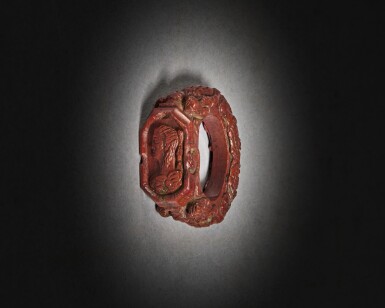
“The Doge’s Ring," probably Italian, circa 1650
A hololith ring, engraved with a cameo portrait of a woman at the head, portrait roundels, Artemis of Ephesus caryatid herms at the shoulders, and interlocking herms at the sides of the shank.
Jasper
UK ring size Q (3.2 cm).
The symbol of their passionate love affair, given by Violet Trefusis to Vita Sackville-West.
This remarkable hololith ring, carved from a single piece of jasper, bears finely engraved portraits and complex figural decoration—an extraordinary testament to Italian lapidary work of the mid-seventeenth century. The bold octagonal bezel frames a female portrait in profile, while the shoulders are flanked by caryatid herms of Artemis of Ephesus, the sides of the shank with interlocking herms. Its elaborate iconography and striking presence inspired the ring’s moniker: The Doge’s Ring.
Far beyond its sculptural appeal, however, the present ring carries a remarkable provenance in the history of twentieth-century English letters. It was given by Violet Trefusis—daughter of Alice Keppel, mistress of King Edward VII—to her lifelong friend and lover, Vita Sackville-West. According to family lore, Violet first encountered the piece as a child of six, when accompanying her mother on a visit to Sir Joseph Duveen’s Bond Street gallery. Offered dolls, she instead insisted on this Renaissance jewel. Four years later, she met Vita at school; the two became inseparable, and in Florence, at the end of a summer of Italian lessons, Violet, then fourteen, confessed her love and presented Vita with the Doge’s Ring as a token of devotion.
The ring’s story is inseparable from the intertwined lives of Violet and Vita, whose love affair scandalized and fascinated society. Their clandestine relationship, conducted despite marriages and maternal interventions, was memorialized in their own writings—Trefusis’s Broderie Anglaise and Sackville-West’s Challenge—and famously fictionalized by Virginia Woolf in Orlando. Vita’s son, Nigel Nicolson, would later write in Portrait of a Marriage that his mother “fought for the right to love, men and women, rejecting the conventions that marriage demands exclusive love, and that women should love only men, and men only women.”
Vita herself wrote in 1920 of the ring: “I have it now, of course I have it, just as I have her.” The Doge’s Ring thus survives as both a Renaissance masterpiece of lapidary art and a symbol of a storied love affair, emblematic of the Bloomsbury milieu’s rejection of sexual and social convention.
PROVENANCE:
Vita Sackville-West — Violet Trefusis (gifted by the former)