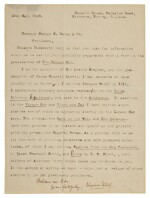

Virginia Woolf | Rare letter to her American publishers
Lot Closed
October 15, 04:18 PM GMT
Estimate
6,000 - 8,000 USD
We may charge or debit your saved payment method subject to the terms set out in our Conditions of Business for Buyers.
Read more.Lot Details
Description
Virginia Woolf
Typed letter signed ("Virginia Woolf") to Messers George H. Doran & Co., providing biographical publicity information for the American publication of The Voyage Out.
One page (225 x 167 mm) on typewriter paper, written from Hogarth House, Paradise Road, Richmond, Surrey, England, 10 May 1920, signed with underlining and corrections in ink, stamp with date 24 May 1920 to verso; light toning, fold marks, small area of adhesive residue to upper outer corner of verso. [With:] one leaf of onion skin (225 x 167 mm) bearing a charcoal portrait sketch of Woolf, unsigned; light toning.
An important Woolf letter and a striking contemporary likeness.
In this rare letter to George H. Doran & Co.—her American publisher—Woolf provides concise autobiographical notes for publicity surrounding the publication of The Voyage Out in the United States. She places herself firmly within the English literary tradition, noting her parentage (daughter of Sir Leslie Stephen, goddaughter of James Russell Lowell), her marriage to Leonard Woolf, and her contributions to the Times Literary Supplement and The Athenaeum.
She outlines her published works to date, The Voyage Out (1915) and Night and Day (1919), as well as shorter pieces such as The Mark on the Wall and Kew Gardens, printed by the Hogarth Press. Woolf describes the ethos of the press, remarking that “as a general rule we do all the work of printing ourselves,” and references its early successes, including Stories from the Old Testament by Logan Pearsall Smith and, most notably, T.S. Eliot’s first book, Poems (1919). She closes by foreshadowing a volume of short stories “not previously published.” This is allegedly the only known letter that Woolf wrote to Doran.
The accompanying portrait, executed in charcoal on onion skin, presents Woolf at a formative moment in her career. Together, they offer an example of Woolf’s literary self-fashioning and her contemporary image, capturing her emergence as one of the central figures of twentieth-century literature.
REFERENCE:
The Uncollected Letters of Virginia Woolf, Stephen Barkway and Stuart N. Clarke, eds (Edinburgh: Edinburgh University Press, 2025)