A monumental illuminated Qur'an, copied by Muhammad ibn Salih al-Kumi, East Caucasus, Dagestan, dated 1263 AH/1846-47 AD
Auction Closed
October 25, 04:59 PM GMT
Estimate
60,000 - 80,000 GBP
Lot Details
Description
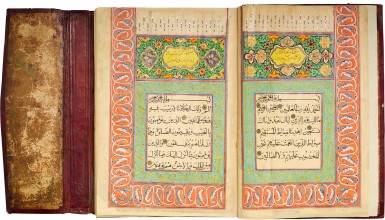
Arabic manuscript on paper, 372 leaves, plus 1 fly-leaf, 13 lines to the page written in bold naskh in black ink, ruled in gold, black and blue, verses separated by gold, silver and polychrome illuminated rosettes, surah headings in red on gold and polychrome illuminated panels, similarly illuminated panels marking juz' divisions within the text, further text divisions marked by illuminated marginal devices, f.1b and f.2a illuminated in gold and polychrome framing text, the following two bifolia with double-page illuminated headpieces, the text followed by two full-page illustrations of Mecca and Medina, in red leather binding with flap
text panel: 36.6 by 23.8cm.
leaf: 50.2 by 33.1cm.
Decorated in a kaleidoscopic array of colour on a monumental scale, this Qur’an illustrates the height of manuscript production in Dagestan.
Manuscripts of this group were previously attributed to South East Asia due to the presence of spurious colophons on a small group of these manuscripts. However, Shikhsaidov and Gallop have since reattributed a number of these manuscripts to Dagestan on account of key features such as the use of Russian paper, and fragments containing Cyrillic script found within the pages of one of the manuscript (Shikhsaidov 2007 and Gallop 2008). Very few manuscripts of the group have colophons that situate them within the Caucasian Qur’anic tradition. The present lot, however, is signed Muhammad ibn Salih al-Kumi, the nisba al-Kumi indicating that the scribe was from the Kumi (or Kuma) region of Dagestan.
Aside from the documentary evidence provided by the colophon of this impressive manuscript, it displays key features that are associated with Dagestan Qur’ans. Among them, Shikhsaidov notes a distinctive form of backwards sloping naskh, that Jan Just Witkam evocatively described as a “bold script of wildness and beauty” in regard to a Dagestan Qur’an in the Leiden University Library (inv. no.Or.11.964, see Witkam 2007, p.278). The confident and energetic script used by the scribe of the present manuscript clearly follows in this tradition.
This manuscript is particularly notable for its extensive polychromatic illumination. In her study of the Dagestan Qur’ans in the British Library, Gallop notes that the illumination is often stamped and hand-coloured (Gallop 2019), a feature displayed in the illuminated headings and marginal medallions of this Qur’an. The illuminator has taken a playful approach to the decoration of this manuscript. While the headings are similar in terms of their layout, they each contain subtle variations within their motifs and colour combinations.
You May Also Like