
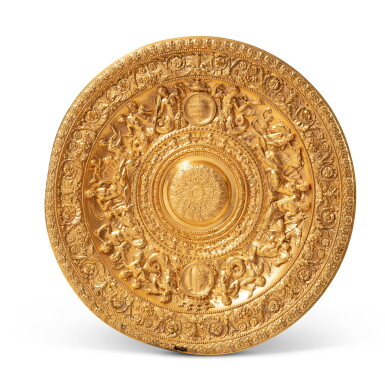
Commande Du Prince Alexandre Torlonia
A large gilt-bronze presentation dish, Charles Crozatier, Paris, dated 1853
Auction Closed
October 12, 05:41 PM GMT
Estimate
30,000 - 50,000 EUR
Lot Details
Description
Commande Du Prince Alexandre Torlonia
A large gilt-bronze presentation dish, Charles Crozatier, Paris, dated 1853
the outer border with an alternating band of flowers and husks above a band of scrolling rinceaux suspending fruiting swags and interposed by acanthus leaves enclosing a roundel surmounted by an eagle atop a flaming brazier above a roundel with Alexander Torlonia anno MDCCCLIII and two star motifs flanked by mermaids the one on the left with a mirror, the one on the right blowing a horn suspending floral swags flanked on the right by Amphitrite and Neptune in drapery seated in their chariot in the form of a scallopshell drawn by winged horses with webbed feet ridden by Cupids, facing on the other side Venus reclining in her chariot also in the form of a scallopshell drawn by four dolphins and flanked by Cupid amongst frolicking mermaids and mermen three blowing conch shells, the base with a ribbon-tied roundel surmounted by a princely coronet with the coat-of arms of Princess Torlonia and Colonna flanked on the right by a merman blowing a conch shell and on the left a merman suspending a floral swag over his left shoulder, the twisted-ribbon border enclosing a ribbon-tied band of vines and grapes, beading and ribbon-tied berried laurel and further beading, with a raised central boss decorated with stylised anthemions within entwined loops enclosing a patera
diameter 27½in.; 70 cm
____________________________________________
Grand plat d'ostentation en bronze doré commandé par le prince Alexandre Torlonia et son épouse la princesse Teresa Colonna Doria par Charles Crozatier, Paris, daté 1853
diameter 27½in.; 70 cm
Prince Alexander Torlonia (1800-1886) and his wife Princess Teresa Colonna Doria (1823-1875), commissioned for the ceremony of the completion of the draining of Lake Fucino, Rome in the presence of the Pope Pius IX in 1853
Sotheby's London, 3 July 2013, lot 8
____________________________________________
Prince Alexandre Torlonia (1800-1886) et son épouse la princesse Teresa Colonna Doria (1823-1875), commandé pour la cérémonie d'achèvement de l'assèchement du lac Fucino, Rome, en présence du pape Pie IX en 1853
Sotheby's Londres, 3 juillet 2013, lot 8
This outstandingly chased and gilded bronze presentation dish was made in 1853 for Prince Alexander Torlonia (1800-1886) and his wife Princess Teresa Colonna Doria (1823-1875), by the renowned French bronzier Charles Crozatier (1795-1855).
For a similar dish, probably the pair to this one, see Sotheby’s, Paris, 30th October 2008, lots 169 and 170. The second lot was a pair of ewers signed and dated CROZATIER 1846 with the same arms (each 33.5cm high). Both lots have been acquired by Musée Crozatier, Le Puy–en-Velay, center of France.
The dish is very much in the mannerist style with mythological references, and, in view of it commemorating the draining of Lake Fucino, Rome, the symbolism is very appropriate with Neptune and Amphitrite and Venus in her chariot drawn by winged horses.
The Torlonia Family:
The Torlonias originated from the Massif Central and had a meteoric rise in Rome during the second half of the eighteenth century both in terms of power and wealth. Marin Tourlonias (1725-1785), was the son of a textile merchant from central France who settled in Rome. He italianised his name to Marino Torlonia and was a valet de chambre at the outset of career, then became a silk and drapery merchant, finally ending up as a banker at the Vatican. In recognition of his services, the Pope bestowed upon him the title of Marquis and Duke thereafter. He had an enormous family comprising fifteen children. Giovanni (1755-1829), one of his sons, founded the Torlonia Princely dynasty. He took charge of the accounts of the Bonaparte family and all the important noble Roman families. In 1797, he purchased a villa located on via Nomentana in Rome from the Colonna family and had it restored between 1802 and 1806 by Giuseppe Valadier (1762-1839), the celebrated architect and silversmith. The Pope later created Giovanni a Marquis and then a Duke.
Giovanni organized extravagant receptions in his palace on the Piazza Venezia, (formerly Palazzo-Bolognetti-Torlonia), which he had purchased in 1807. The Torlonias came to be considered to be the Roman Rothschilds. In 1800, Giovanni Torlonia was known to be the richest banker in Europe. In 1814, the Pope bestowed upon him the title Prince of Civitella-Cesi and allowed him to construct a family chapel in the Basilica San Giovanni in Laterano (St John de Latran's basilica).
In 1829, when Giovanni died, Alexander (1800-1886), his favourite son, was only a young man. However, he quickly gained a reputation as a very astute businessman and banker in his own right. He lived in three residences in Rome: the Piazza Venezia Palace, Villa Torlonia and the Borgo Palace purchased in 1823 on the via della Conciliazione. In 1840, he married Princess Teresa Colonna Doria (1823-1875), 23 years his junior. The various Torlonia palaces became the venue for the most sought after invitations to glittering balls and social events, often with thousands of guests. Alexander amassed a fine collection of works of art. Pope Pius VII called him "il padre della Patria (father of the homeland) ". On 4th June 1842, a ceremony took place in Villa Torlonia where two obelisks were erected in memory of Giovanni and Anna Maria Torlonia, Alexander's parents. Amongst the guests were the Pope Gregory XIV and Ludwig, King of Bavaria. Alexander also owned three theatres in Rome. One of them was the very first venue where Verdi presented his operas 'La Traviata' in 1853 and 'Un Ballo in Maschera' in 1859. One his most outstanding achievements was the financing of the draining of Lake Fucino between Rome and the sea. As a result of this, he was created Prince of Fucino by King Victor-Emmanuel II of Italy in 1875. He had a daughter, Anna Maria with his wife Teresa Colonna. In 1870, when Anna Maria was 15 years old, her father started looking for a husband for her. The Pope advised him to consider Giulio Borghese (1847-1914), son of Prince Marcantonio (1814-1886) and Thérèse de la Rochefoucauld (1823-1894). The wedding took place on 24th October 1872.
Charles Crozatier (1795-1855):
He was born in Puy-en-Velay and, at the age of thirteen, he was apprenticed to the celebrated silversmith Jean-Baptiste-Claude Odiot (1763-1850). When he was eighteen he was admitted to the `Academia delle belle arti’ where he entered the workshop of the sculptor Pierre Cartellier (1757-1831) and he became the favourite pupil of François Joseph Bosio (1769-1845). Between 1821 and 1823, he visited Italy where he made models from antique statues. He rapidly became one of the most famous sculptors in Europe thanks to the invention of a casting process for large statues. In order to replace the statues destroyed during the revolution, Louis XVIII commissioned various major sculptures from Crozatier, such as the one of Napoleon in place Vendôme in Paris, the Louis XIV sculpture after a model by Cartellier, and the chariot on the main arch of the Carrousel which was intended to replace the horses of San Marco in Venice.
At the end of his life, without any heirs, he offered his fortune to the city of Le Puy and he died in his Parisian palace on the rue du Parc Royal, on the 8th February 1855. He was buried at the Père Lachaise cemetery, Paris, and a museum, the Musée Crozatier was built in Le Puy, in his honour and named after him.
The relationship between Charles Crozatier and Alessandro Torlonia and the Fucino ceremonial commission:
During the Restauration period, the most sumptuous table service was the one belonging to Prince Ruffo della Scaletta (1778-1846), the ambassador of the two Sicilies.
In 1818, Prince della Scaletta ordered a colossal surtout de table from the famous Parisian bronzier Pierre-Philippe Thomire. In 1843, Alexander and Teresa Torlonia were in Naples and during a reception at the Ruffo Palace, they were suitably impressed by the surtout de table made by Thomire. They wanted to order a larger one but Thomire was too old at this time to carry out the commission so they asked Crozatier who was at the height of his career to undertake it instead.Their common origins (Puy-de-Dôme) and the talent and knowledge of Crozatier was the start of a long professional relationship between the two, only ending with the death of the sculptor in 1855. The first commission was the surtout de table which was finished in January 1846. The last order was for the two chargers with two ewers made for the ceremony of the completion of the draining of Lake Fucino in presence of the Pope Pius IX in 1853.
You May Also Like


