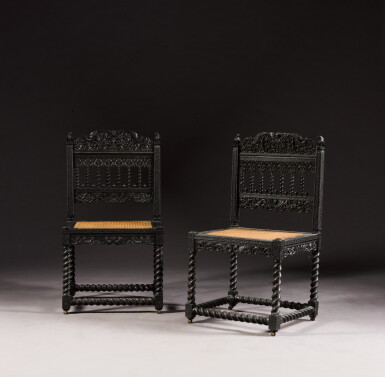
A near matched pair of Indo-Dutch ebony side chairs, India, Coromandel coast, circa 1660-80
Auction Closed
October 25, 12:38 PM GMT
Estimate
8,000 - 12,000 GBP
Lot Details
Description
each of ebony, the open back with pierced and carved decoration, the crest rail with a central winged female head flanked on either side with a nude female figure and a mythical sea creature (makara) on the upper edge, between the crest rail and the lower back rail is a row of eight twist-turned balusters with scrolling foliate capitals, the balusters alternating with seven turned knobs, a winged female head flanked by a pair of makaras at the centre of the lower back rail, the tapering uprights decorated with scrolling vines, the uprights support finials in the form of birds, the drop-in rectangular seat re-caned, the seat rails carved and pierced with a pair of confronting birds at the centre, with twist-turned legs and box stretcher, on later metal castors
(2)
97 by 53.5 by 47cm. (38⅛by 21 1/16 by 18 1/2in.);
97 by 52.7 by 46.2cm. (38⅛by 20¾by 18 3/16in.)
Acquired by Cary Welch in London, 1958-60
The present lot, with its richly carved and pierced ebony decoration and twist-turned elements, and dense scrolling designs comprising Christian and Hindu motifs, is typical of a group of furniture made along the Coromandel Coast in southern India under Dutch patronage in the second half of the 17th century. The rectilinear form of the chair is based on an early 17th century European prototype. It is likely that the twist-turning seen on this type of carved ebony chair is derived from mid-17th century Dutch furniture on which similar turned balusters are seen (Jaffer 2001, p.135-6). Jan Veenendaal discusses relief carved ebony surfaces in his text Furniture from Indonesia, Sri Lanka and India, Delft, 1985. He identifies two distinct periods relating to carved detail and references several examples to support this categorisation. Veenendaal dates furniture with low-relief carving and pierced decoration from 1650-80, as seen in the present lot, and half relief carving usually with bold floral decoration to between 1680 and 1720.
Carved ebony chairs of this type have been recorded in English collections from as early as the mid-18th century. They were originally thought to examples of early English furniture, from the Elizabethan era of the Tudor period. The English antiquarian, Horace Walpole, 4th Earl of Orford (1717-97) is thought to be responsible for perpetuating the Tudor attribution for this typed of carved ebony furniture. In 1748, Walpole saw carved ebony chairs at Esher Place in Surrey and thought that they belonged to Cardinal Wolsey who had lived there after 1519. In 1834, A.W.N. Pugin included a carved ebony chair of this type in his drawings of ‘Ancient Furniture’. Henry Shaw included another chair of this type in Specimens of Ancient Furniture, published between 1832 and 1836. These works were used as reference texts of the time and established this view that the chairs were English and of early date more firmly (Jaffer 2002, p.46). Besides the Tudor attribution, carved ebony furniture of this type was also thought to be Indo-Portuguese in Britain. For a discussion regarding these attributions which prevailed during the second half of the eighteenth and most of the nineteenth century, see lot 57 in the sale.
Two documented groups of this type of chairs are known in English collections. The first group was documented in the 1740 inventory of Longleat House in Wiltshire. A second group was inventoried at Old Montagu House, London in 1746 and is now at Boughton House, Northamptonshire. Horace Walpole is also known to have owned chairs of this form. In 1842, when Walpole’s possessions were sold, two ebony chairs from Strawberry Hill were purchased by the Earl of Derby for Knowsley House, Merseyside; two ebony chairs were bought by the 1st Marquess of Westminster for Eaton Hall. Further examples of similar ebony chairs are known to be in Cotehele, Cornwall; Ickworth, Suffolf; Treasurer’s House, York; and Newstead Abbey, Nottinghamshire (Jaffer 2001, pp.136-7).
Another, almost identical, chair is in the Victoria & Albert Museum, London (IS 6-2000, Jaffer 2002, no.16, pp.46-47). It was a gift to the museum from Robert Skelton, the former Keeper of the Indian Art Department. The object history for the chair on the museum’s website includes an email sent by Robert Skelton to Amin Jaffer in early August 2001, “…discovered the 4 chairs – all identical – in a furniture shop in the Earl’s Court Road for six pounds 10 shillings each early one evening when I was walking to Howard Hodgkin’s house in Holland Park to meet Howard and Cary [Welch] and their wives. This was in the late 1950s or early 1960s… as soon as I mentioned the chairs to Cary he wanted to see them so we went immediately, decided to split the set between us and bought them.” Private correspondence exchanged between Skelton and Welch confirms that the present lot was part of the set of chairs discussed above and purchased between 1958 and 1960.
A closely comparable pair of side chairs, with minor differences in carving, was acquired by the Peabody Essex Museum, Massachusetts, in 1999 (PEM: AE85711.1-2; ibid., p.135-7, illus.p.136).
For similar ebony chairs sold recently in these rooms, see Classic Design: Furniture, Silver, Ceramics & Clocks, 8 November 2022, lot 11 and Furniture, Clocks & Works of Art, 9 November, 2021, lot 4 (formerly at Longleat House, Wiltshire, part of the Longleat group discussed above).
You May Also Like