An Indo-Dutch ebony side table, India, Coromandel coast, circa 1660-80
Auction Closed
October 25, 12:38 PM GMT
Estimate
20,000 - 30,000 GBP
Lot Details
Description
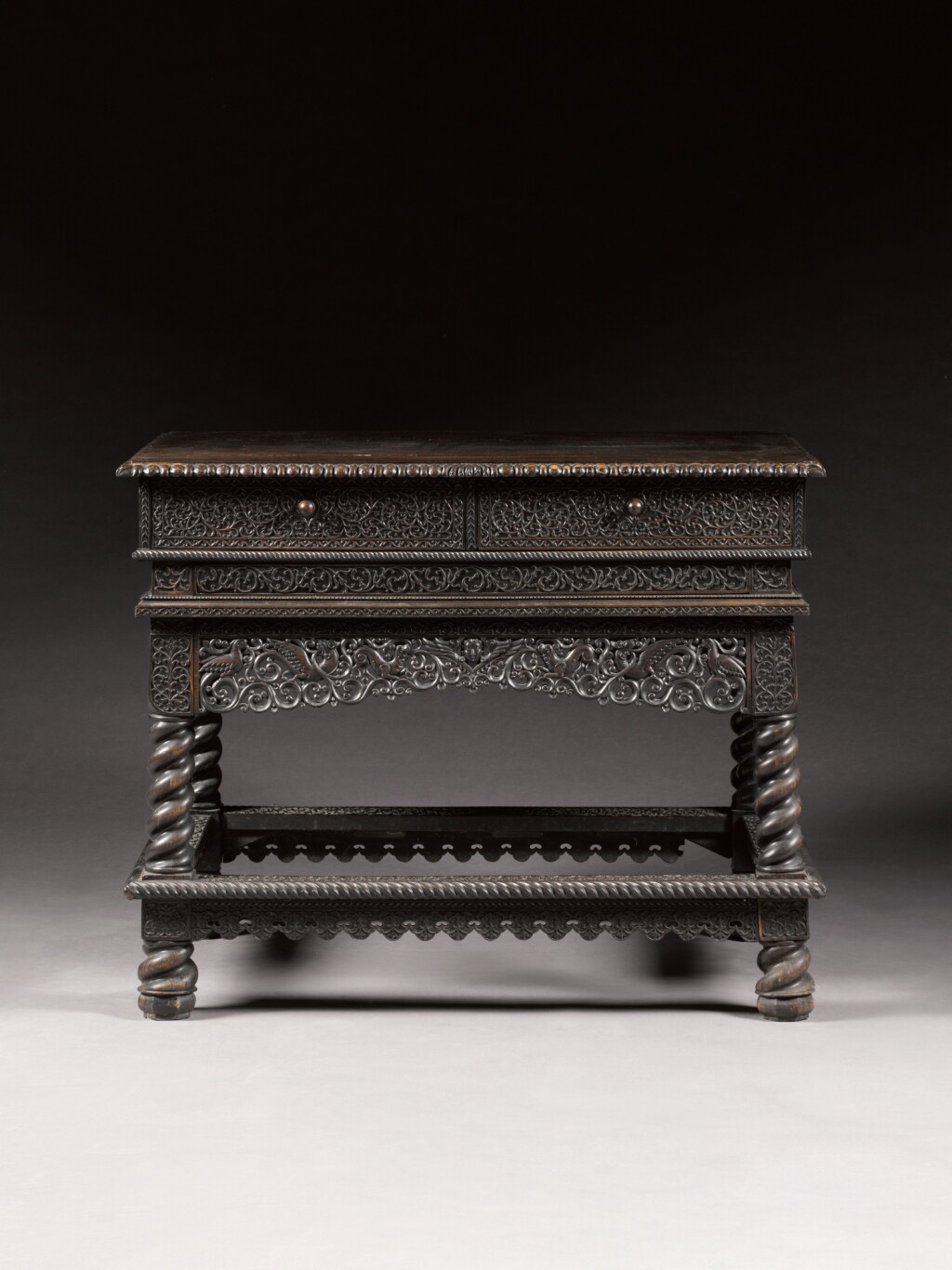
of rectangular form, composed of a case and a stand, the case comprising a plain top with gadrooned border and two drawers to the front with knob handles, the front panels of the drawers, the sides and back of the case with scrolling foliate decoration, an old exhibition label to inside of left drawer 'Art Treasures Exhibition, Wrexham, 1876, Duke of Westminster, Eaton, Proprietor.', the stand with four legs, an apron and a box stretcher, the upper section of the stand and the tops of the legs with scrolling foliate decoration, the carved and pierced apron with a central winged cherub’s head, lions, mythical creatures and parrots, the legs twist-turned, on turned disc feet
76.3 by 94.5 by 67.5cm. (30 by 37¼by 26 5/8in.)
Acquired by Horace Walpole, 4th Earl of Orford (1717-97) between 1759 and 1763
Collection of Horace Walpole at Strawberry Hill, Twickenham, until 1842
George Robins, A Catalogue of the Classic Contents of Strawberry Hill collected by Horace Walpole, London, Covent Garden, 13 May 1842, lot 77
Acquired from the above by Robert Grosvenor, the 1st Marquess of Westminster (1767-1845) for Eaton Hall, Cheshire; thence by descent through the Dukes of Westminster until 1960
Perez & Co., London, 1960-61
Acquired by Cary Welch from Perez and Co., London, 1960-61
(for further information on the provenance see discussion below)
Art Treasures Exhibition, Wrexham, England, 1876 (loaned to the exhibition by the Duke of Westminster)
G. Robins, A Catalogue of the Classic Contents of Strawberry Hill collected by Horace Walpole, 25 April-24 May 1842, p.176, lot 77
W. Chaffers, Catalogue of the Museum of Ornamental Art at the Art Treasures Exhibition, Wrexham, 1876, no.143
A. Jaffer, Furniture from British India and Ceylon, London, 2001, p.139
This superbly carved table is a highly important example of Coromandel Coast ebony furniture and represents a fascinating aspect of English aristocratic taste in the 18th century. According to Robert Skelton and Amin Jaffer, it was owned by Horace Walpole (1717-97), the great 18th century antiquarian, writer and politician, and was part of the extraordinary contents of his famous neo-Gothic masterpiece Strawberry Hill.
This table, with its richly carved and pierced ebony decoration, twist-turned elements, and dense scrolling designs comprising Christian and Hindu iconography, is typical of a group of furniture made along the Coromandel Coast in southern India under Dutch patronage in the second half of the 17th century. The pierced apron of the table features both Christian and Hindu motifs with a winged cherub’s head at the centre, flanked by figures of lions and mythical creatures (half-lion and half bird), and with parrots at the corners. In his text, Furniture from Indonesia, Sri Lanka and India (Delft, 1985), Jan Veenendaal discusses and dates carved ebony furniture with low-relief carving and pierced decoration to between 1650 and1680.
However, in the 18th and most of the 19th century, carved ebony furniture of this type was thought to be early English in origin, specifically from the Tudor period. This theory was due to the dark colour, which gave the group an antiquated look, and the style: the rectilinear forms and intricate carving of figures and mythical beasts was associated with the period prior to the introduction of classical ornament in English design, and the use of twist-turning was associated with Elizabethan furniture (Jaffer 2001, p.130). This attribution was influenced by the English antiquarian Horace Walpole, 4th Earl of Orford (1717-97), as he had come across various examples of this type in English houses with Tudor associations. In 1748 Walpole saw carved ebony chairs at Esher Place in Surrey and thought they had belonged to Cardinal Wolsey, who had lived there from 1519-29. Henry Shaw included a chair of this type in Specimens of Ancient Furniture, published between 1832 and 1836 and in 1834, A.W.N. Pugin included a carved ebony chair of this type in his drawings of ‘Ancient Furniture’. These books perpetuated the view that the chairs were English and of early date (ibid, p.46). An alternative attribution linked furniture of this general type with Indo-Portuguese manufacture. This was partly due again to Henry Shaw’s ‘Specimens of Ancient Furniture’ of 1832-36, which included a pair of carved ebony chairs in the Ashmolean Museum which had been presented by King Charles II and were thought to have been part of the dowry of his wife, Catherine of Braganza, brought from Portugal in 1662 (Jaffer 2001, p.132).
Horace Walpole’s interest in this type of furniture led him to acquire several pieces for Strawberry Hill, the Gothic Revival villa he built near Twickenham, west of London, including three tables and a considerable number of chairs. He purchased these mainly from auction, including a sale at Staughton House, Huntingdonshire, in May 1763, which he described in a letter to George Montagu Esq.: “…I believe I am the first person that ever went sixty miles to an auction. As I came for ebony, I have been up to my chin in ebony; there is literally nothing but ebony in the house; …. There are two tables and eighteen chairs, all made by the Hallet of two hundred years ago. These I intend to have; for mind, the auction does not begin till Thursday…. but I have left commission…” (Walpole-Cunningham 1857, p.88). The footnote to this letter states “The eight very fine ebony chairs at Strawberry Hill were bought at the Lady Conyers’ [sale] at Great Stoughton, Huntingdonshire” (Walpole-Cunningham 1857, p.88).
By the time of the Staughton auction however, Walpole had already bought his first ebony table and chairs, in 1759, and these were used to furnish the Holbein Chamber at Strawberry Hill (Jaffer 2001, pp.130, 138-9). It is this table that is believed to be the present example. The table in the Holbein Chamber was mentioned by Walpole in his 1784 description of Strawberry Hill (Walpole 1784, p.43), and the Holbein Chamber was illustrated in a watercolour by the artist John Carter dated to 1788 (now in the Lewis Walpole Library at Yale University), where the table can be seen on the left, next to the associated chairs (see Jaffer 2001, p.130; the table in the illustration appears to have bulky feet, which ours does not; however, close inspection of our table indicates that the lower parts of the four legs have been cut down, which would account for the discrepancy).
The 1842 sale of the contents of Strawberry Hill was conducted by George Robins of Covent Garden and lasted twenty-four days, from 25 April to 24 May. The table in the Holbein Chamber was sold on the seventeenth day, 13 May 1842, described on p.176, lot 77, of the auction catalogue as “A truly beautiful SOLID EBONY TABLE, the sides most richly carved with open scroll work, on twisted legs and stretcher, the borders also carved in alto relieve, and knulled [gadrooned] edge”. This description matches that of the present lot. The table was purchased by Robert Grosvenor, 1st Marquess of Westminster (1767-1845), along with the chairs in lot 81 of the same day’s sale (Aedes Strawberriannae, p.42, Jaffer 2001, pp.138-9). It remained at Eaton Hall until 1960 (ibid), when it was sold as part of a series of auctions between 1955 and 1961 prior to the demolition of the Alfred Waterhouse designed Eaton Hall, which began in 1961. Cary Welch acquired the present table in London in 1960-61 from a carpet dealership called Perez and Co., which at that time had two premises on the Brompton Road near Montpelier Street, SW3 (as well as one in Glasgow, see University of Leeds Antique Dealers project interactive database). At the time of purchase, it seems that Cary Welch did not know about the potential connection to Horace Walpole and Strawberry Hill and bought it as an example of Ceylonese furniture.
The retrospective identification of the ebony furniture in Horace Walpole’s collection at Strawberry Hill is an intriguing and complex subject. One of the key elements in establishing the provenance of the present lot is that the table and three related chairs from the Holbein Chamber at Strawberry Hill were acquired by the 1st Marquess of Westminster (Aedes Strawberriannae, p,42; Jaffer 2001, p.139). We can be sure that the present table was owned by the Marquess (later Dukes) of Westminster as it still bears a label stating that it was loaned to the 1876 Wrexham Art Treasures exhibition by the Duke of Westminster from Eaton Hall (see fig.1). Furthermore, we are fortunate to have the opinions of Robert Skelton (1929-2022, renowned scholar of Indian art and former Keeper of the Indian Department at the Victoria and Albert Museum), and Amin Jaffer (whose 2001 book Furniture from British India and Ceylon is the most comprehensive recent reference work on this subject), who state that the present table was in the collection of Horace Walpole at Strawberry Hill. Skelton’s opinion about the table first comes in a private letter to Cary Welch sent soon after Welch acquired the table from Perez and Co. in 1960-61: “1St June… Great news about the table bought from Perez. It was at Strawberry Hill, and before that (circa 1780) in possession of Lady Conyers at Staughton House, Gt. Staughton, Hunts.” The Walpole/Strawberry Hill attribution was reinforced by Skelton in 2001 when he wrote to Dr Amin Jaffer of the Research Department of the Victoria and Albert Museum, who at that time was writing his book Furniture from British India and Ceylon. The email in question concerned a chair of this type in the V&A’s collection (IS 6-2000), but in the correspondence Skelton recounted the history of how the present table belonging to Cary Welch had been discovered and acquired: “…I found 14 chairs and two tables at the large carpet shop (Perez & Co.) more or less opposite Beachamp Place on the Brompton Road. The chairs were somewhat similar to ours …. (Veenendaal, pl.48, illustrates a chair like ours and says that the Marquis of Westminster paid £58/16/- for a pair of them in 1842 - a huge amount ….). Cary [Welch] was again in London so we went back together and … he bought one of the tables.” (https://collections.vam.ac.uk/item/O49994/chair-unknown/). Jaffer discusses this context in some detail, and with reference to the table and chairs sold in 1842 from the Holbein Chamber at Strawberry Hill, he concludes by saying “The table was bought for £63 by the 1st Marquess of Westminster, who also purchased a pair of chairs en suite. They were sold from Eaton Hall in 1960 and the table is now in an American private collection.” (Jaffer 2001, p.139). The American private collection referred to was that of Cary Welch and the table is the present lot.
For a near matched pair of carved ebony chairs from the Coromandel Coast also dated to 1660-80, with similar low-relief carving and pierced decoration as our table see lot 58 in the present sale, where further discussion can be found.
You May Also Like