
The Hammer Collection
Rolex
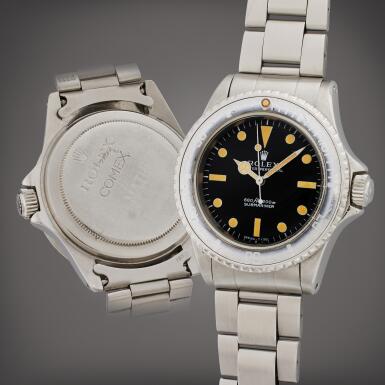
Reference 5514 Submariner 'Non-Logo Comex' | A stainless steel automatic wristwatch with bracelet, Circa 1976 | The Hammer Collection
Auction Closed
December 7, 07:12 PM GMT
Estimate
50,000 - 100,000 USD
Lot Details
Description
Dial: black
Caliber: cal. 1520 automatic, 26 jewels
Case: stainless steel, engraved screw down case back, inside case back stamped 5513
Case number: 4'089'906
Closure: stainless steel Rolex Oyster bracelet with folding clasp
Size: 40 mm diameter, bracelet circumference is approximately 190 mm
Signed: case, dial and movement
Box: no
Papers: no
Accessories: Rolex Henry Hudson letter confirming delivery to Comex and Douglas Matheson, Rolex service papers and International Service Guarantee card dated 2008, email correspondence from Douglas Matheson confirming use of the watch during the salvage of the HMS Edinburgh and additional White Star Line salvage jobs, original vintage Comex drysuit, Comex t-shirt, original Comex breathing apparatus, Comex depth gauge, Comex baseball cap, and Comex medallion key chain
There are few names that pull at collectors’ hearts quite like COMEX. Shorthand for Compagnie Maritime d'Expertises, COMEX was considered to be one of the foremost pioneers in deep-sea exploration and was able to work directly with Rolex on the development of special watches designed solely for that purpose. These efforts resulted in a number of modified Submariners - some of them featuring Helium Escape Valves, issued in the mid-to-late 1960s and designed to prevent damage from an accumulation of helium after full-saturation diving.
Eventually, two models were born of this collaboration: The Sea-Dweller, and the Submariner reference 5514. While the Sea-Dweller was commercially available and has a notably thicker case, the 5514 featured thinner case construction but was fitted with a Helium Escape Valve. Perhaps most importantly, the 5514 was never made commercially, and exclusively issued to COMEX. As such, they have become “grail” watches for many watch collectors. It is not uncommon for many collectors to daydream about the feats that their COMEX took part in.
That is not something we need to daydream about here.
The present 5514 took part in ‘The Salvage of the Century’ rescuing over a quarter of a billion dollars in gold from the ocean’s floor. How? Why?
That story begins in the midst of WWII, when the HMS Edinburgh was sailing from Murmansk Russia back to the United Kingdom. Enroute she was spotted by German U-boat U-456 who successfully got off a torpedo into Edinburgh’s forward bow. The quick acting crew was able to stabilize the ship by closing off her watertight compartments – but U-456 struck again, this time in the Edinburgh’s stern crippling the ship. Heavily damaged, she was taken under guard and tow to attempt a return to Murmansk – being peppered the whole way by enemy U-Boats. Another torpedo hit caused the Edinburgh to be perilously in danger of breaking apart – and so Rear Admiral Stuart Bonham Carter ordered an abandon-ship. Once empty, the Edinburgh was scuttled.
Unbeknownst to many, the Edinburgh was carrying over 5 tons of gold bullion from Joseph Stalin – payment to the British for war supplied being used at the Eastern front of the war. So there the Edinburgh sat, with its golden treasure awaiting collection. The British government had attempted several missions to retrieve its gold, but the political climate of the 1950s and 1960s was not working in their favor – however fortune was smiling upon Dougie Matheson in 1981.
The wreck of the HMS Edinburgh is a treacherous place. In addition to being a tangled mess of steel and iron, it contains dozens of undetonated explosives, bombs, and ammunition. In a 202 Interview, Matheson detailed this daring operation:
“The gold was mixed in amongst bombs and ammunition, if our torches touched a bit of ordnance that would have been the end of the story. There were boxes of shells that looked very similar to boxes of gold. The first couple of dives it was totally awe-inspiring. Seeing the actual ship. You’re on your own and it’s a huge, big wreck. Looking over the side you can see the guns pointing directly back up at you.”
Together, the salvage crew brought up 90 crates of the sunken gold, leaving behind a mere 34 bars – all in 4 hours of deep-water-diving.
Matheson’s 5514 survives in exceptional condition, though it’s COMEX signed dial was swapped during a service a Rolex, the case back still bears his name engraved upon the watch’s issuance. It is still fitted to its folded link 9315 bracelet which is correct for the 5514 references, and its dial, hands, and bezel, have all gloriously aged to a beautiful event patina. Furthermore, the watch is accompanied by a bevy of interesting accessories including a COMEX dry suit, breathing apparatus, and most importantly – documentation from Matheson confirming that this was his watch, and it was used during his historic salvage of the HMS Edinburgh. Given this watch’s extraordinary history – used during the most valuable maritime salvage in history – it’s easy to understand its allure and why it was a trophy of Hammer’s collection.